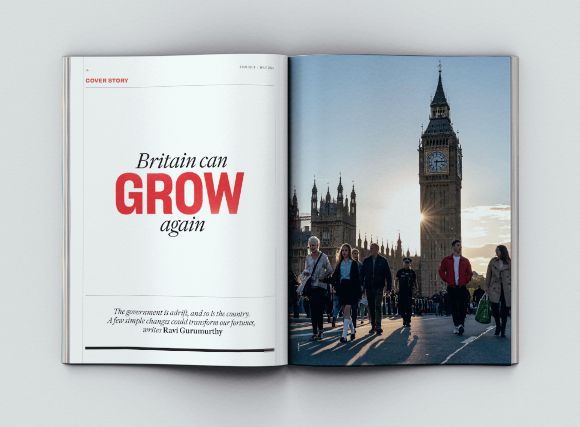
Premier in
Ravi Gurumurthy (“A plan for Britain”, July) shows how Andy Burnham could provide Labour with a more coherent vision of what it stands for, and many of his points are hard to argue with: housing wonks have heaped praise upon Manchester, and Burnham has strong Yimby credentials; the pension reforms he outlined have long been an area of relative consensus in the policy world. Yet Burnham cannot rely merely on the same ideas. His marriage of capitalism with socialism in Manchester cannot simply be transplanted onto the wider country. The level of scrutiny required to avoid bad deals is not possible to replicate for the whole of the UK.
On immigration, the left must finally learn the lessons of the past two decades. An immigration minimum, even if for exceptional people, is perhaps the least politically wise decision a prime minister could make. It should be clear that the country will only accept a vision that believes in Brits. Our top universities are the best in the world: we can produce local talent many times the volume at which we can import foreign successes.
For years, politicians on both sides have believed that if they deliver all will be well; but if this doesn’t play into a narrative which the public buy into, those efforts are wasted. The average person doesn’t think about digital sovereignty, nor would they be greatly affected if spending on pensions went down by a few percentage points in the medium term. What Burnham needs most is a grand vision to sell: major reforms to tax, the health service and welfare; ambitious investment in infrastructure and the military; proper devolution. He will, of course, fail to deliver, but the voters will forgive him if he gives it a proper go.
Bartek Staniszewski, head of policy, Bright Blue
I read Ravi Gurumurthy’s article with enthusiasm, but would like to make a number of complementary points. First, the world is short of natural gas as a transition fuel—China had to revert to coal in the Iran crisis—so the UK should maximise its own production for the global benefit, as well as to boost energy security and tax receipts.
Second, the arguments on energy efficiency relate only to renewables. However, we have nowhere near enough of these, cannot cope with their intermittency and have no grid-scale storage. We need rapid rollout of small modular reactor (SMR) nuclear for baseload capacity, and a plan to move to hydrogen for energy storage and to displace natural gas in combustion devices.
Third, it is easy to forget that the current stance of pension funds is a response to government regulation that forced them to match assets to liabilities at all times, rather than when liabilities were likely to fall due. This pushed them into gilts, and so funding the public deficit at the minimum cost. Along with the Bank of England’s zero-interest-rate policy, this produced the instability that felled Liz Truss and our last growth strategy.
Fourth, taxation should be designed not to damage growth or incentives for wealth creation. That means targeting relatively wealthy pensioners by removing the age exemption for National Insurance, enabling it to be harmonised with income tax and to allow finer grading of tax bands with fewer cliff-edge effects.
Similarly, we should focus on a model of public support that reaches all income levels and is decoupled from the tax system, together with the distortions that has introduced.
Finally, it is not clear we would be better off in the EU. We have increased our relative trade performance, principally in services, for which there was never true market freedom. Our only failure has been not taking advantage of regulatory freedoms, for which our bloated civil service must take much of the blame.
Ian Barrett, Chalfont St Peter, Bucks
Built on sand
Andy Burnham has called for “good growth in every postcode”, but perhaps he hadn’t read your Editorial (July) bemoaning politicians more comfortable with distributing the fruits of growth than generating it.
“Growth” can, of course, mean many things. While most will agree with the need to stimulate the ingenuity of new firms and to increase the productivity of established ones, your piece falls into line with the Treasury’s dismal and destructive campaign over the past 25 years to promote fantasy targets for private homebuilding and an alleged need to smash up the planning system to achieve this.
This approach has been pursued since the Treasury took over domestic policy in 2001, dumped John Prescott’s “Urban Renaissance” and replaced it with the “Barker Reviews”, which suggested that a huge increase in housebuilding would solve many of the UK’s economic woes.
The quarter-century since has seen governments of both parties pursuing this destructive idea, through New Labour’s Orwellian “Sustainable Communities Plan”, the coalition’s “National Planning Policy Framework” and numerous other attacks on sustainable planning and transport policy.
The result hasn’t been significant growth in private housebuilding; volume builders build to maximise their profits, not to feed Treasury fantasies. What it has done is move building away from sustainably located sites in cities to destructively sited, low-density, car-dependent sprawl. Up and down the land, new “red-box-burbs” and “cowpat estates” are springing up at random locations on our already inadequate area of productive farmland.
The great 20th-century broadcaster René Cutforth wrote a portrait of the 1930s entitled Later Than We Thought. Back then the country faced attack by a hostile foreign power and the threat of food shortages. Today we also face attack by a hostile foreign power and food shortages, but also the challenges of climate change, extreme weather, flooding, destruction of nature, etc.
You’re right that we shouldn’t retreat into a Blairite “comfort zone”. Part of that was a belief that smashing up planning would stimulate housebuilding and grow the economy. Today, we need a much stronger planning system to address these growing and dangerous challenges.
Once again, it’s later than we thought.
Jon Reeds, Alston, Cumbria
The state’s mission critical
Jeremy Hunt’s (Hinterland, July) concern that Mariana Mazzucato’s The Common Good Economy just assumes “wealth creation will continue whatever” betrays a shallow reading of her work.
Mazzucato certainly doesn’t take wealth creation for granted. Just recently she wrote: “You misunderstood what missions are. Growth is not the mission. Growth is the result. Missions can’t just be completely top-down, technocratic, otherwise you kill innovation.”
However, every technology that makes the iPhone “smart” was government-funded: the internet, GPS, touchscreen and the voice-activated Siri, Mazzucato reveals in her book The Entrepreneurial State. Instrumental in debunking the myth of a dynamic, innovative, private sector outsmarting a lumbering, bureaucratic state, she should be considered a national treasure.
Free-marketeers decry “big government” yet the City, commercial banks and big business benefit hugely from the state. The British state, for example, mobilised £1 trillion in guarantees to support private banks after the global financial crash.
In the US, the reality is the private sector only found the courage to invest after an entrepreneurial state had made the high-risk investments. Elon Musk, for example, borrowed several hundred million dollars from Obama’s administration to get Tesla up and running. Obama, sadly, didn’t insist on proper union representation—which Musk was, of course, only too happy to exploit.
David Murray, Wallington, Surrey
Never trust any politician who puts their disdain for Arnold Schoenberg on the record. For Jeremy Hunt—brought in as chancellor of the Exchequer by Liz Truss to carve a path through her government’s sudden and self-inflicted chaos—Schoenberg’s example of rationalising the uncertainty he was hearing around him with a system as grounding as it was infinitely flexible ought to have been manna from heaven. And Jeremy, listen up, his music sounds wonderful too.
Philip Clark, Oxford
Didn’t get Brexit done
Ben Ansell (“Don’t mention the Referendum”, July ) contends that Brexit as a policy “won an election”—that of December 2019. While Brexit was the Conservatives’ policy and they were victorious, the three-word slogan “Get Brexit done” suggests that the public were so frustrated by the political impasse which preceded that election that a promise to resolve the issue swiftly tipped the scales in Brexit’s favour. The public had observed interminable parliamentary debates on Theresa May’s “deal”, resulting in umpteen votes and deadlock. The proper action should have been to accept there had been no political decision and either to revoke article 50, to give time for reflection, or to put the matter back to the public in a new referendum.
Today much current thinking, it seems, is that holding another referendum is the only appropriate vehicle for reversing Brexit. Have we still not learnt the dangers of referenda? The issue is too complex, so a decision by parliament would be far more appropriate.
Daniel Beck, Huntingdon
England, their England
I very much enjoyed Mark Damazer’s funny and spot-on appraisal of the England men’s football team’s chances of winning the 2026 World Cup (“Three lions, no trophy”, July).
Unlike Mark, whose reluctant optimism I could sense, I am absolutely certain that England will not win the tournament. It always turns out that way. And very likely it always will. Not winning is in the England men’s team’s DNA. The 1966 victory was a fluke. And it’ll be a fluke if they ever win it again. And until they do, I’m sure many, if not most, of the population will continue to be irritated and bored rigid every four years by all the usual clichés and corny nostalgia. I’d rather have tinnitus than suffer another second of Skinner, Baddiel and the Lightning Seeds’ dreadful “Three Lions” dirge.
Stefan Badham, Portsmouth
Loving the aliens
There is something quietly radical about Angine de Poitrine (“The alien rock band on Team Human”, July). In an era where algorithms generate playlists, lyrics and entire albums on demand, this gloriously odd band are doing something no model can replicate—being genuinely, irreducibly strange. Their music does not optimise for anything. It does not chase streams or demographic data. It simply exists on its own bewildering terms, which is precisely what makes it feel so alive. You cannot train a machine on weirdness this specific. Humanity-saving feels like a stretch—but humanity-reminding? Absolutely. Long may they give us chest pain.
Pakhi Dixit, via email
A poisoned web
Debate around proposals to restrict social media (“Social media in the dock”, June) for the under‑16s is necessary and overdue. Whatever the merits of such a ban, however, it risks misdiagnosing the locus of a far more consequential threat.
Emerging research, including work undertaken through the Smidge project at De Montfort University, points to a significant and under‑examined phenomenon: the online radicalisation of older adults, particularly those aged 45 to 65. While public concern focuses on children, there is comparatively little policy attention directed at the digital ecosystems shaping the beliefs and behaviours of their parents and grandparents.
This omission is not trivial. Generational authority continues to structure family life; anxieties, prejudices and conspiratorial thinking cultivated in online environments do not remain contained there, but circulate domestically and socially. The ideological conditions into which young people are socialised are themselves increasingly mediated by unregulated and often opaque digital networks. A strategy that concentrates resources on youth protection risks overlooking the upstream production of harm. If we are serious about the societal consequences of online radicalisation, policy must be recalibrated to address the full demographic spectrum.
Professor Jason Lee, De Montfort University
Depop happy
Reading Tom Clark (“The Depopulation Bomb”, June) I was struck, as I suspect others will be, by the pessimistic tone. Clark does a good job of outlining the challenges posed by depopulation. Clearly, this is going to require serious thought on how we better manage our societies. Our existing social structures are not fit for purpose.
Clark mentions the current political unacceptability of migration as a solution—but what is unthinkable today can become standard tomorrow, as many social changes in the 20th and 21st centuries have shown. We will find solutions to the issues of an ageing population.
Elsewhere, (“Wild Life”, June), there are multiple examples of how unsustainable growth is damaging the planet’s natural resources and diversity. One doesn’t have to be a Malthusian to recognise that there being somewhat fewer of us might ultimately be a boon for nature and, eventually, for the remaining human population, who get to live in a healthier, habitable world.
Jonathan Hampston, via email
Life writing
Alice Goodman, (Clerical life, July) thank you for this important article. The same thing happened to me. I kept writing anyway, but the rigours of ministry meant my output was very small. Sadly, only after retiring can I use my writing gift and my painting gift as much as I like.
Jonathan Ford, via the website
Correction: This article was updated on 17th July to correct the name of the author of the letter entitled “Depop happy”. We regret and apologise for the error.