Andy Burnham has made no secret of his ambition to fundamentally reshape the British state. His predecessors, from Boris Johnson to Keir Starmer, all promised more devolution, but didn’t deliver it at scale. There is, therefore, every reason to feel jaded. It’s early days but, so far, Burnham has been different. No prime minister has placed devolution so squarely at the heart of their administration, and no prime minister apart from Johnson has entered Downing Street with first-hand experience of governing as an elected mayor.
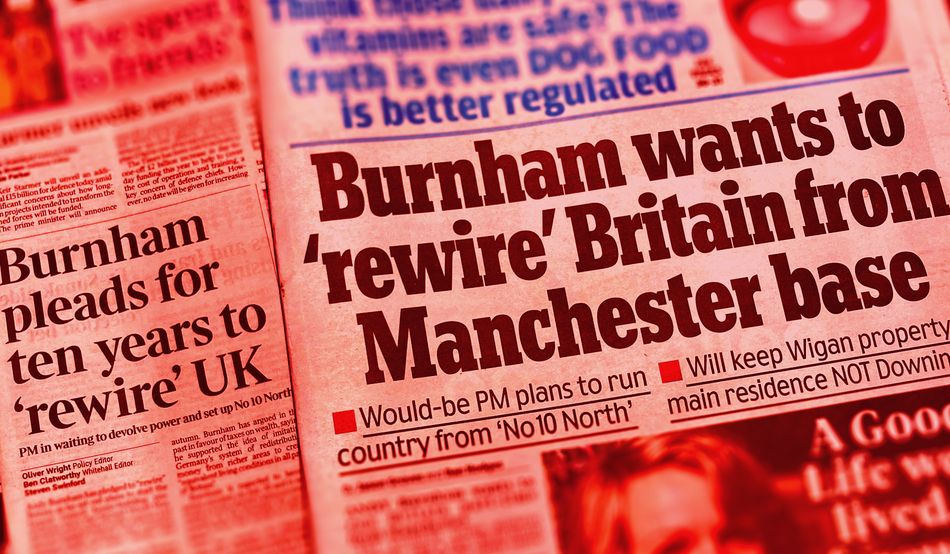
Burham’s campaign left little doubt about his intentions. Speaking at Manchester's People’s History Museum on 29th June, the then-incoming PM pledged the most radical transfer of power out of Westminster in modern British history. A permanent Downing Street presence in Manchester—dubbed Number 10 North—will oversee the programme.
The direction of travel is clear. The politics considerably less so. For much of the past decade, devolution has enjoyed an unusually broad consensus. Governments of different colours have disagreed about the pace of reform and its institutional shape, but they have largely accepted that the UK was headed for more devolution.
And now that Burnham is so clearly focused on devolution, that consensus could be at risk of fraying. One reason is that devolution creates powerful institutions, influential mayors and new centres of political gravity, which inevitably produces winners and losers.
Our analysis illustrates the challenge facing Burnham on this knotty issue. More than a third of Labour MPs—37 per cent—have been elected in constituencies that are not currently represented by a mayor.
Many Labour MPs are supportive of devolution in principle, but some are considerably more cautious in private. Aside from powerful mayors shifting influence away from Westminster, in some cases, such local leaders become future political rivals, or at least divert attention from national politics.
It would be naïve to imagine that politics does not undermine the progress of devolution. This is for good reason. For MPs representing a constituency with a mayor, the average majority is 22.7 per cent. That figure is 10 percentage points lower for constituencies without a mayor, at 12.8 per cent. Among them are razor-thin marginals such as the Forest of Dean, which Labour won by 278 votes in 2024, or Sittingbourne and Sheppey, which it won by 355 votes. Small majorities make MPs nervous of change.
This scepticism is, of course, not a uniquely Labour phenomenon. The Conservative party spent much of the last decade advancing English devolution, clear-eyed that many of the largest of the new combined authorities would elect Labour mayors. Greater Manchester, Liverpool City Region and South Yorkshire quickly became Labour strongholds, though popular figures such as Andy Street and Ben Houchen demonstrated that Conservatives could buck that trend. The longer-term Conservative calculation was straightforward: as devolution matured and expanded into market towns and rural England, new Conservative power bases would emerge alongside Labour's metropolitan strongholds.
Reform UK has disrupted that assumption. Rather than simply producing more Conservative mayors, England's growing system of mayor-led strategic authorities has created new opportunities for Reform. Today, the Conservatives and Reform each hold two mayoralties, suggesting that the political geography of English devolution will not be characterised by the old two-party Labour-versus-Conservative contest. Indeed, there is polling showing that Reform and the Greens are outperforming the Conservatives in the Greater Manchester race to replace Burnham as mayor.
Available polling on devolution shows a similarly complex picture. According to a YouGov survey of Welsh and Scottish voters conducted ahead of the 2026 Senedd election, 58 per cent of Conservative voters supported abolishing devolution in Scotland. In Wales, support for abolition rose to 66 per cent among Conservative voters and 61 per cent among Reform voters. Reform was ultimately forced to rule out abolishing the Senedd after one of its own politicians publicly floated the idea.
The right has long questioned devolution on the grounds that it creates another tier of government, and with it more red tape and bureaucracy, as well as fragmenting national decision-making. Margaret Thatcher abolished the Greater London Council. John Major's Conservatives opposed Scottish and Welsh devolution. Many Conservatives were sceptical of the Greater London Authority and regional assemblies in England.
On the left, objections have taken on a different tone. The concern has rarely been devolution itself, but rather its institutional design and the political consequences—particularly where it shifts power away from MPs and local authorities. Labour governments have a history of centralising tendencies. What administrations say when they take power can change in the face of the need to “grip” priorities from the centre.
As devolution matures, those different strands of scepticism could start to converge. Burnham may well discover that his greatest obstacle is not Whitehall bureaucracy but Westminster politics. The difficult decisions still to come—over mayoral governance and the boundaries of new strategic authorities—are inherently political. They will create new winners and new losers, both between parties and within them.
Now the early signs of the politics of devolution are coming into view. In response to Burnham’s plans, Conservative leader Kemi Badenoch told GB News that “devolution is just a process; it doesn’t, in and of itself, fix any problems.” Such arguments are likely to become louder as more powers, funding and influence move away from Westminster.
Yet Burnham appears considerably more confident than his predecessors about what he wants to achieve in this regard. Whereas the Starmer government often appeared intellectually hesitant about the ultimate destination of English devolution, Burnham has embraced it as the organising principle of his premiership. That confidence may encourage him to pursue bold options, such as creating a new generation of mayoral authorities across England in the remaining parliament, as he should.
Embedding further devolution in the UK would be both a political risk and strategically astute. Institutions, once established, develop their own legitimacy. They create new expectations and new democratic mandates. Future governments may amend them, but abolishing devolved institutions altogether becomes politically difficult.
That is the paradox at the heart of Burnham's devolution agenda. The more successful he is in redistributing power away from Westminster, the more resistance he is likely to encounter from those who stand to lose influence.
Burnham may need to pursue ambitious devolution in the face of opposition. Could his premiership mark the beginning of an era in which the principal argument over devolution becomes not who should wield power, and in what manner, but whether the UK government should devolve power at all? If there is anyone that can make the case for doing the latter, surely it is Burnham.