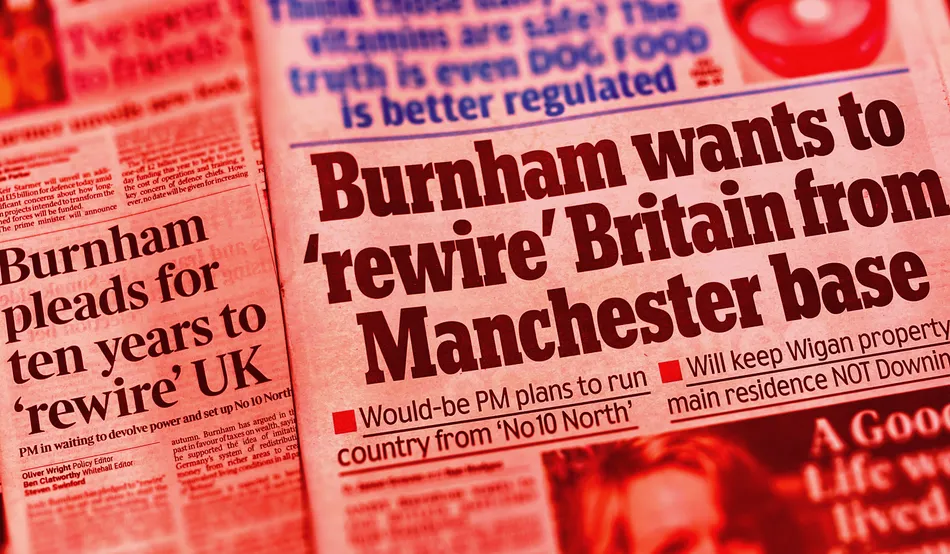
Andy Burnham has long argued that Britain is one of the most centralised countries in the developed world. We share his frustration. West Yorkshire has the ambition and capacity to accelerate growth but remains constrained by Whitehall, while the South Midlands combined authority—which Milton Keynes will join—has been paused despite the appetite from local leaders. And now, as prime minister, Burnham has the chance to build momentum.
He has made a strong start. Burnham’s government has made devolution the defining mission of this parliament: establishing Number 10 North, creating a National Economic Council with mayors at the table, and promising to shift power from Westminster to England’s cities and regions. No prime minister has entered Downing Street better placed to understand what local leaders can achieve when Whitehall supports them.
But politics is rarely a straight race. For the PM, the obstacles to devolution are unlikely to come from a lack of ambition. Whitehall is home to many dedicated and talented civil servants. Yet the system they work within has too often frustrated the transfer of power from the centre.
Burnham’s biggest challenge may not be Reform UK or other political opponents, although Reform’s flirtation with abolishing the Welsh Senedd illustrates that devolution cannot be taken for granted. The greater obstacle is likely to be the British state itself. Whitehall departments are conditioned to accumulate power, not disperse it. Accountability systems reward ministers for keeping a grip on decisions, not handing them over. That is why English devolution has too often seemed Sisyphean. Making the case for further devolution has, at times, felt similar.
He now has the chance to break that cycle. Burnham should move quickly, govern boldly and seize the political opportunity while the momentum is with him. That is why we are backing a new report by Groundwork Research and Re:State that sets out such a path.
As we have heard him make a powerful case for fiscal devolution, that is exactly where the prime minister could start. Until Labour entered government, successive administrations resisted meaningful fiscal autonomy for England’s city-regions at almost every turn. That has finally begun to change. The introduction of an overnight visitor levy will allow places to ensure tourists contribute to the public services and infrastructure they rely on. The Integrated Settlement has also given combined authorities greater flexibility over how funding is spent. Both are significant steps forward.
But these are the beginning, not the end. If Burnham wants to embed devolution permanently, he must go much further—starting with assigning a share of income tax to combined authorities. That would fundamentally change the relationship between Whitehall and the rest of England. Designed well, it would create a direct incentive for local leaders to grow their economies, while giving them the certainty to invest over the long term.
The prime minister needs to radically rethink the role of existing institutions. Today, bodies such as the National Wealth Fund, Homes England and the British Business Bank remain overwhelmingly directed from Whitehall, even though they invest in local economies. Mayors should have a far greater role in deciding where that investment goes, whether through regional growth companies, building on successful models already operating in London and Greater Manchester, or other vehicles entirely.
The same principle applies to public services. If devolution is to pass the “Makerfield Test”—which could also be called the “Milton Keynes” or “Huddersfield” test—people need to be able to see the benefits of devolution in their daily lives. Through devolved powers, mayors have a role in fixing public services, bringing together councils, the NHS, police, employment services and businesses to tackle problems that no single institution can solve alone. Temporary accommodation, children’s social care and economic inactivity all demand coordinated leadership across institutions and local authorities. This is not about taking powers away from councils. It is about helping mayors to become stronger strategic partners who are capable of tackling challenges that no single local authority can solve alone.
That, in turn, requires Whitehall to change how it works. Departments should no longer design reforms in isolation from one another. Public services must operate across the same boundaries as combined authorities, allowing policing, transport, health and economic development to work in concert with one another. A presumption in favour of “coterminous” public services may sound technocratic, but it is the difference between joined-up government and a web of public services that focus too much on their own resilience and budget lines, and not enough on the communities they serve.
We also have an opportunity to think beyond England’s borders. Mayors across the country are increasingly acting as international ambassadors for their regions, attracting investment, supporting exports and forging partnerships with counterparts overseas. Yet they do so with a fraction of the support enjoyed by comparable regions in countries such as Germany, France and Australia. If the government is serious about growth, it should embrace what we call “devolved diplomacy”, giving mayors the capacity to compete internationally on behalf of the UK economy.
None of this should be mistaken for creating another layer of bureaucracy. Quite the opposite. The purpose of devolution is not to make government bigger; it is to make it work better. Decisions should be taken at the level where they can be made most effectively, with Whitehall focusing on the things only national government can do.
England has reached an inflection point. The question is no longer whether devolution works. Across the country, combined authorities and the mayors that run them have already demonstrated that they can drive investment, improve transport and provide visible democratic leadership. The question is whether Westminster is finally prepared to let them succeed.
Andy Burnham has experience that few others have enjoyed of governing beyond Whitehall. Now is the time to reform the state. Hesitate and, as for Sisyphus, the boulder will begin rolling downhill once again.