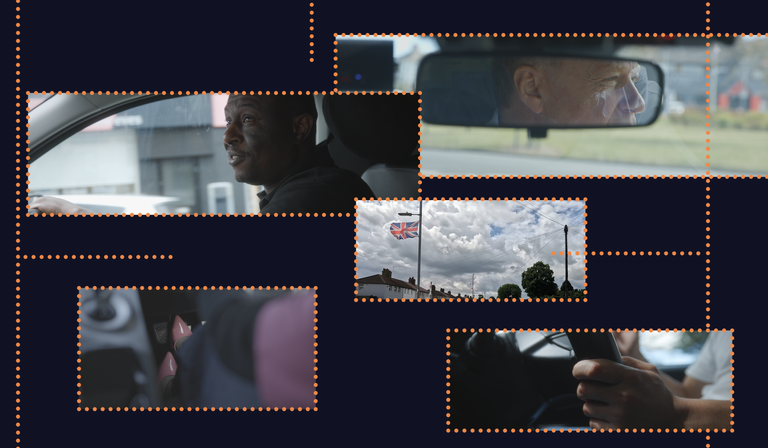
It is a beautiful spring morning when we cross the Swale to the Isle of Sheppey. Though the sky is bright blue, the water is brown with silt and churned up by a cold wind. This summer’s football World Cup will perhaps lend them a different meaning, but, for now, the England flags tied to the lampposts in this corner of Kent are bluntly political. They hang flaccidly, until they are revived with each gust.
We meet Lawrence* by the water; he parks his van opposite a pub that has recently changed hands. He tells me how he would run it differently—he is the kind of person who does things properly. As a Hackney Carriage driver, he feels he has a duty of care towards his customers; it is his job to get them home safely, however long it takes. He has called ambulances for passengers before, sitting and comforting them through illness and intoxication.
Before I met this Irishman in his sixties, I was nervous that we might struggle to connect. We have little, if anything in common. Lawrence’s ideas for that pub were not idle ones; he is tough enough to have run pubs across London before becoming a cabbie. I am a young woman journalist who, at the age of 30, still hasn’t passed her driving test. But I needn’t have worried. As soon as we get inside his cab—him in the front seat, me in the back—the conversation flows easily. The interior feels like its own small, sealed world
Which is why, in a way, I embarked on a joint-project of interviewing taxi drivers with the award-winning production company Dante or Die. Cabbies don’t just have their own views—though they certainly have those—but they also hear from all their fares, from all over the country, from all walks of life. Their vehicles are effectively focus groups on wheels. Or as Daphna Attias, one of the two founders and artistic directors of Dante or Die, puts it, “It feels like taxi drivers are at the frontline of knowing their communities, their streets, and have their fingers on the pulse of what the people in their local area feel.”
Daphna and her co-founder and co-artistic director, Terry O’Donovan, really started to notice the power of these conversations last year—after a series of events brought the idea of “local” into the spotlight. One was Tommy Robinson’s “Unite the Kingdom” rally, accompanied by all those English flags appearing on lampposts across the country. Daphna wondered how taxi drivers were handling this surge in anti-immigration sentiment, not least because many come from migrant backgrounds themselves. Did they feel safe in their cabs? Had their communities changed? Were they talking politics with their passengers? So began Dante or Die’s effort to put these questions to taxi drivers and record the answers. The completed film will be toured around England, later this year, in a repurposed black cab.
Then came the May 2026 local elections and the full revelation of Britain’s fragmented politics. Between them, Labour and the Conservatives lost over 2,000 council seats, while Reform UK swept up almost 1,500. The divide between London and the rest of the country also became starker: the Greens not only usurped Labour to take overall control in three councils, they also gained their first two directly elected mayors, in Lewisham and Hackney. By that point, Daphna and Terry had already interviewed drivers in some of the most fraught constituencies in the country—places such as Bradford, Sheppey, Hull and Peckham. As it turned out, not a single driver who features in their films, or was interviewed for this article, was operating in a local council controlled by a mainstream party after the May elections.
Tagging along with Daphna and Terry, I spoke to these drivers about their lives, about driving through the flags, about the political issues igniting their communities. I left many of these conversations with a feeling of deep unease that was—and still is—difficult to parse.
The problems, frustrations and fears raised by the drivers were similar, whether voiced by British-Pakistani Muslim women cabbies in Bradford, eastern European ones in Hull, or white British taxi controllers on the Isle of Sheppey. Common themes included the cost of living, social isolation and small-boat crossings. But while most can agree about the nature of Britain’s problems, the flags that line the streets mark the fault-lines dividing wildly different ideas of their causes—and solutions.
Perhaps “different ideas” is underselling it; in my experience, these are less differing political persuasions and more utterly incompatible worldviews and versions of reality. Throughout my taxi journey through a divided Britain, I couldn’t help but worry about just how close our communities are to buckling under the strain.
Amberine Nawaz is a girlboss in the best possible sense. Wearing a bright “Pink Ladies” T-shirt, she beckons us past her taxi—a Toyota Prius that has, of course, been painted pink—to the control room, where the walls, sofa and a table laden with a teapot and snacks are all also, yes, pink. On the walls, Amberine’s face beams proudly from newspaper cuttings: her firm, Pink Ladies, is the only service in Bradford that exclusively employs women drivers to drive women customers. Business is booming, she says, and she is always looking for new drivers.
In the corner, her 19-year-old apprentice is answering a landline. The room has a soothing, analogue atmosphere, as if we have stepped onto the set of a 1990s sitcom. Her drivers aren’t just exclusively women, they are exclusively Muslim women, and they flit in and out of the office. They all tell me how much they love working Amberine. “It’s given me more confidence,” says Faiza*. “There are times on Uber where you can get customers who are a bit rude,” she says, whereas driving for Pink Ladies “is so nice because all of the customers appreciate the service so much. They applaud it. They literally love it.” Her colleague Hafsa* agrees. She also drives for Uber beyond Bradford and, while she has never really felt unsafe in her car, she has felt apprehensive about taking fares to certain areas outside the city. There is a divide between Bradford, which Amberine affectionately says sometimes reminds her of Pakistan with its mosques and Asian bridal stores, and the predominantly white towns and villages in the surrounding area. “My daughter has experienced some racism in Skipton,” Amberine says of the market town where the pair live. “She has been called a curry-muncher. She has been told to go to Bradford.”
Faiza describes her nervousness about whether to pick up a passenger in the neighbouring city of Wakefield. “It’s Wakefield. There’s English flags everywhere. And then there’s me driving a taxi on my own. What am I doing?” she asks. “I’ve not had problems where I’ve gone into places with the England flags. But it’s just the fact that they’re there. We’re in England; we know we’re in England. We don’t need the flags around like that. It’s just intimidating, especially after last year and what happened with the whole ‘the EDL is coming to Bradford’ stuff.”
Hafsa has also driven through the flags in Bradford’s surrounding areas. “In my opinion, I feel like if you want to put flags up in your country, that’s fine, do it. It is your country, and nobody’s saying it’s not. But when you see things like that, you do feel like, ‘Hang on a minute. Maybe I don’t belong here anymore?’ Sometimes I feel like I’m out of place.”
Mikhail, who drives a taxi in Hull, feels differently about the flags. “We are in England, so we should know we are in England,” he declares. Mikhail is from Romania and moved to the UK 17 years ago. He doesn’t like city life; he prefers visiting the seaside nearby and he takes Terry and Daphna to a village on the coast for fish and chips. Mikhail is a man of few words, but when he does speak, he reveals a frustration with life in Hull.
He chose the city because it is cheap—but the cost of living has been escalating ever since. “I can’t afford to be sick, I can’t afford to wait in the queue for the doctor,” he says. “I have never been to the doctor.” One of Mikhail’s biggest resentments is that “the difference between people working and on benefits is not big enough”. Hull has one of the highest unemployment rates in the country, at 7.5 per cent; as the fourth most deprived local authority in the UK, people both in and out of work are facing poverty.
His friend Ivan* is more positive. He predominantly drives people who are elderly and have disabilities, and loves interacting with them: he recently gave a bunch of flowers to a customer who is 102. But, like Mikhail, he is frustrated with the relentless financial struggle of life in the UK. “People are getting poorer… honestly, I feel sorry for the younger generation. Now people can’t afford a family,” he says. Having immigrated from Bosnia, Ivan has been in the UK for more than 30 years, living in Edinburgh before moving to Hull because he found the hills in Scotland’s capital exhausting. He prefers Hull’s flat landscape: “Hull is a very nice place. It’s very similar to my place in Bosnia.”
“I like my job, even though most of the hours I don’t even make minimum wage,” he says. He worries about how his children will buy houses, even though they both have good jobs. He believes that immigration is the main cause of the housing crisis, that immigrants are placing pressure on Hull’s housing stock. However, according to the Chartered Institute of Housing, there is no clear link between migration and Britain’s housing crisis, which has deeper roots in the selling of social housing, a chronic failure to build new supply and outdated planning rules. I ask him whether he feels customers in Hull share his views.
Some do, comes the answer, but Ivan reckons that many people do not think about things as deeply as he does. He has a perspective on the world that some might call conspiratorial—it is very important to him that we talk about his theories, including about the origins of the many magnificent old buildings in Hull that he passes in his taxi. He is a believer in the Tartaria internet conspiracy theory, which has been dubbed the “QAnon of architecture”—the idea that many old buildings were built by a lost, extremely advanced civilisation. This way of thinking also extends to politics: he believes, for instance, that the UN’s 2030 Agenda for Sustainable Development represents a plot by elites to create a new totalitarian world order.
Ivan is particularly concerned about asylum seekers coming to Britain on small boats, something that drivers across the country repeated to me—it is obvious that this fear, sloganised by Rishi Sunak’s Conservative government and spread by Reform ever since, has become entrenched, even among people who are not active supporters of Nigel Farage. Ivan was himself a refugee from Bosnia, but regards himself as different from those arriving today. “When I came in here as a refugee, I would say, properly, because of the war, nobody gave me food or something. I’ve been helped—but not this way,” he says, “So something is dodgy, in my opinion, something is going on behind it that people, the British people, or English people, don’t know what’s going on.”
I ask Ivan whether this issue will decide his vote in the upcoming elections. “Politics is something different,” he says. “I don’t think that we choose. People say, ‘Oh, I’m going to vote for Nigel Farage or another guy.’ [But] I think they have all been chosen before us. So it doesn’t matter.”
“It used to take about five minutes to get a job,” Frank says, as he drives his cab through the streets of Peckham in south London. “But now it’s so difficult. The business has gone down since the Covid. People are not using cabs. They’re using buses or walking.” Frank is a 62-year-old driver from Ghana and has operated a taxi in London for 20 years. He qualifies as a gentle giant, both for his height (a towering 6’5”) and because he instantly makes me feel calm, not least by peppering our conversation with inspiring maxims from his Christian faith. He has a sunny disposition and loves the housing estate where he lives—he tells me that it is a place of real community and, as if to prove the point, we meet in his neighbour’s flat. But since the pandemic, he tells me, finances have become more difficult. Before Covid, “everything was good… you can travel, you can save money… financially, you feel secure.” Whereas now, “you pay for the car, you pay for your rent and the feeding, and there’s nothing left. So there’s no savings.”
Frank is not the only driver to talk about the impact of the pandemic—many of them said that Covid-19 was a watershed moment for their communities. According to data from the Joseph Rowntree Foundation, household disposal incomes in the UK have not yet fully recovered to their levels at the end of 2019. But it’s not just about money: a survey from mental health charity Mind found that one in three adults say their mental health has deteriorated since the pandemic; while the Campaign To End Loneliness points out that levels of loneliness, which increased during the lockdowns, are also yet to return to pre-pandemic levels.
Just under 50 miles from Peckham, in Sheppey, Lawrence agrees. “Covid finished a lot,” he says. And that includes pubs: more than 2,000 have closed in the UK since the start of 2020. This has changed people’s social habits, Lawrence claims. They aren’t going to the pub anymore, instead turning their garden sheds into “man caves” and drinking at home—all of which means they aren’t using taxis. “I can go over to Morrisons and I can get 18 Magners for 12 quid,” he says. “In the pub, a pint of Magners would probably be five or six quid.”
Frank and Lawrence are grappling with the same pressures, but the politics of their local areas could hardly be more different. Given its local council, Sheppey—one of the most deprived authorities in the UK—has been dubbed “Reform Island”. Lawrence is not a Reform voter. He is not impressed with Farage, (the since deposed) Keir Starmer or Kemi Badenoch; in fact, the only two politicians he deems worthy of the premiership are, rather paradoxically, Boris Johnson and Andy Burnham.
While he doesn’t support Reform and stresses that immigrants, including Irish people like himself, have built Britain, he supports the appearance of flags across the island. “Nobody’s put a flag up on my street, but if my neighbours did, I’d put one up. And an Irish flag too,” he adds. “I think a lot of it with the flags is because of the boat people… and a kind of a fingers-up to the government, because the government are doing nothing about it. They’ve got no record of who they are, where they’ve come from, what [crimes] they’ve committed.”
Meanwhile, in Frank’s constituency of Southwark, Labour lost overall control of the local council for the first time in 16 years after the Greens won 22 seats in May. The new council leader is a former Labour councillor who defected to the Greens last year, presiding over a Green-Lib coalition. For Frank, politics can be a risky conversation in the car: “I am very careful who I speak to about politics.” Accordingly, he won’t be drawn on whom he will vote for at the next general election, but he does reveal that he doesn’t trust Farage. “He should never be our prime minister… that would bring a lot of commotion.”
Frank remembers a time when he was scared to drive to certain parts of southeast London, such as Eltham, where Stephen Lawrence was murdered in a racially motivated attack in 1993. Now he feels confident driving anywhere in London, but worries that this progress could be reversed. “Britain is multicultural—everyone should feel welcome and not threatened,” he says. “God forgive me if I’m exaggerating, but I have spoken to one or two English people, and they say they won’t live here if [Farage] wins. So that shows that there is quite large support for us black communities. It’s big support from our English brothers and sisters—they’re fighting for us.”
In May, some of her fears were realised, when Reform won 29 seats on Bradford council, which covers an area that approximately 170,000 Muslims call home. The council’s leader, Stephen Place, has been accused of posting sexist and Islamophobic social media content. Many of his most controversial posts focus on asylum seekers in small boats.
And so it is around the country: people want change and people are also worried about what might happen next. But the changes they want, and the worries they have, are unprecedentedly different. Peckham has never been the same as Bradford; Bradford has never been the same as Hull. But the divide between places like Peckham and Hull now feels so vast that it is difficult to imagine how any political party could close it.
Perhaps it is naive to believe that conversation is so central to building those bridges, when the country’s core problems—the escalating cost of living, the unaffordability of housing, the stagnation of real wages—are so deeply entrenched. But I can’t help but hope that by speaking to taxi drivers—who, in the singular intimacy of their cabs, spend all day talking to people—Dante or Die is on to something.
As I journeyed through a divided England, the notion that Westminster isn’t listening was almost universal. In recent times, the government’s answer to that charge has been to co-opt the very policies of the right-wing parties that are sucking up votes. But this kind of populist gesturing is not really what it means to listen. Listening is something deeper, something more challenging: it is getting out and facing the country’s problems head-on. It is hearing people’s fears and frustrations without seeking an easy fix, or worse, a convenient scapegoat.
A year on since the first Unite the Kingdom rally, all the cabbies we interviewed continue to drive past the flags, serving their communities, working hard against rising fuel costs and carefully deflecting those questions from customers that feel too charged to answer.
That said, Mikhail has a readymade response for those who accuse people like him of stealing jobs: offer them one. “If you want to be a taxi driver, come with me,” he says. “I will introduce you to my taxi company.”
*Some names have been changed