A little respect
In your editorial (“The public square should be open to all faiths”, May), you suggest that we must defend strongly tolerance as a liberal virtue. I could not agree more that we should celebrate our diversity as a nation, and that Nick Timothy was wrong to describe the iftar in Trafalgar Square as an “act of domination”.
I wonder, however, whether Tolerance is the virtue we should be aspiring to. Toleration requires us to put up with something or someone of which we do not approve. I would suggest that our turbulent times instead require us to move beyond a tolerance of others and towards a Respect for our common humanity. Respect requires us to apply some effort to understanding the individual or the custom in front of us and to identify the traits and values we share.
Bernard Williams, as celebrated by Jane O’Grady (“Bernard Williams's reckoning with history”, May), called for this shift from tolerance to respect in his papers on equality. In an age of rapid-fire social media exchanges, we all benefit from taking a little time to consider the individual that we are conversing with over the ether.
Nick Timothy does not need to celebrate Eid, but he should respect that it is an important celebration for a significant number of British people, in the same way that Easter is an important celebration for others.
Public celebrations of faith represent our respect for the individuals who participate as people who together share a religious or spiritual belief. We should not tolerate any less from our politicians.
Jenifer Warner, London
A man without a plan
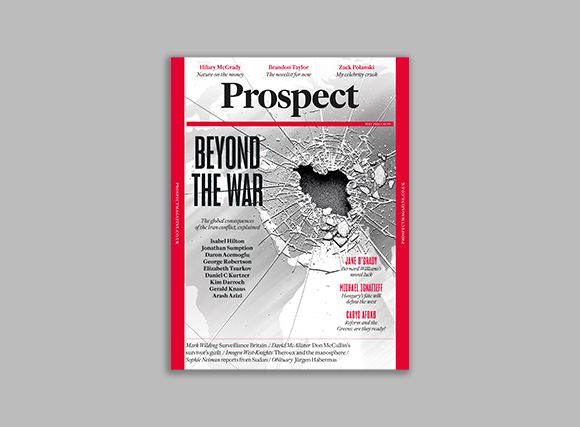
It’s shocking to hear the surprise of many media commentators that Donald Trump would go to war without a plan (“Beyond the Iran war”, May). Two reflections occur to me. First,has everyone forgotten the old story of the emperor’s new clothes? The disasters of the Iran war suddenly had everyone pointing and laughing, “He is an idiot after all!” Second, Trump has always used chaos as a political weapon. It serves him well. He keeps the media and opponents guessing, leaping around like cats chasing a laser toy, hanging on his next outrageous utterance or proposal. But the Iran war has laid bare what truly lies at the heart of chaos. Partying at Mar-a-Lago while death rains down on civilians. An illegal war based on lies and evasion. A girls’ school blown up. A dangerous region destabilised. A world economy shaken. Chaos, it turns out, isn’t funny after all. It has a heart of darkness; a face of evil.
David Cheshire, Verwood, Dorset
UK-made weapons were reportedly used in the recent deadly American Tomahawk missile attacks on Shajareh Tayyebeh girls’ primary school in Minab, Iran (“His mother waved him off to school. He didn’t return”, Prospect online, April).
Components of the Tomahawk missile are produced in Scotland. No matter how much our government tries to frame British involvement in the US-Israeli war on Iran as “defensive”, people across the country are seeing through this messaging for what it is: a war-mongering cover for the UK’s alignment with US foreign policy.
F-35 fighter jets are playing a critical role and the British arms industry plays a very significant part in the F-35 programme. Fifteen per cent of every F-35 is produced in the UK, with components produced across the country. Our government is further implicated in the conflict through the use of British bases, jets, helicopters and the recent deployment of a warship.
Louis Shawcross, Royal Hillsborough, County Down
The Enlightened Nietzsche
In her fascinating profile of Bernard Williams and his philosophical debt to Friedrich Nietzsche (“Bernard Williams's reckoning with history”, May), Jane O’Grady writes how Williams rightly differentiated between the juvenile Nietzsche who espoused that all truths were relative—the earlier incarnation who inspired postmodern “philosophical sensationalists who revel in nihilism, paradox and relativism”—and the mature Nietzsche who repudiated this stance and laid great emphasis on the quest for, and importance of, truth.
What Nietzsche properly objected to were convictions, and the idea that truths should be set in stone and never open to question: “The claim that truth has been found, and that there is an end to ignorance and error, is one of the greatest temptations there is. If it is believed, it paralyses the determination to examine, to investigate, to be cautious and to experiment.” And while he forwent relativism, he continued to stress the importance of perspectivism, writing in 1886: “In so far as the word ‘knowledge’ has any meaning at all, the world is knowable: it can, however, be interpreted variously, it has no meaning hidden behind it, but rather innumerable meanings which can be assigned to it – ‘perspectivism.’ ”
Most of Nietzsche’s writings, far from giving weight to postmodern relativism, illustrate his debt to the values of the Enlightenment, to the idea that the tangible, unmysterious world is “out there”, that judgements should be plural and that truths should be contingent and open to revision. Paradoxically, then, this is a vision not too dissimilar to his arch--detractor, Jürgen Habermas (Obituary, May).
Patrick West, Deal, Kent
Shedding some light
Isn’t it curious that Henry David Thoreau and Ludwig Wittgenstein (“Philosophy in the age of AI”, May) shared a kindred spirit? Thoreau escaped to a cabin to “front only the essential facts of life”. Wittgenstein fled the “high civilization” of Cambridge for a primitive wooden hut in Skjolden in Norway, and declared that the “spirit of this civilization... is a spirit alien and uncongenial to me”. They also shared a preference for manual labour. Thoreau’s dictum was: “Simplicity, simplicity, simplicity!” Wittgenstein’s: “What can be said at all can be said clearly, and what we cannot speak about we must pass over in silence.”
David Evanoff, via the website
PR rubbish
I cannot fault Peter Kellner’s analysis of what is wrong with the additional member system (AMS) used to elect MSPs (“Scotland’s voting system is ripe for exploitation”, Prospect online, April). But when it comes to what should replace it, the solution he mentions—a PR system using party lists—is extraordinary. It is essentially the same as the system used in Israel, which is liable to give grossly excessive leverage to tiny parties with minimal national support, but whose votes a larger party needs in order to get over the 50 per cent hurdle that provides a working majority. That would be -potentially at least as disastrous as AMS is proving to be.
The obvious solution is the system already in use in Scotland to elect local authorities, namely the single transferable vote (STV) and multi-member constituencies. It is also the system used in both the Republic of Ireland and Northern Ireland, with the exception of Westminster elections in Northern Ireland. It is also a near enough proportional system to satisfy the electorate in the Irish Republic, which has twice supported it in referendums offering the option of reverting to first-past-the post. It is the system advocated by the Electoral Reform Society for use in the whole UK. (It was indeed the British parliament that bequeathed STV to Ireland on its independence just over 100 years ago, and would ideally now do the same for Scotland—and England.)
I also strongly suspect that the Welsh Senedd will come to regret its choice of “pure” PR.
Richard H Burnett-Hall, London
The god of science
Peter Burden’s letter in your March issue, in response to the Quaker feature (“Disagreement among Friends”, December), hit the nail on the head when he wrote: “Christianity as a whole… needs to reform its perception and understanding of what is God”. But the author omits the major reason why we need new thinking: the advances in science, especially cosmology.
I live in a science city. The established churches have shown declining membership numbers for decades now. The old link between God the Father and God the Creator can no longer be maintained. The Creator, in modern cosmology, operates at a distance and in dimensions we can hardly imagine. So, in a city like ours, many people have bought into the scientific view of the universe and, in their employment, the forms of practical work derived from scientific insights. They can safely ignore the orthodox practice of Christianity.
The Quaker discussion will, I hope, fix on the belief that there is a “spark of God” in every human being. There is a Quaker reinterpretation of Genesis 1:26, that human beings are made in the image of God. It has shed the idea of this as a human right to an unqualified domination of the world, and replaced it with the image of the God of the Sermon on the Mount—with an inborn tendency in us all to -practise cooperation and tolerance, to seek peace, to refuse to accept injustice and to advocate for the interests of the weak—a seed which, one can assert, has developed over the millennia of human and biblical history. As another ancient text also has it: ubi caritas et amor, deus ibi est. But however eloquently the point is made , following this inner light is a choice which individuals, communities and cultures may make or not, as the case may be.
Amid the broad and rapid changes in the west, seeking new interpretations of Christianity is not to demand a new reformation. Rather, it follows the model of Christianity entering a new cultural context. It is not like a Christian mission—finding dynamic points of contact in a previously unknown culture. Rather, it is a case of a new culture overtaking Christianity in one of its old homelands. But the task is similar in both cases—to search out the points where this ancient source of inspiration links into issues where people today are urgently seeking orientation.
Paul Jenkins, Basel, Switzerland
The pains of being OCD
I’m with Sarah Collins (Mindful life, May) on the often-crippling effects of obsessive compulsive disorder (OCD). It’s a real pain in the arse. And it’s even worse when you’re also affected by attention deficit hyperactivity disorder (ADHD). I’d really love to just have a conversation with someone where I actually listened to their every word and gave them my undivided attention. Instead, I’m all at once daydreaming, fantasising, harbouring depressive thoughts, interrupting and finishing their sentences and literally dashing away to a nearby desk to rearrange someone else’s stationery into a neat order, because I know I will be unable to even try to focus on anything else until I have done so.
I am forever wondering what I could and would have achieved in my life if only I had been able to concentrate more. When I was young, the official name for it was hyperactivity, but teachers then weren’t particularly interested in diagnoses. A hyperactive child tended to be written off as a naughty or a stupid child. And that child’s education (and therefore life chances) would generally suffer as a result, because the majority of teachers didn’t have the time or the patience for them. Ironic really, teachers having no patience for pupils who had no patience.
On the plus side (and maybe Sarah will agree with this) I have probably achieved things because of these afflictions that I might not have achieved without them. Unfortunately for me, however, it’s more likely to have been a case of quantity over quality, whereby much can be amassed and stored up without actually taking any time to think about whether or not I really want or need any of it.
Maybe we never fully puzzle out what the real source of stress is in our lives (the cause being part internal and chemical, part external in the form of coercion or constraints), but it is possible to manage our thoughts and get better. And it’s great that Sarah sees “yapping” as a prized possession. After all, it’s when we stop talking that most of the world’s problems begin to get worse.
Stefan Badham, Portsmouth
Stay Sharpie
Alan Rusbridger’s column (“We need to talk about Donald Trump’s mental health” Prospect online, April) was brilliant. I tend to watch all Trump’s speeches and yes, they are “sane-washed” by the UK media in particular. During his Sharpie pen speech my jaw was on the floor. I cannot believe the speech was not broadcast on British news. It seemed to me to be longer than five minutes and was sandwiched between insane rantings about walls and nice ceilings! I hope it will take just one senior acolyte to break ranks and bring this lunatic down.
Gavin O’Donnell, via the website