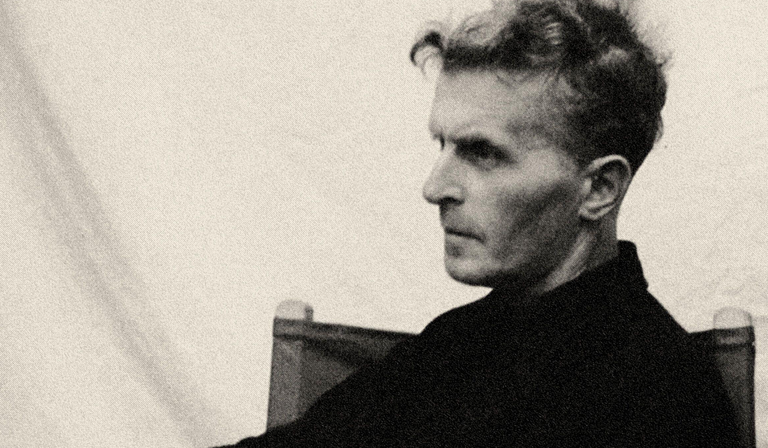
If there is one meeting of minds I’d love to drag out of history and into the AI era, it would be that shared by Alan Turing and Ludwig Wittgenstein.
The real-life hookups between the young father of computer science and the 20th century’s most disruptive philosopher took place in seminar rooms and the Cambridge University Botanic Garden in the late 1930s. Discussions centred on the foundations of mathematics. Witness accounts suggest sparky exchanges, as the philosopher insisted that maths was more invented than discovered, while the computationalist warned that brushing off its contradictions might nevertheless result in collapsing bridges. At one moment, the reputedly kindly Turing conceded “I see your point,” only for the perennially forbidding Wittgenstein to rebuke: “I have no point.”
Back in 2026, deep conceptual confusion dogs the endless soulsearching about where large language models are leading us. Some enthuse that, as tech outstrips human capabilities, chatbots will have to be credited with minds of their own. Others deny anything of the sort, regarding the very term “artificial intelligence” as a misnomer for a conjuring trick based on fancy cut-and-paste operations. Surely a fresh bout of argy bargy between Turing, the original prophet of learning machines that could pass off as human, and Wittgenstein, a restless interrogator of language and meaning, could help us clear things up.
It goes without saying that the great Austrian would regard my daydream of a zeitgeisty reunion as beneath contempt. As Anthony Gottlieb relays in his brisk and insightful new biography, “Ludwig always used the word ‘journalist’ as a term of abuse.” Still, I am emboldened by a question from the horse’s mouth that gives Gottlieb his subtitle. “Why should philosophy,” Wittgenstein asked of a friend, “in the age of airplanes and automobiles be the same… as in the age when people travelled by coach or on foot?” In the same spirit, doesn’t the age of AI lend a new urgency to Wittgensteinian themes about how words connect to thought and reality?
Wittgenstein is no longer the dominant force in professional philosophy that he was during the generation after his death in 1951—but he still towers over the cultural imagination, the most iconic of all modern geniuses except Einstein. After all, he ticks every box.
Intensity: a loner who repeatedly fled to a Norwegian hut to contemplate without interruption. Eccentricity: a man who didn’t care what he ate, just so long as it was the same every day. Technical difficulty: his raw materials were mind-bending paradoxes. A poetic touch: his metaphors could transform something as dull as “uttering a word” into “striking a note on the keyboard of the imagination”. Force of personality: he attracted disciples who bought his conviction that he had solved—or, in his preferred term, “dissolved”—the problems of philosophy. Obliquity: his revolution was effected through such gnomic one-liners as his famous statement of purpose, “to show the fly the way out of the fly-bottle”. Profundity: despite his avowed focus on dry-as-dust logical forms and quotidian communication, he always kept half an eye on the transcendent.
The journey through life that forged this character is almost as fascinating as its product. Wittgenstein was a scion of the Austrian empire’s second-richest family who impoverished himself by giving away all his money—not to good causes, but to his siblings, who were already so wealthy he needn’t worry about them being further corrupted. His steel magnate father was a formidably well-connected patron of the arts: Brahms was a regular at the music-obsessed family’s salons. Yet it was a far from happy home. His mother made no effort to communicate except through the piano keyboard, and no fewer than three of his brothers committed suicide. Young Ludwig, a boy of Jewish heritage, attended the same school as one contemporary, born just six days earlier, who would achieve greater prominence: Adolf Hitler. And there was little in his student life to suggest where he would land; he headed for Manchester to study aeronautical engineering.
Even later, as one devotee would put it: “Wittgenstein was not, strictly speaking, a learned man.” The three-chapter story of his admission to Cambridge, his subsequent award of a PhD for a book that he told his (supposed) supervisors they would never understand and his eventual elevation to the chair of philosophy is remarkable. It is a case study in chaotic nepotism. At the same time, however, it illustrates how the academy used to create paths for original brilliance, routes now closed off by demands for credentials and demonstrable “impact”. Cambridge provided a passport to the glamorous world of Keynes and the Bloomsbury Set which, inevitably, the stern philosopher hated. Like a medieval saint, he repeatedly fled his privileged perch. He scrambled, successfully, to put himself into the line of fire in the First World War; during the Second, he metamorphosed into a lowly aide to hospital pharmacists. He packed in philosophy for a while to become a primary-school teacher to peasant children. Later, he made earnest, though unsuccessful, efforts to become a manual worker in the Soviet Union. (If he was coming their way, the authorities said, they’d bag him a university.)
Oh, and he had a chequered series of affairs, a couple of which ended in tragedy, with young men (and one young woman) aged between 20 and 22. Putting everything together, you can see why there have been few seers since Christ whose personal stories have commanded more attention. In 2015, Bloomsbury published a two-volume compendium of firsthand reminiscences that filled 1,138 pages. Derek Jarman directed an aptly quirky 1993 biopic. Various apostles published their own gospels, and in 1990—just as Wittgenstein was approaching the edge of professional living memory—Ray Monk produced the definitive biography: The Duty of Genius.
When so much has already been said, Gottlieb needed a fresh angle. He traces the intellectual journey that starts out with the budding engineer’s unsolicited visit to Bertrand Russell in 1911 as the story of a single mind. That may sound like the basic task of any intellectual biography, but the usual, encyclopaedia-entry rendering of Wittgenstein is as the author of not one but two distinct philosophies. His early work attempted to unearth the essentials of how language conveyed meaning. Later on, he mostly came to accept that the “meaning” of words was simply the way they are used. This led him to give up on theory and instead find his way to profound questions by observing language in real life. Where some accounts treat the earlier and later Wittgenstein as embodying entirely different worldviews, Gottlieb’s emphasis is on the connective threads between them: the unresting obsession with “running up against the limits of language”; the aphoristic expression; the compulsion to philosophise; and the faith that clear thought could help troubled minds kick that nasty habit.
The book’s other striking feature is its foregrounding of the cultural cloth from which Wittgenstein was cut. A dedication to Gottlieb’s father reveals a family connection to Vienna, the most electrifying crucible of thought in early 20th-century Europe. Quite a chunk of the book is given over to diverse, and sometimes unsavoury, Viennese influences. Otto Weininger looms large, a Jewish thinker who developed theoretical underpinnings for both antisemitism and misogyny: he has recently been described as a trailblazer for the manosphere. So, too, do physicist Ludwig Boltzmann and the spiky satirist Karl Kraus. The neoliberal economist Friedrich Hayek, a distant cousin, pops up as well.
Many such names also occur in Monk’s longer book, but my distinct recollection is that it put relatively more stress on Wittgenstein’s direct philosophical influences—the likes of Gottlob Frege and Bertrand Russell. The unlikely triumph of that biography is to take you so deep inside the philosopher’s obsessions and internal world that you emerge with half an idea of what it might have been like to be him. This one, however, can claim to be in keeping with the later Wittgenstein’s spirit in this sense: it makes sense of a mind through its social context and web of relationships.
Wittgenstein’s most audacious intellectual move was to upend philosophical hierarchies that traced back to Descartes. The Cartesian idea—“I think, therefore I am”—is that the individual mind’s own experience is the only solid foundation on which a sure understanding of the outside world can be built. The mature Wittgenstein instead regards the foundation as being human practices in all their variety—shopping, housebuilding, gameplaying, etc—and language as a set of tools that evolves in pursuit of those practices. Thought is doubly derivative: its possibilities are shaped in turn by the linguistic tools at hand. Only once a child has been taught to go beyond howling and describe itself as being “in pain” can she actually think of herself as such, or indeed begin to conceive of others in that way.
Wittgenstein is not out to deny the existence of purely subjective experience, but rather to contest the possibilities of talking or even thinking about it meaningfully. Language only gets its claws into reality, he thinks, through shared rules of use. In one typically off-the-wall passage, he invites readers to: “Suppose everyone had a box with something in it: we call it a ‘beetle’. No one can look into anyone else’s box.” This attempt to label the putatively private “thing in the box” would, he suggests, be meaningless. No conceivable use of the word “beetle” in this context could identify boxes that were empty or filled with constantly changing contents. Hence the beetle “drops out of consideration as irrelevant”.
What does any of this have to do with chatbots? Well, understanding language as something defined by public use—rather than private intention—helps us grasp how simply scraping text from around the web and finding patterns in the way words fit together can form the basis for passably imitating a human. But Wittgenstein also insists that the rules of language reserve various attributes, including consciousness, for “a human being and what resembles (behaves like) a living human being”. A lot of work is done by “resembles” there, and I can imagine a latter-day Turing and Wittgenstein thrashing out whether resemblance can be established in a bounded imitation game. Or whether instead—as the philosopher might say—it is something to be assessed across all sorts of contexts, including the history and relationships of a supposed mind.
I certainly wouldn’t expect Wittgenstein to spell out clear answers as to why your Copilot legal researcher might be “hallucinating” case law, or whether your ChatGPT therapist was “really” thinking. But I reckon you could rely on him to dream up the sort of questions that might help you decide. Indeed, if you want an enlightening analogy for getting to grips with bewildering technologies, his Philosophical Investigations is a good a place to start. Picking it up for the first time in decades, I stumble on this:
When children play at trains their game is connected with their knowledge of trains. It would nevertheless be possible for the children of a tribe unacquainted with trains to learn this game from others, and to play it without knowing that it was copied from anything.
Should a kid from the trainless tribe join in a game with experienced railway children they would, as I picture it, mostly play along fine. Occasionally, though, they might do something odd, breaching a rule they didn’t know about, perhaps by jumping up above the imagined track. Now think of yourself as the child who has grown up knowing trains, and the chatbot as another child who hasn’t, yet is a natural mimic who keeps a close eye on you. I don’t know about you, but this little flight of fancy on the grouchy old Austrian’s airplane makes me feel just a little more grounded in the age of AI.
Reviewed here
Ludwig Wittgenstein: Philosophy in the Age of Airplanes by Anthony Gottlieb (Yale University Press, £16.99)