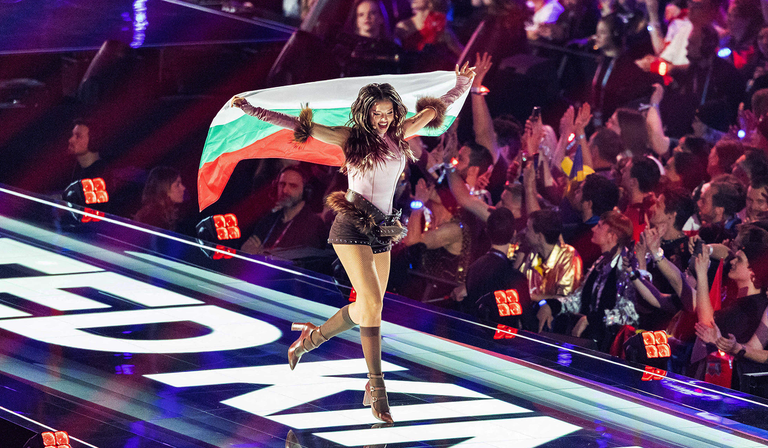
This year’s Eurovision Song Contest, the final of which was held on Saturday, had all the usual hallmarks. Pyrotechnics; the entire continent’s supply of sequins and rhinestones; obligatory glam-goth vibes from eastern Europe; the perplexing presence of Australia; someone going absolutely ham on a violin; several people in full gold or silver body paint; and, of course, Graham Norton’s delightful near-contempt for how ridiculous the whole thing is. The winner this year was Bulgaria—a first—with their catchy, frenetic, typically Euro-nonsensical tune “Bangaranga”, which took top spot in both the public and jury votes.
But all is not well with Eurovision. This year marked the 70th anniversary of our continent’s proudest annual carnival of high-camp mania. It should have been an occasion for celebration, but 2026 has been an unusual year for the contest. This year, five nations refused to participate: Ireland, Iceland, Spain, Slovenia and the Netherlands—in protest at Israel being allowed to compete. Their absence was noticeable: Ireland, Spain and Iceland are Eurovision big-hitters. “We will not be in Vienna, but we will do so with the conviction that we are on the right side of history,” Spanish Prime Minister Pedro Sanchez said on X. RTE, Ireland’s national broadcaster, decided to not even air the programme this year, in solidarity with Palestine.
These tensions have been a feature of Eurovision since Israel’s response to the Hamas attacks on 7th October 2023. There were protests against Israel’s inclusion in 2024 and 2025, both before the contest and during the final, in the streets of the host cities, although no nations pulled out as a result. This year, protestors carried banners through the streets of Vienna reading “No stage for genocide”. Last year, Israel was even accused of vote rigging. Their act, Yuval Raphael, came middle of the pack with the judges, but outstripped every other contestant in the public vote. Several broadcasters were dubious—and quick to suggest that social media accounts linked to the Israeli government had been campaigning for members of the public to submit all of their 20 maximum possible votes for Israel. In response, the Israeli government claimed they were the target of a smear campaign. The European Broadcasting Union (EBU), which organises Eurovision, launched an investigation which found no foul play, but the incident has left a bitter taste.
Even though the UK has kept on competing and broadcasting the show, the public here has been turning away from Eurovision since the events in Gaza in 2023—though causation is hard to prove. Viewing figures for the contest in the UK dropped to 5.2 million this year, the lowest since 2010. Some of my friends and acquaintances tuned in last year, often a little sheepishly, but this was the first year when nobody I knew was watching.
Eurovision has always been more than just fun
I have watched Eurovision every year since being introduced to it while living in Sweden, where they take it all so seriously that there is a pre-Eurovision, televised contest, called Melodifestivalen, in which they select the act that will represent the nation. It’s a lot of fun. But it’s always been more than just fun. The raison d’être of Eurovision is, at least in part, to foster a spirit of European community, away from the headlines and the politics, so that we can unite once a year around the kind of music that would seem over the top in a fever dream. But, inevitably, politics comes into it. There’s a long tradition of allied countries voting for each other.
And, while five nations refusing to participate is an unprecedented walkout, countries have abstained for political reasons before now. In 2012, Armenia refused to compete in Azerbaijan because of the Nagorno-Karabakh conflict. Greece boycotted in 1975 over Turkey’s invasion of Cyprus. The EBU doesn’t have much of a leg to stand on over Israel being permitted to compete, given that it banned Russia over the invasion of Ukraine. This year’s entry from Israel, a song called “Michelle” by Noam Bettan, sung in French about a relationship gone sour, has no political overtones, but it is noteworthy that last year’s entrant was a survivor of the Hamas attack on the Nova music festival on 7th October.
What does this all mean for the future of Eurovision? Nothing good. “We’re going through some challenging times at the moment,” contest director Martin Green said at a press conference before this year’s final. Something of an understatement, and the challenging times don’t look set to end. This whole debate will roll around again in 2027, and I would not be surprised if more countries drop out if Israel persists in participating. There’s no amount of body glitter that can cover up what is becoming an ugly way for Israel to launder its reputation through cultural soft power. The show will go on, but in what form, and with what participants, remains to be seen.
Some things, at least, never change. This year, we in the UK continued our proud tradition of dud Eurovision performances. Our entry, “Eins, Zwei, Drei” by Look Mum No Computer, was awarded a desultory single point—from Ukraine.