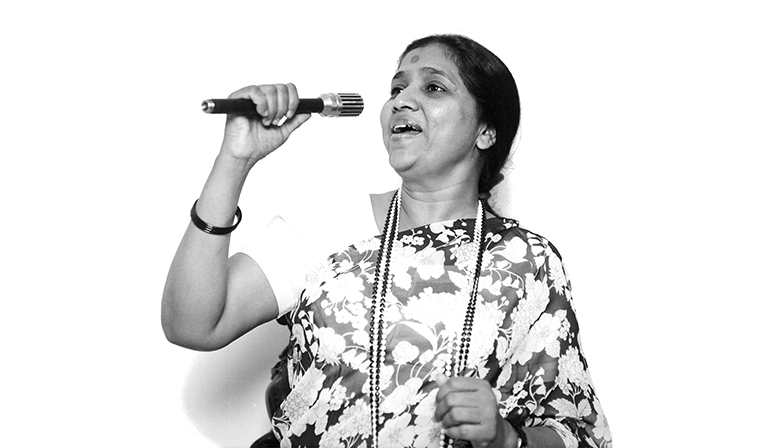
For fans of the lurid, multicoloured fantasy world of Bollywood, Asha Bhosle represents its defining sound. The singer, who died aged 92 on 12th April in Mumbai, was in 2011 the most recorded music artist in history, voicing more than 11,000 songs that were lip-synced by onscreen actors to embody characters as varied as coquettish cabaret singers, wronged lovers and fierce leading ladies. Bhosle transformed the Bollywood trope of playback singing into an art of its own, thanks to her remarkable range that could traverse everything from whispered intimacy to the innocence of a soaring falsetto and the simmering tension of a gravelly baritone. Her voice was not only a technical marvel, but a signifier of growing complexity within the female roles of Hindi cinema—a marker of nuanced emotion rather than simple, sweet purity.
Making her film soundtrack debut at age 10 in 1943 and recording her final song with Damon Albarn’s globe-trotting project Gorillaz in 2026, Bhosle’s career expanded beyond the confines of cinema to become an emblem of post-independence Indian musical culture for diaspora communities around the world. In the UK, the British Asian group Cornershop released the single “Brimful of Asha” (1997) in tribute to Bhosle’s talents, and the following year it climbed to number one on the UK charts with producer Fatboy Slim’s remix of the track. “Few have reached the ability to be loved in so many languages and dialects,” Cornershop founder Tjinder Singh wrote in memory of Bhosle in April. “Even fewer have reached so many with the astonishment of heart that her songs gave us. [She] helped us throughout all our good and difficult times.”
Born in 1933 in a hamlet in the western Indian state of Maharashtra, Bhosle was raised as the third of five siblings in a musical family. Her father, Deenanath Mangeshkar, was a classical vocalist who performed in regional Marathi plays and, although Bhosle never formally trained under him, she would later recall that watching him sing gave her a lifelong passion for the power of the voice. Following his death when Bhosle was eight, the family was forced to look for ways to make ends meet. Eldest sister Lata Mangeshkar took the lead by becoming a playback singer.
With her syrupy-sweet, melismatic voice, Lata would go on to become the other pre-eminent female voice in Bollywood alongside her sister. Rumours of petty rivalries would follow both women’s careers, with many noting how Lata’s rigid, classically trained style clashed with Bhosle’s more free-flowing, genre-agnostic spirit. Yet Bhosle consistently dismissed the gossip, stating that “she is my sister and favourite singer.” In fact, it was Lata who trained Bhosle and landed her a debut role singing as the infant lovechild in the 1943 film Maze Baal. Duetting with her sister in the song “Chala Chala Navbala”, Bhosle’s dextrous falsetto adds a yearning naivety to her character and slices through the bouncing, upbeat instrumental. Even at 10, Bhosle displayed the natural musical emotion that would become her signature as her voice matured.
In 1949, at 16, Bhosle escaped her sister’s shadow after she eloped with Lata’s secretary, Ganpatrao Bhosle, who was almost two decades her senior. Despite Lata and Bhosle’s mother disapproving of the marriage, the couple went on to have three children. They separated in 1960, while Bhosle was pregnant with their third child, amid allegations of abuse. During their time together, India underwent a radical shift, as the violent unrest following the 1947 independence and Partition influenced an age of socially engaged popular Hindi cinema. Bollywood was being watched by more Indians than ever and film production began to ramp up in turn, creating greater opportunities for Bhosle to voice the onscreen action.
Striking up an influential working partnership with the composer OP Nayyar throughout the 1950s and 1960s, Bhosle lent her voice to leading ladies for the first time and gained popular recognition in films like the 1957 social drama Naya Daur and 1958’s noir-influenced Howrah Bridge. In the latter, Bhosle’s shimmering higher register combines with Nayyar’s melodramatic strings to lend a seductive intimacy to character Edna’s attempt to charm leading man Prem Kumar in the central song “Aaiye Meherbaan”.
In her early leading vocal takes, Bhosle was already breaking the stereotype of the prized and passive heroine by adding a sensual provocation to their performances. It’s a subversive signature that can be felt in the 1968 film Kismat, where Bhosle employs languorous phrasing and an unusually low register for a female part to reflect actor Babita Kapoor’s hedonistic portrayal of a drunk singer. “Piya Tu Ab To Aaja” from Caravan (1971) takes on a jazz cabaret theme embellished by Bhosle’s breathless vocalisations between her soaring lines, which became controversial at the time for adding an orgasmic suggestiveness to actor Helen’s lithe performance as the film’s vamp.
Bhosle’s own life increasingly reflected the liberated narratives of the women she portrayed
Bhosle’s own life was increasingly reflecting the liberated narratives of the women she portrayed through song. Following her divorce, she took on the unusual role in a conservative society of a single mother with three children, before forming a new creative and romantic partnership with composer RD Burman, whom she would marry in 1980. With Burman, Bhosle found a new sense of creative freedom, singing over western instrumentals in the hippy pastiche of Hare Rama, Hare Krishna (1971), as well as performing a forlorn, downtempo balladry on the genre-splicing 1973 film Chura Liya Hai Tumne Jo Dil Ko.
Celebrated as one of Bollywood’s most boundary-breaking musical couples, Bhosle and Burman incorporated everything from funk to rock and jazz in their music, pushing Bhosle’s voice into new territory. “He uncovered my range as a singer,” Bhosle said of Burman in a 1989 interview. “Until he made me explore the inner recesses of my own voice, I was totally unaware of the fact that I could sing with such suppleness of throat.”
Their journeying ethos led Bhosle into other cross-genre collaborations, such as 1981’s Umrao Jaan, where she tackled the ancient tradition of Urdu ghazals and performed vocal acrobatics through Sufi poetry, or in 1991 when she made her international debut as part of pop singer Boy George’s Jesus Loves You project, adding ethereal wordless vocalisations over a New Age, rave-influenced backing track.
As the new millennium arrived, and following Burman’s death in 1994, Bhosle’s experimentations only continued, delving further into electronica with REM’s Michael Stipe on the 2001 track “The Way You Dream” and collaborating with experimental ensemble Kronos Quartet in 2005 on neoclassical arrangements of popular Burman and Bhosle numbers.
Outside music, Bhosle was a passionate cricket fan and close friends with Indian star batsman Sachin Tendulkar, as well as working on the tongue-in-cheek love song “You’re the One for Me” with Australian player Brett Lee to mark the 2006 ICC Champions Trophy in India. At 79, she made her acting debut as a mother with Alzheimer’s disease in the 2013 film Mai and also launched an Indian restaurant brand, Asha’s, in Dubai and Kuwait.
Still singing into her 90s and working with the cream of new Indian composing talent like Slumdog Millionnaire’s AR Rahman, Bhosle’s creative talent was restless and constantly maturing. Sampled by artists as varied as US rapper Busta Rhymes and James Bond composer John Barry, her voice remains instantly recognisable no matter the context—it is the sound of a country finding a new, ebullient mode of self-expression.