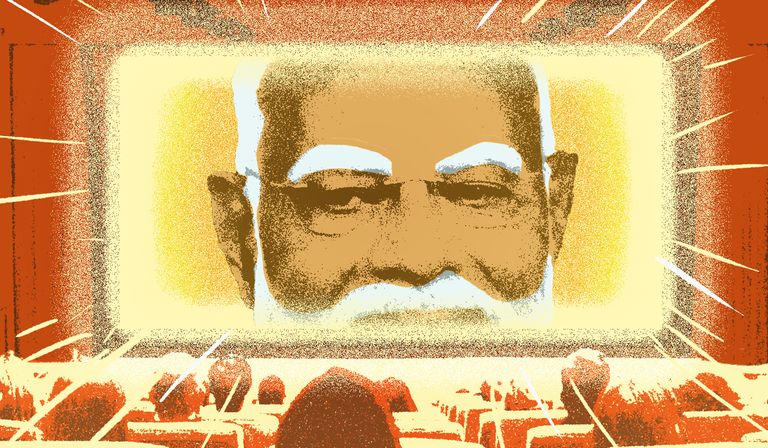
In the darkness of the Indian cinema, reality falls away. Enter a world in which beautiful heroines sing in chiffon saris on alpine landscapes without getting cold. In which floppy-haired heroes perform physics-defying stunts and dance atop moving trains. And in which love, of course, always conquers all.
It is hard to overestimate the vastness of Bollywood—India’s Hindi-language film industry, based in the bustling heart of Mumbai. India churns out more films annually than both the US and China, serving a population of 1.45bn people and reaching global audiences from Nigeria to Russia.
But what, precisely, is now being served up? Something noticeably different since the election of Narendra Modi as prime minister in 2014 and the concurrent rise of his Hindu nationalist Bharatiya Janata Party (BJP). As India’s politics has shifted rightwards, the film industry has moved with it.
Unlike the relationship between Hollywood and Donald Trump, some of Modi’s most vocal supporters include high-profile actors and filmmakers. The prime minister frequently appears alongside Bollywood’s finest and makes cameos at celebrity weddings (including Priyanka Chopra and Nick Jonas’s big fat Indian wedding in 2018). A growing contingent of actors-turned-BJP politicians have even made their way to parliament, including action star Sunny Deol and actresses Kangana Ranaut and Kirron Kher.
The “saffronisation” of the country—named after BJP’s official colours—is taking place on screen, too. Bollywood has a history of sumptuous period films set in India’s Mughal era, from Humayun (1945) to Mughal-e-Azam (1960) to Jodhaa Akbar (2008). But since 2014, as it has become clear that films made in the same vein are now politically and economically straitjacketed, the old portrayals of cultured Mughal rulers have been replaced by new ones of bestial, flesh-eating brutes with thick beards and dark, kohl-rimmed eyes.
The 2025 historical epic Chhaava is a case in point. It portrayed a daring Hindu king with superhuman strength (and the ability to break a CGI lion’s jaw with his bare hands) facing off against a monstrous Mughal emperor, Aurangzeb (“Wherever you see saffron, stain it red with blood”). Following the film’s release, right-wing groups called to destroy the real-world Aurangzeb’s tomb, leading to riots in Nagpur last March. In 2022’s Samrat Prithviraj, meanwhile, another lionslaying Hindu king—whose consort Princess Sanyogita is played by former Miss World winner Manushi Chhillar—turns history on its head by killing his Muslim counterpart, Muhammad Ghori.
Cinema is perfect for broadcasting Hindutva narratives to unwitting audiences
Nor is this rewriting of history reserved for period films. For a leader who refuses to engage with critical journalists, cinema is perfect for broadcasting Hindutva narratives to unwitting audiences. And so there is a subgenre of hagiographical biopics of far-right figures—including Ajey (2025), about the extremist monk-turned-BJP leader Yogi Adityanath, and another about Modi himself, which drew criticism (and a temporary ban from the Election Commission of India) for its original planned release date on the day polls opened for the 2019 general election. Its opening transparently declared: “THE INTENT OF THIS FILM IS TO INSPIRE PATRIOTISM, NATIONALISM AND REVERENCE FOR OUR GREAT NATION ESPECIALLY AMONGST THE YOUTH AND ALSO PEOPLE AT LARGE.”
Even more troubling—says Shakuntala Banaji, a professor of media, culture and social change at the London School of Economics who specialises in studying authoritarian uses of media—has been the “swing into very vicious forms of propaganda”. Take The Kerala Story (2022), which billed itself as a true account of 32,000 girls from Kerala who were groomed into joining Isis—and was premised on the idea of “love jihad”, a far-right conspiracy theory that is used to target interfaith couples in India. When journalists criticised the film for exaggerating the number of radicalised women, the figure on posters was reduced to just three. Still, the BJP leveraged the film in its campaign for the Karnataka assembly election, and it won the National Film Award (selected by a panel appointed by the government).
Or The Kashmir Files, released in the same year, which portrayed the exodus of Hindu Pandits from Kashmir and Muslim militant groups in the 1990s. This featured gratuitous (and fictionalised) episodes of violence—including a scene in which a widow is forced to eat rice soaked in her husband’s blood. Videos circulated on social media of moviegoers shouting, “Shoot the traitors!” BJP leaders organised special screenings and Modi personally met its creators.
Both films were endorsed by the prime minister and granted tax-free status in several exclusively BJP-ruled states.
In the moral universe of these films, argues Banaji, “the core theme is that violence and extreme violence are completely acceptable norms for individuals and groups who happen to be Hindu to use against [Muslims]… there’s always an excuse built in, in terms of the historical imagining of those films, about why one might need to use [violence] against insidious, vicious and usually completely inhuman or subhuman Muslim groups and characters.”
“If [filmmakers] push against an exclusionary idea of India’s Hindu nation,” she says, “you begin to see that you either have to be producing within the indie sector, or you are gradually pushed out, or you are the target of a lot of hate.”
The most striking example of this is the case of India’s Muslim actors. The “Khans of Bollywood”—Shah Rukh Khan, Aamir Khan and Salman Khan (no relation to each other)—are among the most wealthy and recognisable celebrities in the world, but they also occupy a precarious position.
Two years after Modi’s election, when Aamir Khan mentioned a “growing sense of disquiet” in the country and confessed that his Hindu wife had broached the prospect of having to move abroad, the subsequent backlash saw him being dropped from contracts, including as the face of the government’s “Incredible India” tourism campaign.
A few days later, the “king of Bollywood”, Shah Rukh Khan—worth £1.3bn and sometimes described as the biggest actor in the world—came under fire for suggesting India had become more religiously hostile (“I think we should be a little more tolerant”). BJP leaders compared his language to that of terrorists, and he was forced to retract. Separately, his son was detained without bail for a month by narcotics police, despite a lack of evidence. “If they could do this to the king,” observed Samanth Subramanian in the New Yorker, “imagine what they could do to us”.
Actors and filmmakers tread a fine line between self-preservation and complicity
Actors, like everyone else, have had to adapt to this new India. But they tread a fine line between self-preservation and complicity. Shah Rukh Khan visited a senior BJP figure to ensure the smooth release of Raees (2017), assuring him that his Pakistani costar, Mahira Khan, would not be promoting the film in India. Around the same time, Aamir Khan attended his first award ceremony in 16 years, to be honoured by Mohan Bhagwat, the head of the Hindu supremacist paramilitary group Rashtriya Swayamsevak Sangh (RSS).
It is impossible to understand Modi’s India without understanding the RSS, which was founded in 1925 as an echo of European fascist parties and now has some 6m active members. The group’s disciples have included Gandhi’s assassin and many BJP politicians—up to Modi himself. Its primary aim is to establish a Hindu Rashtra, a theocratic or semi-theocratic state, with minority faiths inevitably relegated to second-class status, or worse.
On 7th and 8th February this year, the group held centenary celebrations in Mumbai and rolled out the saffron carpet for Bollywood’s brightest stars. And it wasn’t just the usual suspects, Modi’s vocal allies in the film industry, who attended. Directors, actors and composers who had never attended an RSS event were present, too. Ten years ago, this would have been unthinkable.
Even Salman Khan made an appearance, permitting himself to smile at a line in Bhagwat’s speech acknowledging Khan’s influence: “What Salman Khan wears, college students do the same… Why do they do it? Because he is wearing it. Why is he wearing it? They don’t know.”
In those words was a clue to why all the actors were invited in the first place. After all, the country’s far-right leaders don’t just see themselves as the custodians of Indian culture—but also its shapers. And by merging the blind devotion of nationalist politics with the blind devotion of Bollywood fandom, what can stop them?