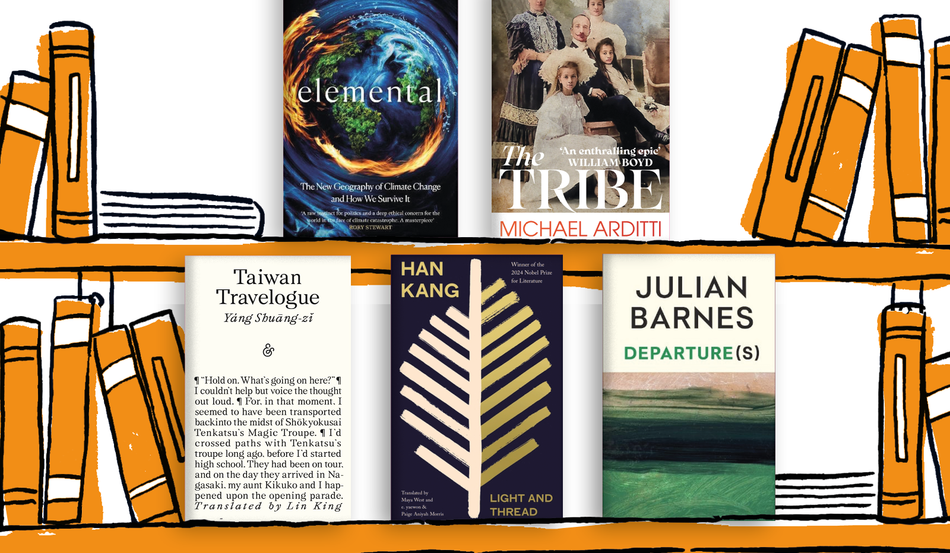
Elemental: The New Geography of Climate Change and How We Survive It
by Arthur Snell (Wildfire, £25)
In this account of the ways in which a changing climate will affect political regimes, Arthur Snell, a former diplomat turned “geopolitical affairs consultant”, makes a compelling case that “climate change changes everything”. Geography has always been a key determinant in global affairs, but now “the climate crisis means that some aspects of geography are changing in real time, rather than geological time”.
Perhaps most importantly, it is changing where in the world we can reliably grow food. In the Sahel, increasingly frequent and severe droughts and floods have already decimated agricultural productivity. As a result, the region, home to 350m people, has become “ungovernable”: six countries experienced military coups within a two-and-a-half-year period in the early 2020s. Imagine what might happen as agricultural yields in India, China and Brazil decline.
The destabilising effect of climate change is also felt in regions that are becoming more hospitable—or, as in the case of the frozen north, navigable. Donald Trump may claim in public that climate change is a “hoax”, but his desire for Greenland (and, for that matter, Canada) suggests that at least some of his advisers believe the scientists when they say the Arctic is melting. His counterpart in the Kremlin certainly does: as the polar ice disappears, a new “Great Game” is underway at the top of the planet and, right now, Russia is in the box seat.
Snell argues that climate change may also be a stabilising factor in some—albeit rare—instances. For example, if China refrains from invading Taiwan, it will be because of worsening food insecurity. Its reliance on imports makes its leaders nervous about a potential naval blockade.
Which nations will rise, and which will fall, in our climate change-affected future remains uncertain, but Elemental is essential reading for anyone interested in these questions.
Richard Roberts
Light and Thread
by Han Kang, tr Maya West, e yaewon & Paige Aniyah Morris (Hamish Hamilton, £12.99)
Han Kang, the Korean novelist, was the first writer born in the 1970s to win the Nobel Prize in literature. Han now has readers all over the world, but her friends still describe her as introverted, shy and given to keeping where she lives a secret. It’s no surprise, then, that her writing is both mysterious and appealing.
The day before the Nobel presentation, Han was struck down by one of her terrible recurring migraines. She spent the day in bed, thinking about what she was going to say to the assembled dignitaries.
When the moment came, she touched on her five novels, of which The Vegetarian is the most famous and Human Acts—about the Gwanju uprising of 1980—for many the most moving. But it was her description of finding a small box of her first poems written in pencil that shed the brightest light on the roots of her creativity.
Han’s new book, Light and Thread, which begins with her Nobel lecture, goes a great deal further than disclosing what she told the dignitaries who were invited to Stockholm in December 2024. Gathering together essays on a 20-year-old overcoat or the small teacup she used while writing her last book, We Do Not Part, and which she donated to the Nobel museum—as well as poems and photographs, some going back nearly two decades—Han explores not just what makes her write, but what drives her over and over to return to writing.
Writing, for Han, is like gardening. Or love. “It is the gold thread connecting between our hearts,” she wrote in one of her childhood poems. As soon as she finishes one book, she starts another. “Because that’s the only way to be connected again.” Light and Thread shows how writing helps Han make sense of the world; more than that, it’s what makes her human.
Fiammetta Rocco
Departure(s)
by Julian Barnes (Jonathan Cape, £18.99)
Julian Barnes has an announcement to make. A few pages into his diverting remarks on the follies and tragedies of memory, he tells us emphatically, “this will be my last book”. The departure(s) of his title are thus his disappearance as a writer, preliminary to his disappearance as a person. He has cancer of the blood which will be his companion unto death, and this will be his last word.
At which point, this being Julian Barnes, it all gets a lot more complicated. Just before I finished the book, its wrapping fell off and it was only then that I saw the hardback cover bore the following endorsement from Philip Larkin: “A mesmeric original.” Larkin was referring to Flaubert’s Parrot, but the point stands for the whole oeuvre, of which this may be the parting shot. Barnes quotes Larkin’s “Poetry of Departure” admiringly; this is his Novel of Departure(s).
Only it isn’t quite a novel. It’s “one of those hybrid things” which Barnes’s female lead Jean admonishes him for. Barnes himself, or “Barnes”, is the direct interlocutor of Stephen and Jean, the subject of the story in the middle of this meditation on memory. Larkin once said that the English novel had a beginning, a muddle and an end. The story of Stephen and Jean is the tale of two people who start out in life together and then try to rekindle their romance. A beginning and an end—but no middle.
Slight as they are, you will root for Stephen and Jean. And you will root for the author, too. As he says in response to Jean’s criticism of his love of the hybrid form: “don’t think I don’t know what I’m doing”. Maybe he means it when he says this will be his last book. But maybe that is to confuse author with narrator. And maybe he will just forget.
Philip Collins
Taiwan Travelogue
by Yáng Shuāng-zǐ, tr Lin King (And Other Stories, £14.99)
If, after reading the first few pages of Taiwan Travelogue, you mistake it for a genuine memoir written in the 19th century, you’d be forgiven. To all appearances, the book would seem to be a newly unearthed literary gem from Japanese colonial Taiwan, the first-person account slotted in between not one but four sets of translator’s notes. In actuality, though, this is Yáng Shuāng-zǐ’s erudite, multidimensional and timely debut novel, first published in Mandarin in 2020 and now deftly translated by Lin King.
Reminiscent of Catherine Lacey’s Biography of X—another brilliant work of faux nonfiction—by way of Rick Stein, it centres on famed Japanese writer and self-professed “glutton” Aoyama Chizuko, who sails to Taiwan in 1938 for a book tour, determined to eat her way around the country. Thanks to her “cherubic” but enigmatic interpreter Ō Chizuru, she is introduced to the island’s diverse array of foods, which she logs—and thus preserves—in long, torturously mouthwatering passages.
But Aoyama-san—though a vocal opponent of Japan’s colonial “Southern Expansion” policy—remains comically oblivious to how demanding, ignorant and entitled she is. Because of her “mainlander” status, an awkwardness festers in her relationship with Chizuru, whom she is falling for.
Painstaking historical research by Shuāng-zǐ results in a novel that is stunningly intricate. Minor details, from “patriotic bento” to decommissioned bridges, are pieced together to tell a nuanced, moving story of a region that continues to be torn apart by colonial forces, the oncoming war a harbinger of more change for its cultures and customs. It’s a thoughtful, impressive and ultimately hopeful read—but make sure you have snacks to hand.
Miriam Balanescu
The Tribe
by Michael Arditti (Salt Publishing, £12.99)
When the new Holocaust Museum of Greece opens later this year in Thessaloniki, which was once one of the only cities in Europe where Jews were the majority, it would do well to stock copies of Michael Arditti’s ambitious new novel about a family of wealthy Sephardic Jews.
The Tribe opens in June 1911, when Greece’s second largest city was still part of the Ottoman Empire. It follows the exploits of the Carrache family, whose ancestors left Spain for what was then called Salonica after their expulsion in 1492, taking in six decades of tumultuous history that sees the fictional family scattered across the globe.
We meet Jacob Carrache on the festooned streets of Salonica, waiting for the Sultan’s arrival. “He had every reason to be contented with his lot. At fifty, he was in his prime, with a lovely wife and five healthy children. The Carrache businesses were thriving,” Arditti writes, from a third-person perspective that shifts, chapter to chapter, between various family members. (The family tree at the start of the book will prove invaluable.) In this first section, all five children—Leon, Esther, Irène, Ruben, and Bella—get a turn shifting the story forward, as well as Jacob’s wife, Mathilde, and his social climbing, tobacco factory manager, Mercado.
We get adolescent rebellion, parental matchmaking and the stirrings of a nascent Sapphic relationship, nimbly headed off by Jacob’s machinations, but the opening 150 or so pages of this hefty read are but an appetiser before the narrative meat. By 1913, shortly after the Greeks invade, the Carraches are on the move again, this time to Paris, where part two starts in September 1939. The war years will not be kind, as the novel’s closing third, set in the early 1960s, make clear.
Arditti is a skilled and knowledgeable storyteller, and this is a fascinating, if slightly wooden, tale. With so many family stories to impart, and quite so much history to get through, there is an excess of exposition. Which luckily doesn’t entirely detract from an epic reading experience.
Susie Mesure