Back in February 2022, just days after Russia launched its “special military operation” against Ukraine, the Venice art biennale released a brief statement, beginning: “La Biennale di Venezia, a place where all peoples meet in art and culture, stands by all those who are suffering as a result of the Russian attack on Ukraine.” A few days later, it was announced that the curators and artists of the Russian pavilion had withdrawn their work in protest. “La Biennale expresses its complete solidarity for this noble act of courage and stands beside the motivations that have led to this decision,” said another brief statement.
You can only imagine the cognitive dissonance, then, when the same organisation confirmed last week that Russia would be once again exhibiting at this year’s biennale, with the war showing no sign of ending any time soon. The biennale’s president, Pietrangelo Buttafuoco, told la Repubblica that the event would be a “space of truce”, pointing out that Iran, Israel, the United States and Ukraine would also be exhibiting.
Russia has been quick to point out that it was never formally barred from the biennale, suggesting this is all a fuss over nothing—that Russia has not attended in recent years because it did not feel wanted, is all. But the fact that the biennale had originally banned anyone with “links” to the Russian government from taking part—at an event supported, promoted and largely funded by national governments—makes this completely moot. Just as we resist Russian euphemisms to describe its war against Ukraine, we should also be entirely clear about what this decision amounts to. Russia was banned from the biennale and now it is not. Venice—and, by extension, the Italian government, given that they appointed Buttafuoco—has decided that taking a stand on a conflict beyond a short press release is more hassle than it’s worth.
Making this more incongruous is that the biennale is now out of step with most other major international events, which have maintained their bans on Russian participation indefinitely. The country was banned from this year’s Winter Olympics, also staged in Italy, and it is still banned from the upcoming football World Cup. (Although this latter situation could soon be changing, perhaps newly motivated by the Venetian precedent. Fifa’s president, Gianni Infantino, has already made it clear that he believes Russia should be allowed to compete again.)
Now, we could talk in a lot of depth about the machinations behind this—such as that baldly political appointment of Buttafuoco, a former journalist and Berlusconi acolyte with historic ties to neo-fascist groups—but what is more important to focus on here is representations. Long before we started talking about culture wars, the art world knew that appearances are more crucial than reality; that far from being a substitute for political action, symbolism is political action.
This is because, compared to an event like the Olympics, in which “problematic” countries can be disappeared without trace, Russia’s absence at Venice was forever marred by a conspicuous presence. Alongside the likes of the UK, Germany and France, it is one of the few privileged countries to have a permanent spot at the biennale’s Giardini site, in the form of an ornate, tsarist-looking structure dating back to 1914 that could have been excised straight out of the Winter Palace. In the previous art biennale, Russia leased it to Bolivia; while at the architectural biennale last year, it was made (by mutual agreement) into a generic “educational space”. Short of outright demolishing it, which would also be a lot of hassle, the very existence of this building has meant the question of “what to do” about Russia is forever begging a new answer.
Compounding this is the exalted status of the Giardini itself, the original core of the biennale. Unlike the nearby Arsenale, which features an ever-changing cast of countries, it is an arena in which great powers of the past have an unshakeable permanence. To be in the Giardini is not just to be visible; it is also to matter. Russia, the world’s most irritating troll, understands all of this perfectly well. “Politics exist within temporary dimensions, whereas cultures communicate in eternity,” as Mikhail Shvydkoy, Russia’s special representative on international cultural cooperation, said of his country’s return. Temporary dimensions, you say? Temporary, for instance, like the supposed dismemberment of Ukraine from eternal Mother Russia?
Though what’s perhaps most depressing about Shvydkoy’s statement is that it could be uttered by just about anyone, anywhere, of any political leaning and at any point in time. But this should merely underscore that, for all the bromides passed around about the universality of the arts, none of this is really about the arts—just as culture war is never really about culture. So long as governments are involved, the sad truth is that the creation and nurture of truly cross-cultural spaces will always come second to the pursuit of ideological agendas.
At the last art biennale, the Israeli pavilion—also in the Giardini, tucked in by the corner of the US—was boycotted by the artists and curators set to exhibit over their government’s violent assault on Gaza. All the same, the empty pavilion was guarded by armed police. A cultural display, in which no culture is present, protected by the state-backed threat of violence. Is there ever a more fitting symbol of the diminished, sidelined state of culture in this day’s politically depressing age?
Russia’s return to Venice
There had been a ban on the country and its participation in the biennale. Now there is not. What does that say about the art world and politics?
March 12, 2026
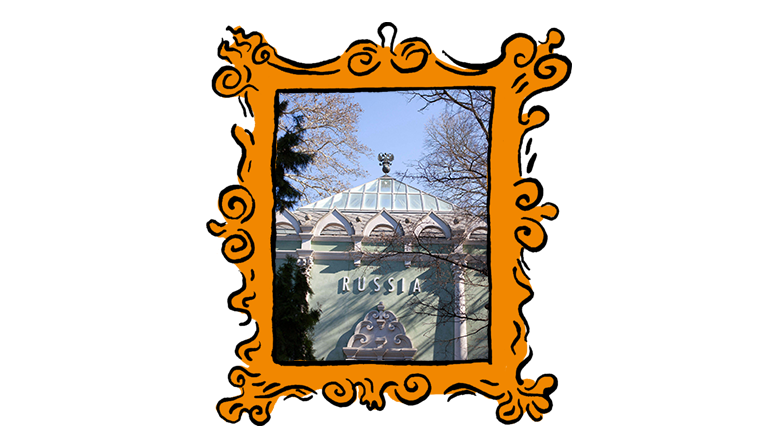
Image: Imago / Alamy