“We all need a little bit of imagination—reading or looking at art—to take us away from the harsh reality of everyday life,” says the art dealer Sadie Coles, as she takes me on a tour of her Savile Row gallery. In contrast to the white-cube aesthetic of Coles’s other two London spaces, here the interiors are bedecked with Persian carpets and floor-to-ceiling curtains that, in a more domestic setting, might encourage a cosy day on the sofa with a good book. Which is appropriate enough for Coles’s current exhibition, Lord Arthur Savile’s Crime, inspired by the page-turner of the same name published by Oscar Wilde in 1887.
Dripping with Wildean wit, the novella tells the story of its eponymous aristocrat, who, reeling from a fortune-teller’s prediction that he will commit an unspecified future murder, decides to do the decent thing and actively kill someone as soon as possible, ahead of his marriage to his beloved Sybil—lest it spoil their wedded bliss.
The painter Maggi Hambling had recommended the rollicking story to Coles last year after visiting the new gallery space, which is housed in the former Burlington Fine Arts Club—the very kind of 19th-century establishment where Wilde and his characters would once have socialised.
As well as connecting with the history of the Mayfair townhouse, Lord Arthur Savile’s Crime offered, in Coles’s view, some contemporary creative inspiration. “I thought it would be a good thing for visual artists to respond to, as Wilde as a writer is so descriptive, with a close attention to detail that is very loaded,” she explains. “His work is also about performative human behaviour, which is so relevant today.”
She sent around 50 artists a copy of the book, asking whether they would like to contribute a work in response. The results include some literal takes on the story and its author, such as Cecily Brown’s painting of Lady Windermere’s salon, where the opening drama takes place (palmistry included), and a digital video by TJ Wilcox celebrating Wilde’s use of a green carnation as a symbol of homosexual identity. Other pieces are more tangential, spinning off in unexpected directions from the written work’s details or atmosphere.
Fiction, of course, has been a central subject of western visual art for centuries. In Amsterdam, you can currently visit the Rijksmuseum’s exhibition Metamorphoses, as a reminder of how Ovid’s compendium of Greek and Roman myths shaped the work of European greats such as Titian, Caravaggio and Rubens. In Britain we have seen interpretations of Shakespeare, Milton and Dante in the work of William Blake and the highly popular Pre-Raphaelites. But while 21st-century artists have responded to literature on occasion (for example, Anselm Kiefer’s paintings inspired by Finnegans Wake, and Paula Rego’s Jane Eyre lithographs), the last few decades of avant-garde art have been more readily framed by theory than fiction—making the Sadie Coles show something of an outlier. Today’s artists and curators may like reading fiction as much as anyone, but if the contemporary art scene has been stereotyped as po-faced, earnest and inaccessible, it is arguably because of its paucity of storytelling.
However, there are signs—like the Sadie Coles show—that this is beginning to change. A show earlier this year at the Fitzrovia Chapel responded to another novella, this time about the London of the 1980s rather than the 1880s: Michael Bracewell’s Souvenir, a dreamlike text published in 2021 that revisits post-punk subcultures across the city.
Curated by the chapel’s artists-in-residence, filmmakers Iain Forsyth and Jane Pollard, the exhibition included packed tables where visitors could explore books, magazines and other objects (such as a Walkman, typewriter and toys) evocative of the novella. Arranged by artist and designer Sal Pittman, these tableaux were described in the curators’ catalogue essay as “abstracted, theatrical vignettes that enable visitors to sit inside the text”. Last autumn, a group exhibition at London’s Michael Werner Gallery dedicated to the Dominican-born novelist Jean Rhys—best known for Wide Sargasso Sea, a postcolonial response to Jane Eyre—gained widespread acclaim. It was curated by the Pulitzer Prize-winning critic and New Yorker staff writer Hilton Als, who had overseen a New York show on Toni Morrison in 2022. (The Bluest Eye by the American novelist was, coincidentally, the inspiration for the city’s Whitney Biennial later that year.)
If galleries are looking to attract a wider public, then works of fiction offer a compelling conduit: open vessels enabling artists to respond in idiosyncratic ways, while allowing a “way in” for art-world outsiders. “People who visit the exhibition seem to respond very well to a narrative structure that they can discover,” Coles says. “Giving people an entry place helps with younger audiences especially, and people who are not necessarily used to connecting with the art market.”
Human beings have been wired to tell and hear stories since our days as nomads gathering around fires. Today “storytelling” is a buzzword, whether it’s about business branding or politicians’ connection with the public. Visual artists can smell a gimmick a mile off; the quality of their responses to Lord Arthur Savile’s Crime indicates their sincere engagement. By embracing the worlds of fiction and narrative, the art world can reclaim storytelling from the grasp of content marketers and populist MPs, exploring with more integrity and nuance how it functions for society, culture and the human condition. As Oscar Wilde himself proclaimed: “I cannot think otherwise than in stories.”
Art’s new connection with story
Galleries are putting on more shows built around works of fiction. Why?
February 26, 2026
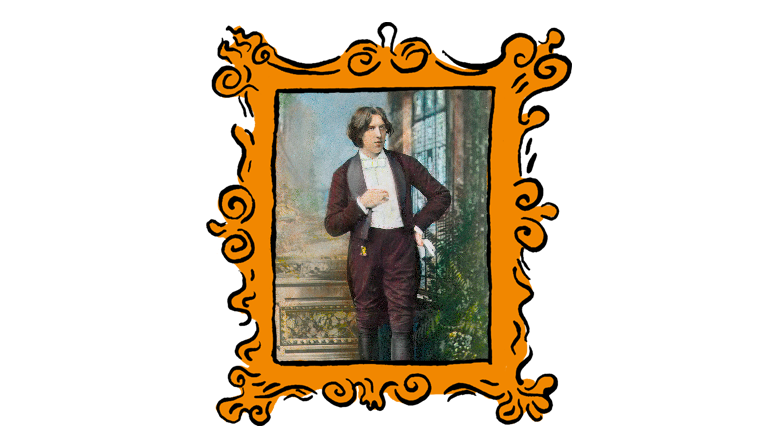
Oscar Wilde in 1882. Oil over a photograph by Napoleon Sarony. Image: Alamy / The Granger Collection