In 1604, the painter Karel van Mander called it the “Bible for artists”; Ovid’s Metamorphoses, an epic retelling of the mythical contortions and tussles between mortals and the gods, has proven endlessly inspiring for centuries. It is to this 2,000-year lineage that the Rijksmuseum in Amsterdam is paying tribute in its newest exhibition, in collaboration with the Borghese in Rome.
Logistically, this is an impressive show: among those featured are such renowned but eclectic artists as Caravaggio, Titian, Tintoretto, Magritte, Noguchi, Louise Bourgeois and more; in all, there are 80 works from 50 museums across Europe and the US, including the National Gallery, the Met and the Louvre. The very realisation of this collaboration perhaps speaks to the persuasiveness of the curators’ argument: that Ovid’s work is not only influential but intrinsic to the western canon. Given the range the show promises, it’s hard not to agree.
Despite this, what’s quickly apparent is how the content of Ovid’s work—never mind what it represents—brings unique curatorial challenges. Fundamentally, the Metamorphoses is a work about change: from the human to the animal, from the ethereal to the material. Yet how do you pick up on the constants across a body of disparate works if, by definition, what you’re trying to capture is that which is not constant?
In the oldest works, the links to Ovid need no explanation. In one section dedicated to the story of Arachne, turned into a spider on losing a weaving contest to the god Minerva, we find Luca Giordano’s evocative depiction from 1695. As though dropping all mortal pretences, Minerva abandons her weaving materials on the ground to lurch forward on a cloud, gilded by a tempestuous sky. Arachne raises her hands in horror—already her fingers have transformed into the sinewy tendrils of a cobweb.
Elsewhere, however, the link requires much more work. Next to Giordano’s painting are a pair of Bourgeois’s famous spider sculptures. Iconic on their own terms, but were they really made with Arachne in mind? The best the wall text offers is that Bourgeois’s mother wove tapestries like the myth’s protagonists—which is reaching, somewhat.
Indeed, the more contemporary the works—especially those by artists still alive and with a thing to say about their intent—the more apparent this reaching becomes. In Spawn (2019) by Juul Kraijer, three large screens show a woman’s face covered in snakes. The woman remains placid, even as the snakes come close to sticking their tongues in her eye. We’re stopped short of saying this is Medusa; rather, it is only its “associations” with the myth that are immediate. Of another work by Kraijer, a photograph of a swan’s neck entwined by a woman’s arm, we are told outright that this does not refer to any episode of the Metamorphoses—only that it “readily evokes” Leda and her seduction by Jupiter.
As we go through the exhibition, we realise that, for all the fantastical transformations that define the Metamorphoses, what Ovid really offers is less an observation on change than its consolation: “All things are changing; nothing dies. The spirit wanders, comes now here, now there, and occupies whatever frame it pleases.” Two works depicting Leda and the Swan are copies after Da Vinci and Michelangelo; the essence of the originals, long since lost, have prevailed through the work of admirers. Nearby is a section dedicated to Pygmalion: in a painting by Jean-Léon Gérôme from 1890, we see the artist in his studio madly embracing the sculpture he has fallen in love with, as the statue’s body turns in a gentle gradient from cold marble to flesh and blood. The western canon, too, might be best understood through this myth: a thing of our own creation, kept alive by the love of those who experience it.
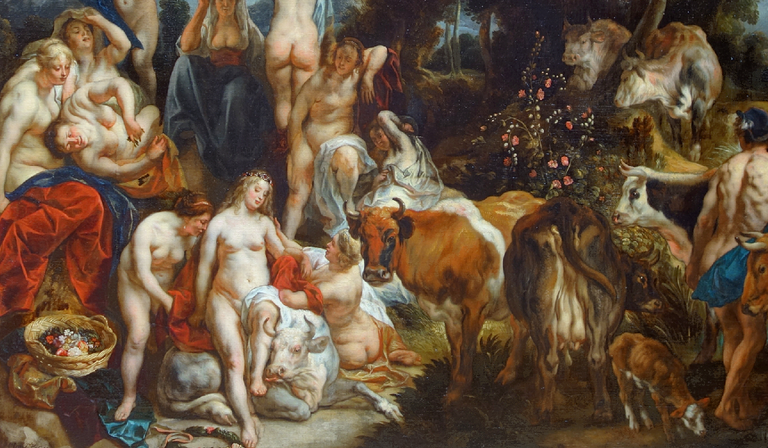
Judging by the hesitancy to connect the more recent works to the Metamorphoses, the question that arises is whether artists today are falling out of love with the canon. In Book II, Ovid recounts the tale of Jupiter disguising himself as a bull to get close to Europa, who—“little knowing on whose back she was resting”—is ridden off across the waters to Crete. In The Abduction of Europa (1643) by Jacob Jordaens, we encounter a resplendent scene right before the decisive moment. Europa, already sat unsuspectingly atop Jupiter the white bull, is being doted on by friends in a forest. Nearby Mercury is herding cattle. Behind Europa are a merry band of bathers. We know what is about to happen next, but when we look at this picture all we can think about are those friends, seemingly so integral to her life, that Europa will be forced to leave behind.
Perhaps the most haunting lesson from Ovid is that we may not be the ones to choose what remains amid the process of constant change; that nothing is permanently central to the story. Could the same now be said, increasingly, of Ovid himself?
Metamorphoses is on display at the Rijksmuseum, Amsterdam, until 25th May. It then travels to the Galleria Borghese, Rome, from 22nd June