This exhibition overwhelmed me; during three days in Florence, I visited it again and again. I had expected to see serene and beautiful images, but I had no idea of Fra Angelico’s range of both tone and subject matter. I had not imagined that a creator of jewellike miniatures could also, in his Christ as King of Kings—a close-up depiction of Christ’s suffering face—conjure up such a raw blast of agony and despair. I had not known that giant “silhouetted crosses”, well over 10 feet tall, might be endowed with the startling simplicity of 20th-century pop art. I had not thought that a single small panel might be so packed with intricate detail that I could be glimpsing new subtleties on looking at it for the seventh or eighth time.
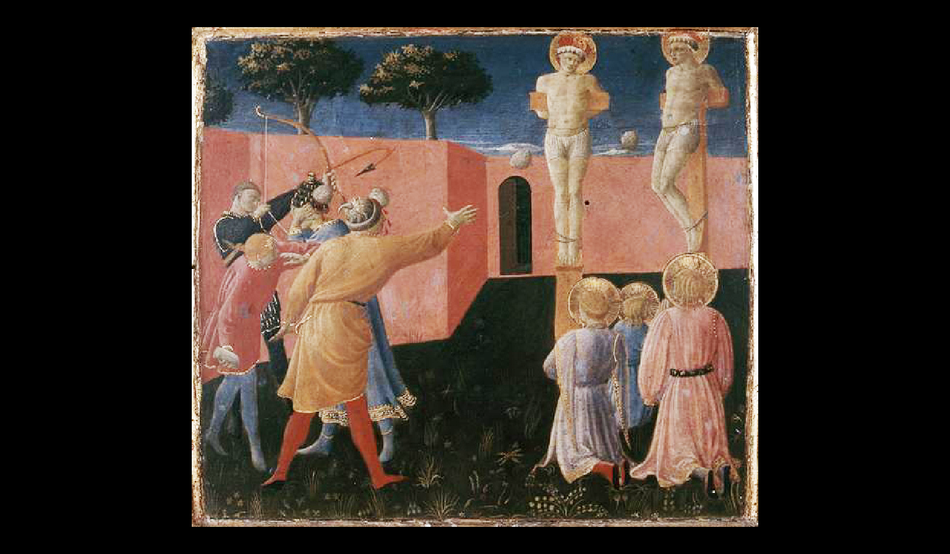
Nor did I know that in his predellas—the sequences of small paintings beneath some of his larger panels—Angelico could be such a good, humorous and straightforward storyteller. In one of several paintings devoted to the lives of Cosmas and Damian, we see the two saints strung up on crosses. Their tormentors fling stones and shoot arrows; the stones fall back on the thrower, and an arrow bends back through 180 degrees, its tip about to wound the archer. In another small painting, we see St Cosmas three times. First he is falling through the air, halo first, after being pushed off a cliff. Next, he is almost immersed in the sea, only his lower legs sticking up into the air. Last, he reemerges, upper body clear of the water, hands folded in prayer.
Though I had visited the Convent of San Marco before, I had also failed to register the austere beauty of the frescoes Angelico painted in each of the monks’ cells. All are free of ornament and most are rendered in the palest of colours. Much of their power derives from their geometry—from the simple half-circles and ovals that frame and lend weight to the central figures. Christ and John the Baptist are framed by a half-circle of the river Jordan. Rainbow-like arcs of pale colour surround Christ crowning the Virgin. The Virgin and Announcing Angel are framed by a plain vaulted ceiling similar to that of the cells themselves. Other figures are framed by half-circles of stylised rock. Here, Angelico is closer to Piero della Francesca than to the International Gothic of his earliest work.
Had I been better read, I might have been less astonished by this exhibition. Not being so unswerving a technical innovator as his contemporary Masaccio, Angelico has often been undervalued by art historians; poets and philosophers seem to have been quicker to intuit his greatness. Rilke wrote of his angels, “These faces are the many-coloured mosaic of heaven’s power, and there is no other picture of heaven that could be as great and rich and gripping.” Hegel asserted that Angelico had invented what he called “artistic interiority”. Rather than merely painting the idea of bravery, or sexual love, or some other quality, his understanding of “the indwelling meaning of facial expressions” had enabled him to “conjure these emotions in the viewer”.
A Russian friend has sent me a poem by Nikolay Gumiliov, the first husband of Anna Akhmatova and a great poet in his own right. Devout and traditionalist, Gumiliov was the first major writer to be shot by the Bolsheviks, in August 1921. After saying that Angelico means more to him than Raphael, Michelangelo and Leonardo da Vinci, he continues:
These colours, all so shimmering and clear,
Were born with him – and lost after he died.
A legend says that all the paints he used
Were blessed by bishops – sanctified.
One of the seraphim, I’ve also read,
Flew down, and took his brushes, to compete
In his celestial art, then quietly laughed
In glad awareness of defeat.
Angelico’s works are all, to some extent, collaborative. The carpenters and gilders who made the frames for his altarpieces remain anonymous. The marble frame of the huge Linaioli Tabernacle, however, was designed by Lorenzo Ghiberti, and Ghiberti may have offered at least some guidance with regard to the composition of the paintings themselves. Some of the San Marco frescoes were executed, to Angelico’s designs, by Benozzo Gozzoli, his most gifted pupil. And one of the earliest paintings in the Strozzi exhibition was begun by Lorenzo Monaco, the last great painter of the International Gothic, and completed by Angelico after Monaco’s death.
The exhibition testifies, too, to an impressive degree of diligent and devoted collaboration on the part of all involved. The 150 works included—mostly by Angelico himself, a few by his contemporaries—come from 70 different lenders in many countries; one, from a private collection, has never before been shown in public. Twenty-eight of the works have recently undergone major restoration. One of the highlights—the San Marco altarpiece (1438-43)—consists of 18 sections that have been separated since the Napoleonic wars. Seventeen of these sections have been brought together at the Palazzo Strozzi, from nine lenders. The complexity of organisation behind all this is hard to imagine. In a world so often described as fractured and polarised, such devotion to a common goal deserves to be celebrated.
Shared devotion is also central to Angelico’s subject matter. Several of the catalogue essays point out that the Dominican order, to which Angelico belonged, put more value on collective devotion than on personal mystical visions. The San Marco altarpiece exemplifies this; an excellent Wikipedia entry describes the saints and angels around the enthroned Madonna as “conversing about their shared witness of the Virgin in glory”. With this work, Angelico laid the foundations for a new genre—the Sacra Conversazione or Holy Conversation—which would flourish for at least the next 200 years.
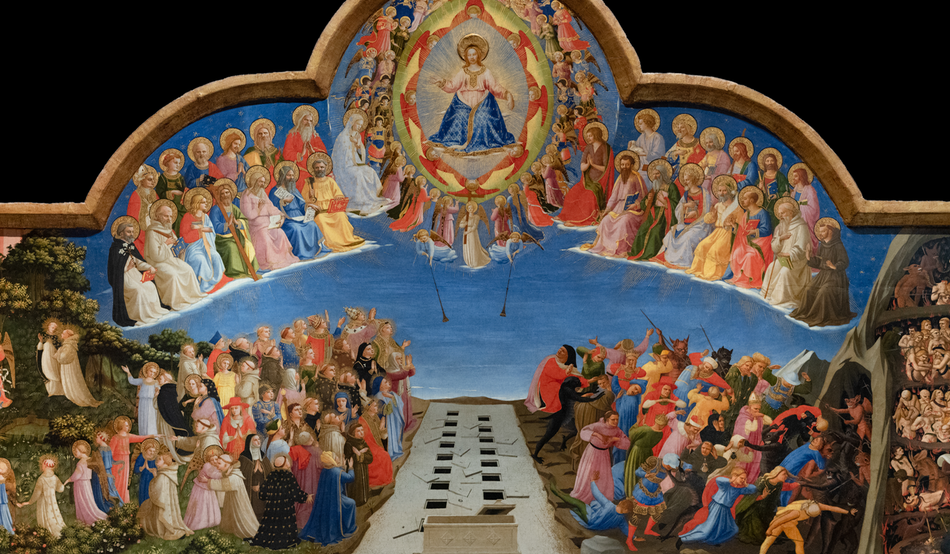
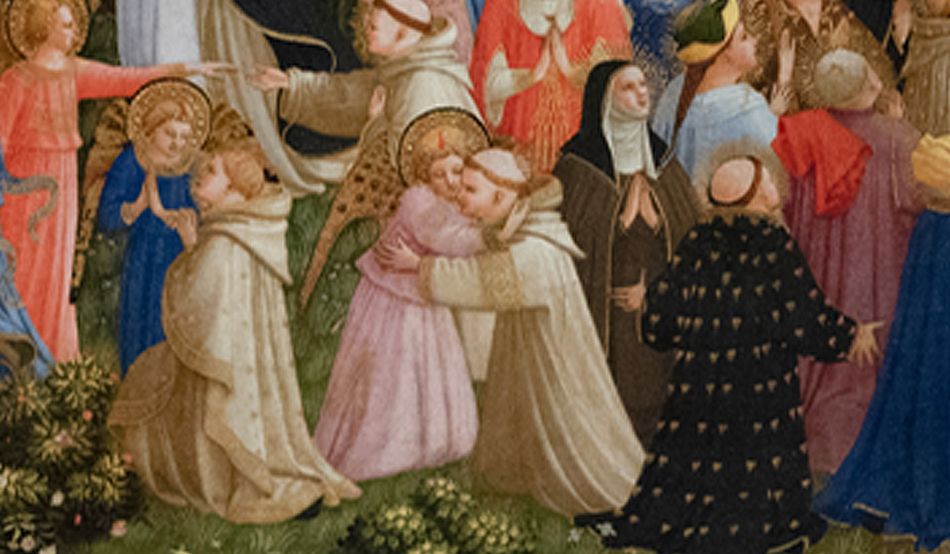
Angelico’s joyful celebration of mutuality and relationship is equally vivid in his earlier Last Judgment (1425-31). The saints and angels in the paradisical half of this painting, to God’s right hand, are all deeply engaged with one another, welcoming one another, embracing, holding hands in many different ways, sometimes just touching fingertips. Some of these meetings—especially, the depiction of an angel embracing St Dominic—are deeply moving; it may have been such scenes that prompted Hegel to write about Angelico’s “artistic interiority”.
In similar vein, the art historian Paul Hills says of the earlier Scenes from the Lives of the Desert Fathers (Thebaid) (1410): “Even though it illustrates stories of hermits who sought the solitude of the Theban desert, most of the scenes scattered across the rocky landscape actually depict the sociable exchange of fraternal greetings or one hermit coming to the aid of another. These warm encounters already reveal Angelico’s eye for the telling gesture, and the sympathy with which he imagines acts of charity as well as shared sufferings.”
In his last years, Angelico shows still greater psychological understanding. In a sequence of small paintings for the large wooden cabinet known as the Silver Chest, he tells the story of the life of Jesus. An early scene depicts the flight into Egypt. Mary walks ahead, absorbed in her child; Joseph walks behind, leading the donkey and carrying a staff, a bucket and a water pouch. Joseph looks resolute and manly, a practical fellow gritting his teeth to do what has to be done; there is no sense of any closeness between him and Mary. In a later scene, however, Joseph is transformed. Christ is in the temple, impressing the learned doctors; Mary and Joseph look on, clasping each other’s hands. The look on Joseph’s face is one of quiet wonder. What is happening lies beyond his understanding, but he is able to share his love and wonder with his wife.
Some of the San Marco frescoes depict complex scenes; many are simple. The image repeated most often is of St Dominic adoring Christ on the cross. The aim, of course, was to encourage monks to follow St Dominic’s example; the images were, in the words of the critic Martin Holman, “a pathway for prayer”. Holman continues, “Thus, each cell seems to have two openings: one through a window to the physical world and another giving onto the spiritual dimension.”
The poet Julia Nemirovskaya wrote to me in a somewhat similar tone, “The frescoes were not addressing me—they were waiting for me. I felt an almost physical slowing down, as if the space required me to adjust my breathing to the pale yet luminous colors and their internal light. What moved me most was the way suffering is treated. In the Crucifixion, the pain is present, but held with such tenderness that it becomes bearable. Walking through the corridors felt like moving through a sequence of thoughts rather than images. It felt intimate, almost private, as if I were intruding on someone else’s prayer.”
My own understanding of the nature of prayer is hesitant, but I believe it must entail—among other things—a state of deep attentiveness. Immersion in music is one way of learning to attend more deeply; close looking at visual detail is another. Angelico’s most richly ornamented panels both teach and reward attention. It took me time to see that some horizontal gold streaks in a small tabernacle are the outlines of two long trumpets being sounded by angels flying in horizontally from each side of the painting. It took me still longer to see that a delicate arc of gold tracery is a chain linked to a censer being swung by another angel.
Angelico has an unusual gift for depicting fabrics of all kinds: a plain, white damask tablecloth, a bishop’s gorgeous vestments, sumptuous curtains and Oriental carpets. His ability to evoke transparency is still more remarkable. In the second of his Last Judgements, he conjures up two sky-blue angels against a sky of the same blue. In a small tabernacle, he depicts marble steps showing through the pale pink of an angel’s body; behind her, the surreally vivid reds, greens and yellows of the celestial marble are clear but slightly muted.
Angelico’s art is both spiritual and sensual, both otherworldly and this-worldly. The radiant Christ reaching out to the figures emerging from Limbo, in one of the most memorable frescos, is a supreme image of earthly generosity. Christ’s light shines on these people as they emerge from the dark, and he would be ready to lend a helping hand should they slip. In the words of a contemporary poet, Elizabeth Cook: “Some of Angelico’s mysticism seems to lie in his grounded, earthy lack of mysticism.”
Henry James, visiting San Marco in 1873, seems to have felt a conflict between his spontaneous response to the frescoes and his lack of Christian faith. In his Italian Hours he wrote, “I looked long. One can hardly do otherwise… You may be as little of a formal Christian as Fra Angelico was much of one. You yet feel admonished by spiritual decency to let so yearning a view of the Christian story work its utmost will on you.” James goes on to refer to Angelico’s colours as being “dissolved in tears that drop and drop, however softly, through all time”. This last image is beautiful, but its excessive eloquence is unlike James—a sign, perhaps, of his feeling troubled by his lack of literal “belief”.
The critic Cody Delistraty, after quoting James in a review of an earlier exhibition, offers a different understanding: “Nearly every Angelico artwork is gripping, and one’s devotion to the beauty and emotional power of Angelico’s works feels achingly close to a divine devotion; the barrier between religious belief and the shock of beauty is the thinnest line.” This resonates with my own experience; I never felt that my own agnosticism lessened my appreciation of Angelico. And several recent experiences make his work seem more immediate than ever.
During my three days in Florence, I met a Russian-Jewish friend, an exile living in Italy. He told me the painful story of his brother, still in Moscow, a Putin supporter who volunteered for the notoriously brutal Wagner group. In the end, this man—responsible, no doubt, for many deaths—seems to have lost his mind. Unable to help, my friend had no choice but to cut all ties with him.
I had never before met someone with a close family member who had followed such a path. Looking at the damned in the infernal half of Angelico’s two Last Judgements, I understood that there was nothing fanciful or hyperbolic about these scenes. If we make seriously wrong choices in life, we end up being tormented by demons. Such choices and resulting torments are hard to reverse; it is difficult, after losing one’s humanity, to recover it. Angelico—like Dante 100 years before him—understood this. In the second of his depictions of the Last Judgement, the faces of the damned are blurred; they have lost the individuality that marks us out as human. The faces of the blessed, by contrast, are intensely expressive, each in his or her unique manner.
There are also people, today as at all times, who have chosen the road to Calvary. In Putin’s Russia, Alexey Navalny is only one of many Russian public figures to have made this choice; Anna Politkovskaya was one of the very first and most fearless. While writing this article, I learned that a memorial plaque to her, on the wall of the building where she was assassinated nearly 20 years ago, has been smashed. The culprit, accused of “petty hooliganism”, was fined 1,000 roubles, the equivalent of 10 pounds sterling.
The plaque will no doubt be replaced—perhaps more than once—by quietly determined people like the saints in Angelico’s depictions of Christ being taken down from the cross. The work of burying the crucified, preserving their relics and writing their history is endless, though it sometimes takes on new twists. For 20 years from the mid 1990s, the historian Yury Dmitriev worked at locating mass execution sites in Soviet Karelia and, through archival research, identifying as many as possible of Stalin’s buried victims. Asked why he never took a break from this work, Dmitriev replied: “I understand the meaning of my life now and I know that I must do this… I must finish the book, people are waiting for it.” Dmitriev is now serving a 15-year sentence in a prison camp; he has been diagnosed with cancer but is receiving no treatment.
Infernal torments, crucifixions, depositions from the cross—all run their course now, as ever. If we are fortunate, angels, too, may make an appearance, however momentary.
During the last year, my wife has twice been hospitalised. She is now recovering, but on two occasions she was close to death. Those days are now hard to remember, but I shall not forget one of Elizabeth’s carers, a young Muslim woman wearing a headdress, asserting with calm certainty as I left the Intensive Care Unit late at night: “Don’t worry. She’ll be all right. She’ll be back home within a week.”
This seemed unlikely, but the young woman proved right. As well as being unfailingly alert to Elizabeth’s practical needs, she was an angel of faith. Fra Angelico can, perhaps, help us to recognise angels. No one, I believe, has portrayed them more convincingly, nor with more tenderness.
Fra Angelico at the Palazzo Strozzi, in Florence, closed on 25th January. The painter’s work can usually be seen at other museums, including the Museo di San Marco and London’s National Gallery