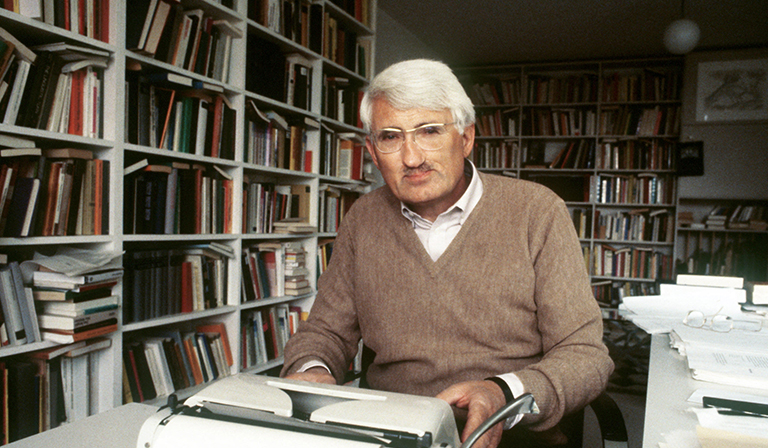
The work of Jürgen Habermas, who died at the age of 96 on 14th March, was a lengthy reminder, sadly all too necessary today, about truth and rationality in the public argument. It was also a lifelong attempt to grapple with the ideological disaster that engulfed Germany in the 1930s and which haunted Habermas all his life.
Habermas was born in Düsseldorf on 18th June 1929 into a moderately patriotic middle-class family. At the age of 10, encouraged by his father who rose to the rank of major in the Wehrmacht, he was recruited into the Hitler Youth. In the autumn of 1944, the 15-year-old Habermas received a letter calling him to the Western Front. On the night the military police came to look for him, in February 1945, he happened to be away from home. When the Allied forces arrived in Germany a few weeks later, the young Habermas was spared military service. As he came to maturity and independence, the Nuremberg trials changed both his perspective and his life: “All at once we saw that we had been living in a politically criminal system,” he later wrote. The demand to avoid the all-encompassing ideological life was the inspiration of the philosophical career upon which he then embarked.
Habermas found his first intellectual home, and his mentors, at the University of Frankfurt’s Institute for Social Research, which Theodor Adorno and Max Horkheimer had just re-established after their wartime exile in the United States. Habermas became Adorno’s assistant in 1956, but soon broke from his great predecessor. He did not share Adorno’s despair and did not believe, as his mentor did, that enlightenment values were the unwitting saboteurs of the striving for human emancipation. He believed instead in, as the title of Ernst Bloch’s monumental volume put it, The Principle of Hope. Habermas found that hope in what he called his habilitation thesis. It was an unfashionable defence of rationality in public life. Indeed, the first collection of his essays to be published in English, in 1970, was called Toward a Rational Society.
This faith in reasoned discussion as a powerful virtue in the quest to improve the human condition led Habermas to his 1981 magnum opus, The Theory of Communicative Action. Habermas set out the conditions for what he called the “ideal speech situation”, by which a community of citizens would, in an “acid bath of relentless public discourse”, subject their arguments to rigorous scrutiny and thereby elucidate any errors. It was a theory of liberal conversation that those who had come of age in 1968—by which time Habermas had been lured back to Frankfurt by Adorno—found tame to the point of naivety. Later, Habermas’s disputes with postmodernist thinkers such as Jacques Derrida would turn on the same point, which was his apparent insouciance regarding the existence of raw political power. Habermas himself would retort that it was precisely to tame this power that his work was devoted: the chorus of many voices was the only way to prevent the domination of the loudest.
The Theory of Communicative Action is a forbiddingly complex book, but Habermas was never a remote figure. He was not just a theorist of the public sphere. Instead, he was, in the manner of European public intellectuals such as Roland Barthes and Hans Magnus Enzensberger, an eager participant. He had civil but rivalrous debates in the academy with Derrida, John Rawls, Michel Foucault and Hans-Georg Gadamer. But it was when his contentious conversations spilled out into the public sphere that Habermas had the greatest effect on the conversation of his country. He had a long dispute, for example, with the historians Ernst Nolte and Klaus Hildebrand over what he regarded as the apologetic tone in their writing and their tendency, so he alleged, to detach Nazi rule from the general run of German history, as a reaction to Bolshevism. Habermas alleged that Nolte and other right-wing historians were trying to exonerate their nation from the Hitlerite catastrophe. He criticised what he saw as their attempt “to make Auschwitz unexceptional”.
This led Habermas to take up Dolf Sternberger’s idea of “constitutional patriotism”: the theory that, in modern states, the constitution can—and should—take the place of the nation as the focus of citizens’ feelings of collective identity and civic solidarity. He applied this to the German constitution but also, more and more in his latter years, to the European Union, an ideal he felt was being betrayed by its institutions. In his 2008 book Ach, Europa, Habermas argued that the dream of a united democratic Europe was being hollowed out by technocratic bodies—he was especially severe towards the Council, the Commission and the European Central Bank—which had no conception of the conversation between peoples that ought to be the ultimate source of their legitimacy. The EU, in the form Habermas envisaged, was his best hope as the bulwark against the populism that had shadowed his youth. He saw in Brexit the return of a populism he had not witnessed since his boyhood days in Düsseldorf.
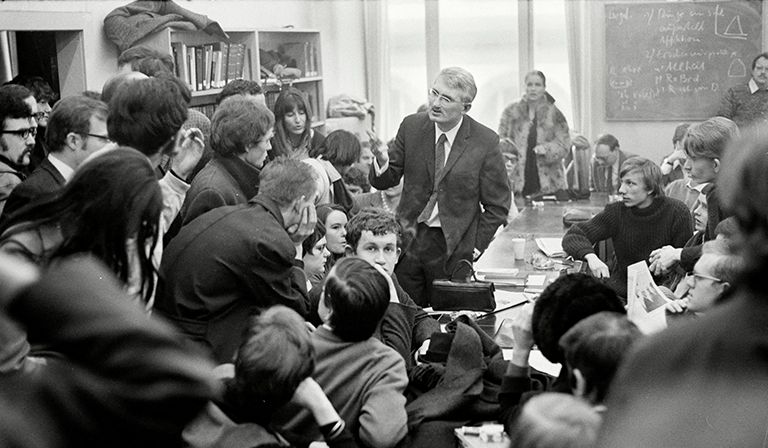
The child is never entirely the father to the man, but Habermas himself saw his career as an antidote to the bleak totalitarianism under which he had grown up. His theory of communicative action was an attempt to answer Orwell’s nightmare about state ownership of the language. His constitutional patriotism was aimed at asserting the right of the citizen against Kafka’s fear of the state that broaches no reason. Throughout it all ran his fear of the nightmare of his youth. Almost up to his final days, Habermas was engaged in public discussion. In 2023, he put his name to a statement arguing that Israel’s military retaliation to the 7th October attacks was justified and that “Jewish life and Israel’s right to exist are central elements worthy of special protection in light of the mass crimes of the Nazi era”.
The work was dense and serious, but Habermas was never like that. He was a popular colleague and had a long and happy marriage, with three children to whom he was close; and, near Munich, an idyllic house by a lake whose design took its inspiration from Alfred Loos. It was in this house that he died.
He was active and alert to the end. His final book of conversations with colleagues, Things Needed to Get Better, appeared in English last November. It was a rebuke to the depredations of our times but also a rallying cry against defeatism, the charge he often levelled at his detractors.
His intellectual critics were many and it would be wrong to deny them a point. Richard Rorty spoke for many when he said that the walls Habermas built against fascism were too flimsy. Maybe we cannot talk our way towards civility after all, but it is hard not to warm to a man who came to see his own history, and that of his country, in the light of reason, who saw in democratic conversations and rational institutions the prospect that life would never again be shattered by the unreason that sleeps in all men. Jürgen Habermas was, as his friend Thomas Nagel once said, “a figure of hope, emerging from the background of a dark history”.