“Scottishness is not some pedigree lineage. This is a mongrel tradition!”
Received with rapturous applause at a pro-devolution rally in 1992, these words, spoken by novelist William McIlvanney, came to define the cultural politics of contemporary Scotland.
More than the utterance of any politician, McIlvanney’s phrase captured the promise of a hybrid Scottish nationality that had been seeded across decades of cultural revival. Rather than a search for purity, the cause of democratic nationhood was about transcending antique ideas of ethnicity at the dawn of a new century.
The longue durée of Scotland’s diverse linguistic heritage underpins this sentiment. In the words of Pàdraig MacAoidh, the country’s first native Gaelic speaker to occupy the role of Scotland’s national poet, or makar: “Scotland is, and has always been, a polyglot nation.”
But the place of Gaelic within Scottish society has often been contested. While Gaelic was spoken throughout Scotland up to the early Middle Ages, by the 17th century the still independent Kingdom of Scotland was deploying coercive measures to assimilate a still distinct Gaelic clan-based culture.
In notable contrast to Welsh or Irish, only around 1 per cent of Scotland’s population are fluent in Gaelic; Unesco defines the language as “definitely endangered”. Scholars Conchúr Ó Giollagáin and Iain Caimbeul argue that the remaining heartland vernacular Gaelic-speaking communities in the Outer Hebrides, northeast Skye and Tiree are experiencing an advanced stage language shift to English. Globalisation, low levels of intergenerational transfer, an individualised and competitive wider culture and lower level of communal use are just some of the factors reinforcing this decline.
The young Scottish parliament passed the Gaelic Language Act in 2005, the first piece of legislation to afford the language limited public status. In 2025, this legacy was furthered by the unanimous passage of the Scottish Languages Act, establishing Gaelic as an official language of Scotland.
While the SNP have been returned to office after this month’s parliamentary elections, the ascent of Reform changes the arithmetic: for the first time, measures to support the Gaelic language could face organised political opposition at Holyrood. Indeed, Reform is now in a position to destabilise much of the broad consensus that has underpinned post-devolution Scotland.
It should be said that Holyrood’s progressive credentials are sometimes overstated: consider the acrimonious debate back in 2000 on the repeal of Section 28, which prohibited the teaching of homosexuality in schools. Even so, throughout its existence, the parliament has lacked a formal bloc advocating right-wing populist or reactionary politics.
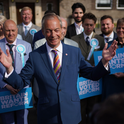
While there is an established tradition of backbench social conservatism at Holyrood, including within the SNP itself, this has generally taken the form of a faith-based conscience. We can contrast this tradition with the revelation of grossly homophobic remarks made about George Michael’s grieving partner in 2018 by Reform’s Scottish leader, Malcolm Offord, which came to light early in the election campaign.
Offord lacks Farage’s more subtle command of the politics of resentment: Farage successfully dominated much of the pre-election mood music by bemoaning the “cultural smashing” of Glasgow, citing that one in three pupils in the city speak English as a second language. Farage’s remarks invite comparison with the 1,273 children in the city receiving Gaelic Medium Education, a system where pupils are taught exclusively in Gaelic in their first three years of primary school, with English introduced at later stages. This method of teaching has become increasingly popular since the 2005 act.
There was no mention of Gaelic in Reform’s Scottish manifesto, and Farage’s description of Welsh people as “foreign speakers” in a paid-for video have heightened fears that this particular aspect of Scotland’s cultural consensus could become newly contested. It could even build upon the softer scepticism already prevalent on the right in Scotland, which casts Gaelic language legislation as cumbersome and a drain on the public purse. The Scottish Conservative party manifesto, for example, described the statutory duty placed on the national economic development agency Scottish Enterprise to create a Gaelic language plan as “unnecessary paperwork”.
Perversely, it is also precisely Gaelic’s claim to authentic indigeneity that makes it ripe for exploitation as a culture war talking point. For many anglophone Scots, Gaelic speakers are a truculent minority, demanding undue prominence, consideration and funding. In 2024, broadcaster Andrew Marr described Gaelic signage at a train station in Edinburgh as “offensive” and “ridiculous”. The basic, inclusive premise of legitimising Gaelic throughout Scotland and beyond its heartlands in the Gàidhealtachd (Highland) can be easily recast as yet another case of “wokeism”.
The struggle for a thriving Gàidhealtachd is best summed up by the motto of the radical Highland Land League that emerged in the late 19th century: An tir, an canan ’s na daoine (the land, the language and the people). The long march that resulted in a Scottish parliament was informed by a broad process of cultural awakening, with polyglot artists, pop stars, writers and intellectuals all clamouring for new forms of Scottishness that might reconcile the nation’s past divisions and contradictions.
In a newly disrupted Holyrood chamber, with a tranche of new MSPs keen to exploit ethnic, linguistic and cultural faultlines, the cultural consensus that aided the modest gains that Gaelic has made under devolution will come under unprecedented strain. But the value of a definitively polyglot Scotland could also be a key rallying point for a reassertion of mongrel traditions—and the myriad cultural threads that make up the fabric of the contemporary nation.