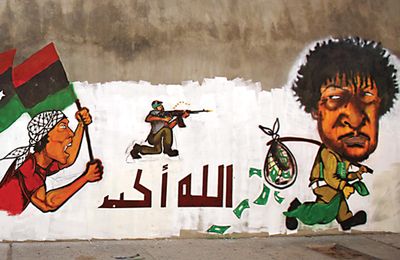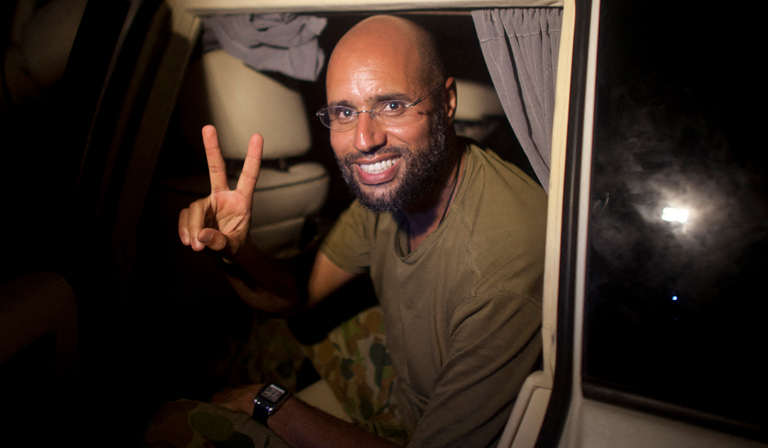
The last time most Libyans saw Saif al-Islam Gaddafi alive was in 2021. Muammar Gaddafi’s son, who for some time had been considered his heir apparent, had not been seen for years before, to the extent that some diplomats talked of the need for proof that he was alive. Perhaps as a result, many Libyans refused to believe that the man who appeared in highly stylised photographs accompanying a New York Times feature that July—his first interview in a decade—was really the late dictator’s son.
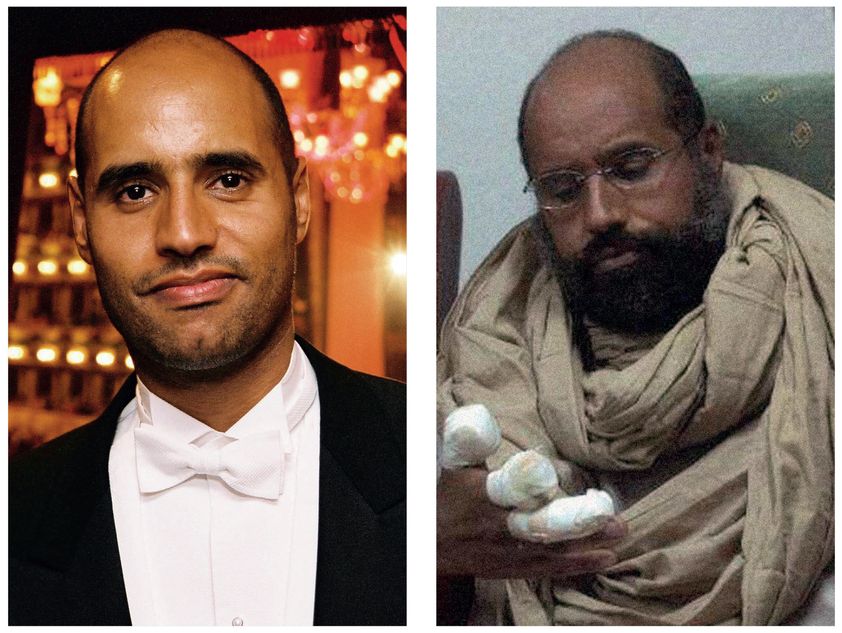
Soon after that, in November, a clip went viral of Saif al-Islam registering to stand in imminent presidential elections. There was no mistaking him in this footage, and yet Libyans were struck by his physical transformation. Saif al-Islam’s once babyfaced features were hollowed, and he had grown a greying beard. He wore a Bedouin-style mustard coloured turban and robe. He seemed keen to cultivate an image of himself as desert mystic, an effect rather undermined by his agitated manner as he brusquely signed the candidacy papers.
Those elections—which would have been Libya’s first ever presidential ballot—never took place, and Saif al-Islam is now dead, shot by masked assailants who burst into his residence in Zintan, a conservative town perched amid the Nafusa mountains, on 3rd February this year. Photographs circulating on Libyan social media appeared to show his bloodied corpse swaddled in blankets in the back of a pickup truck.
Libyan authorities have launched an investigation but few in the country believe the perpetrators will ever be found, let alone brought to justice. Everyone has a theory regarding who may have been behind the killing, and there are many who might have had reason to want Saif al-Islam dead, or at least out of the picture—from rivals within Libya’s bitterly divided politics to those who continue to nurse deep grievances over his father’s idiosyncratic and often brutal 42-year dictatorship. The details of his killing indicate it was well planned.
Saif al-Islam Gaddafi’s life was truly one of three acts—or, as one Libyan quipped to me, “three very different Saifs”. Born to his father’s second wife in 1972, he was the eldest of their seven children. His parents gave him a distinctive first name which translates as Sword of Islam. He studied architecture in Libya’s capital, Tripoli, and obtained an MBA in Vienna before undertaking a doctorate at the London School of Economics; he was awarded the PhD in 2009, though his thesis was later dogged by allegations of plagiarism. The Saif al-Islam who Libyans saw during this period was a jetsetting playboy who hung out with models and was often photographed with his pet tigers.
Returning to Libya in 2009, he sought to present himself as a suave and worldly reformer of the Jamahiriya, a neologism his father had coined to describe the state he had built after taking power following a military coup in 1969. Many inside and outside Libya were persuaded by Saif al-Islam’s talk of opening up and modernising the oil-rich country. And then came 2011.
A very different Saif al-Islam emerged as protests against his father’s regime, inspired by the peaceful ousting of autocrats in neighbouring Tunisia and Egypt, quickly evolved into an armed uprising. Just days after the first demonstrations, he delivered a chilling televised address where he wagged his finger menacingly and warned the protesters that “rivers of blood” would run through Libya. After the UN Security Council mandated a Nato-led intervention that tipped the war in favour of the rebels, Saif al-Islam swapped his designer suits for military fatigues and gave defiant speeches at rallies surrounded by gun-toting loyalists. I spent months on the ground during the uprising and repeatedly heard Libyans, the younger generation in particular, express their shock at how the man they thought would deliver a new Libya had turned against them, and so violently too. In London, Howard Davies resigned as LSE director over the institution’s links with Saif al-Islam, including a donation of £1.5m from a charity he founded that bore the family name.
Before the year was out, Saif al-Islam’s father had been killed by rebels in his hometown of Sirte and three of his brothers were dead. Saif al-Islam was captured as he tried to escape to Niger. Photographs showed him with bandaged fingers; his right thumb and forefinger were missing, an injury he claimed was inflicted during a Nato bombardment the month before. In 2021, he told the same story to New York Times journalist Robert F Worth. The rebels who seized him were from Zintan, which is around 150km southwest of Tripoli. He would spend the next 15 years there, his status evolving from detention to incrementally more relaxed forms of house arrest until, in February, the gunmen came for him.
For the Zintani militiamen holding him, Saif al-Islam was a useful bargaining chip in the turbulent power plays of post-Gaddafi Libya. “He’s the goose that lays the golden eggs,” a politician from Zintan once told me. Although he was indicted in 2011 by the International Criminal Court for crimes against humanity, the Libyans refused to hand him over and insisted instead on putting him on trial at home. The next time Libyans saw Saif al-Islam in the media, he was wearing a blue jumpsuit and sitting in a cage in Zintan as he was tried by video link. He was sentenced to death in absentia in 2015, but that was later commuted following the passing of a disputed amnesty law.
In 2014, Libya’s troubled transition descended into a civil conflict that ebbed and flowed for six years until a ceasefire between former Gaddafi-era general Khalifa Haftar and his Tripoli-based opponents. Haftar, who has done more to spoil post-Gaddafi Libya than most, wanted to install himself as the country’s military ruler. Those ambitions—which to Haftar’s critics were reminiscent of Gaddafi—were the main driver of the 2014-20 war. Throughout that time, as diplomats and policymakers struggled to find a resolution, many regularly asked if Saif al-Islam might hold the key, though the suggestion often raised eyebrows. Some Libyans questioned his psychological state after everything he had experienced since 2011. Russia, however, embraced the idea even as it was also supporting Haftar. It was an open secret that Saif al-Islam had Russian interlocutors, some of them connected to the Wagner mercenary group. Moscow-linked propaganda campaigns on Libyan social media pushed him as the saviour of a broken country. Others around Saif al-Islam sought to portray him as a quasi-messianic figure, someone who had accurately predicted in 2011 the chaos that followed his father’s fall.
Since 2021, Libya has been divided between two poles: the internationally recognised Government of National Unity (GNU) headed by prime minister Abdulhamid Dabaiba in Tripoli, and the octogenarian Haftar and his sons, whose stronghold is in eastern Libya. Both Dabaiba and Haftar wanted to run in the presidential elections scheduled for December 2021. Polling at the time showed Dabaiba and Saif al-Islam were the frontrunners; Haftar, who tried to overthrow the Tripoli government in 2019, was trailing behind. While Dabaiba’s appeal lay in his folksy populism and willingness to dispense state largesse in the form of grants—including to newly married couples—Saif al-Islam’s was more complicated. After years of civil conflict, he had become a cipher for a particular kind of nostalgia for pre-2011 Libya that was often laced with a creeping regret over what had transpired since.
Apart from the former regime’s true believers, Libyans who had supported the 2011 insurrection also considered voting for him. “I know former rebels, friends of mine, who fought against Gaddafi that year, who would have voted for Saif in 2021,” Mohammed Alnaas, a Libyan novelist in his early thirties, tells me. “That was a massive change.” Many diplomats believed that, had the presidential elections not been postponed, Gaddafi’s son would have won.
Saif al-Islam’s often surreal New York Times interview from that year did not dent his popularity. A source close to Saif al-Islam told me that his Russian interlocutors had advised him against it, arguing that his first public appearance in a decade should be with an Arab media outlet. It was a classic Saif move, one Libyan official observed. “He took the Libyan people for granted and saw no real need to engage with them. It’s the New York Times readership he wanted to impress and convince.”
Worth reported that a laughing Saif al-Islam told him: “I’ve been away from the Libyan people for 10 years… You need to come back slowly, slowly. Like a striptease. You need to play with their minds a little.”
In recent years, the so-called “Greens”—supporters of the Gaddafi regime ranging from the ideologically committed apparatchiks who formed the backbone of his system to grassroots sympathisers scattered inside and outside Libya—have become more assertive. Some have formed political parties. Haftar integrated many from Gaddafi’s feared security and intelligence services into his forces. In Tripoli, Dabaiba, whose own family was close to the regime, has appointed figures who were part of the status quo before 2011 to key positions. The UN mission in Libya brought several “Greens” into its dialogue processes in the spirit of reconciliation.
But the fractured “Greens” have never formed a cohesive current, and not everyone within it supported Saif al-Islam and his presidential ambitions. Some from Gaddafi’s old guard still believe that his tentative reform efforts sowed the seeds of the 2011 uprising. As the “Greens” gradually entered the machinery of the post-Gaddafi state, a key question was whether they would prove conciliatory or vengeful if they reached a critical mass or triumphed in elections. In 2021, I asked a contact who met Saif al-Islam some months before he registered as an electoral candidate which category Gaddafi’s erstwhile heir belonged to. “Definitely more vengeful,” he replied.
With the death of Saif al-Islam, many wonder how former regime supporters who already felt less than conciliatory towards the post-Gaddafi order might channel their grief and anger over his killing. Saif al-Islam’s lawyer claimed that Haftar’s forces would not allow his burial in Sirte, the coastal town where his father was born and died, and which they now control. Instead, he was interred in Bani Walid, another bastion of the former regime, a couple of hours drive southeast of Tripoli. Photographs of the funeral showed thousands of mourners. At the graveside, there were vows that his death would not be in vain.
Saif al-Islam’s assassination further flattens Libya’s political landscape between the House of Dabaiba and the House of Haftar. To the dismay of Libyans who still dream of elections, which were promised in 2021, the view in Washington and some European capitals is that the best chance of stability amounts to a carve-up of the country’s oil wealth between the two camps. Just days before the gunmen stormed Saif al-Islam’s home, Donald Trump’s adviser Massad Boulos convened, along with French officials, a meeting between Haftar’s son Saddam and Dabaiba’s powerful relative, Ibrahim Dabaiba, in Paris. Boulos confirmed the talks almost a week later, saying they were aimed at achieving national unity and long-term stability in line with what he described as Trump’s broader peace agenda. Boulos, who has visited Libya twice since Trump’s inauguration last year, wants US companies to tap into the nation’s vast oil reserves, calculated to be Africa’s largest.
Saif al-Islam is survived by his mother, Safia, his brothers Saadi and Hannibal (who was released last year after spending a decade in detention in Lebanon) and his sister Aisha, plus a half-brother, Muhammad, from his father’s first marriage. These remaining family members all reside outside Libya, and it is hard to imagine any of them taking Saif al-Islam’s place as a symbol of the Gaddafi era, someone around whom loyalists and nostalgics could rally. What is more likely is that, with Saif al-Islam gone, the Gaddafi name recedes further from the Libyan imagination and the “Green” networks fragment even further.
Fifty-seven years after Muammar Gaddafi came to power as a young coupist, the murder in a small mountain town of the son who dreamed of succeeding him appears to be the epilogue of the Gaddafi family’s long hold on Libya.