For years, debates about Iran have revolved around a single question: Will the regime fall? Amid intensifying protest and economic pressure, this question has regained urgency. History, however, suggests that this framing is incomplete. The more consequential question is: What happens if the regime does fall?
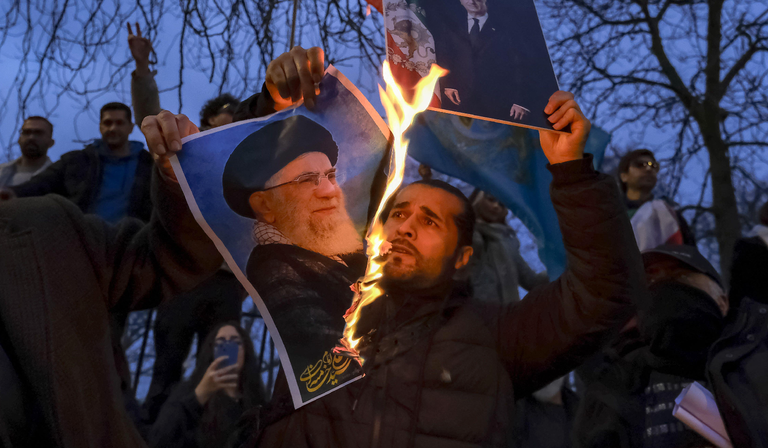
Iran’s government is organised around the supreme leader, Ayatollah Ali Khamenei, and his family, and is supported by clerics and an often brutal security apparatus (many thousands have been killed in these latest protests). This arrangement will be hard to break. The personalisation of power around Khamenei, the violence of security forces and the military, the theocratic network that legitimises state repression and a system of state-driven propaganda that conceals atrocities and spreads disinformation—all these maintain the regime.
And even if mass protest did trigger regime collapse, Iran would still have functioning ministries, entrenched bureaucracies and deeply embedded networks of power. The primary risk, therefore, is not the inevitable mayhem, but an unmanaged redistribution of power.
If the Islamic Republic does fracture, there are four possible scenarios, none of which would lead to Iran becoming a democracy overnight. The first, and most likely, is a managed transition driven by the fragmentation of the elites. The removal or incapacitation of the supreme leadership would create a power vacuum at the top, while much of the state remained intact. Security officials and political factions would splinter but avoid direct confrontation with each other. Senior bureaucrats would continue to administer the state. A temporary government would emerge through the jostling of elites, not by popular mandate. This would require restraint from all sides—a tall order given the recent violence. Officials would need safety guarantees. The protesters would need to accept they can’t govern alone. While deeply imperfect, this would at least offer a chance of ending clerical rule while preserving a functioning state.
In the second scenario, clerical authority would collapse first. Given the erosion of religious legitimacy in recent years, the security establishment may well sacrifice its clerical counterpart, including Khamenei himself, to preserve power. Coercive institutions would step in to prevent disorder. The security apparatus would present itself as the guardian of stability, national unity and territorial integrity, while distancing itself from revolutionary theology. Regime slogans would be replaced by pragmatic appeals to order. Iran would resemble post-Yeltsin Russia, where state inefficiency and myriad crises enabled the rise of Vladimir Putin.
The third and most dangerous possibility is further fragmentation. This would occur if political authority and coercive control collapsed at the same time. Rival groups in the Islamic Revolutionary Guard Corps (IRGC) —the branch of Iran’s armed forces mandated to protect the regime and export the revolution—would compete for dominance, as would political factions. Governance would stall; external actors might intervene.
Sceptics of regime change frequently invoke this scenario, but Iran is not Libya or Syria. It is a country with a longstanding bureaucracy, a strong national identity and limited societal appetite for civil war. Conflict would likely be confined to border provinces, such as Sistan and Baluchistan, which borders Afghanistan and Pakistan, or Kurdistan on the Iraqi border. Neighbouring states, including Turkey, would oppose instability, possibly via military means. Even in these circumstances, civil war is not inevitable.
The last scenario, viewed by many protesters as the most desirable, is the return of the Pahlavi dynasty. Here, the regime would collapse rapidly as protests, possibly aligned with foreign intervention, eliminated senior clerics and security and militar y commanders. Crown Prince Reza Pahlavi would return to Iran from Washington DC, where he lives, and assume power with US and Israeli backing, restoring the monarchy that was overthrown during the revolution of 1979. Some clerics would emigrate to Iraq, a centre of Shia Islam, and security personnel would flee to Russia. The bulk of the IRGC would be absorbed into the regular army.
Over the past decade, support for Pahlavi has grown. Under his rule, Iran would likely become a secular, pro-western and even pro-Israeli state, a change driven by widespread anti-religious sentiment, hostility towards Islamist governance after decades of it, and resentment of Russia and China, as well as a desire for normalisation with the west.
Iran’s demonstrations are the result of a major rupture between society and the state. Clerical rule has lost legitimacy in the eyes of many. Yet loss of legitimacy does not automatically produce political order. And now that order must be achieved amid uncertainty.
The most decisive moment may come the day after the regime crumbles. Whether that leads to negotiation, the restoration of authoritarianism or further splintering will depend less on protest slogans than on decisions made later, behind closed doors. Ignoring that day risks turning this rare opportunity for change, long fought and yearned for, into an even greater tragedy.