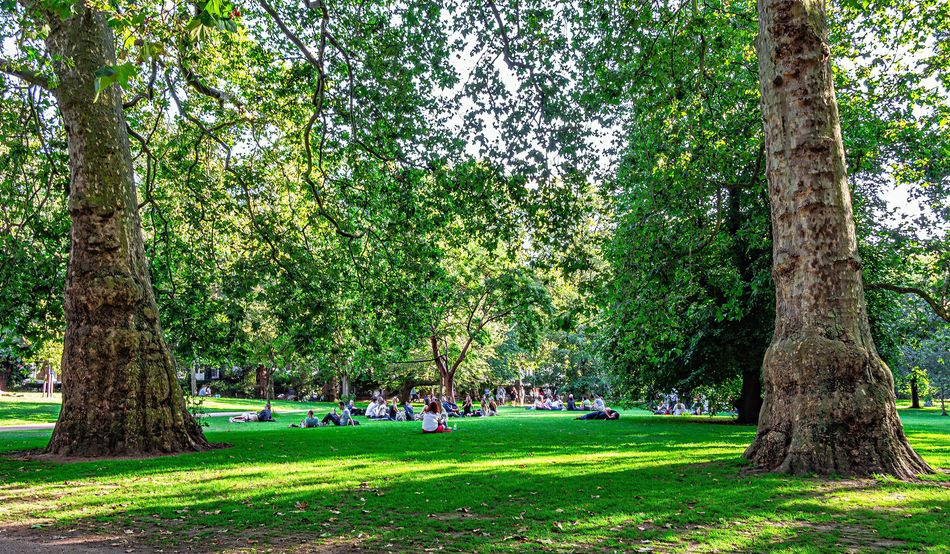
London has many ways of reminding you that you have been there before: the warm metallic fug of the Underground, the plane trees, beautiful and hostile, shedding their irritant fluff across the parks, the weather performing three seasons before lunch. After years away I found, with the usual shock of return, that the city was both completely familiar and no longer mine.
That doubleness followed me all week. I was there to speak about a book that returns to my father’s death; I am about to return to America, my home country, after nearly 25 years away. Return had become more than a feature of my itinerary. It had become pressure, problem, obsession.
Our politics are drenched in it, too. Return to sovereignty, tradition, the way things were. “Make America Great Again” remains the crudest version of this promise, but it is hardly the only one. Brexit, too, drew much of its force from the dream of a country restored to itself. The future, once the natural home of political hope, now looks to many like a threat. The past has become seductive again.
Progressives are often impatient with this longing. I am impatient with much of it myself. As a philosopher, I defend the Enlightenment: the idea that human beings need not submit to the dead hand of the past, that inherited authority must answer to reason, that institutions should justify themselves to persons understood as free and equal. Kant’s famous injunction, sapere aude—dare to know—asks us to break free from blind tradition. Politically, too, I am progressive. I believe we must criticise unjust institutions and try to make better ones. We have a duty to try.
These commitments go naturally together. Progressives think the future can be made anew in the present. Reactionaries think the past, and its inherited wisdom, should rule. And so, progress tends to align with critique, emancipation and hope; regress with attachment, reverence and loss. One trusts the new; the other seeks strength and safety in what has been.
But loss, insecurity, confidence and hope are all primordial human experiences, as well as formidable social forces. There is no adjudicating between them once and for all. This is what my own season of return has forced me to consider. The question is not whether we should go back. We all do, both individually and collectively. The question is how, and for what.
Going back in time is, of course, impossible. The dead do not rise; old cities do not wait unchanged for our arrival. Still, we return in memory, art, ritual, politics, and dreams. We revisit what we have lost or fled or failed to understand. We try to see what might yet be recovered, and what is gone forever. We go back not only because the past might have been good or better, but because it is unfinished. And we need to understand it if we are to find our way forward.
In literature and myth, the future is often blocked because some debt to the past remains unpaid: the dead unhonoured, the crime unconfessed, the family secret buried. The ghost of Hamlet’s father haunts not because the past has some mystical power, but because the living have not yet learned to live truthfully with who and what they are.
Politics is not so different. The past is not dead matter lying inert behind us. It is active, contested, volatile. Milan Kundera wrote that “the struggle of man against power is the struggle of memory against forgetting.” But there is also a struggle over what the past was, to whom it belongs, what it demands, excuses, glorifies or condemns. People fight bitterly over the past because they know the present and future depend upon it.
This is why regressive nostalgia is so dangerous. It turns history’s disorder into a usable picture: wholeness before fragmentation, greatness before decline, innocence before corruption. Reactionary politics returns not to know the past but to idealise it: as a weapon against the present, a veto over the future.
But there is also a form of return that is generative rather than regressive. It does not try to restore the past, still less submit to it. It goes back to see what was missed, misunderstood, buried or owed. Its driving force is loyalty to truth.
Perhaps this is what our politics now gets so wrong. We are offered two bad choices: a reactionary return to an imagined wholeness, or a thin progressivism that treats attachment to history as shameful, unenlightened. But human beings need continuity as well as change. Repetition can be deadening, but it can also sustain meaning: songs sung again, stories retold, graves visited, promises renewed.
The danger lies not in return itself, but in returning falsely. We can search for innocence, or for truth. We can make the past an idol, or make it answerable to the future.
I came home from London with no simple faith in either progress or nostalgia. But I did bring back a thought that felt like hope: that going back need not mean going backwards.