The Trump administration has offered little justification for its war in Iran. What it has offered instead is a tone.
“No stupid rules of engagement,” defence secretary Pete Hegseth crowed. “No nation-building quagmire, no democracy-building exercise.” The war, he boasted, would rain “death and destruction from the sky all day long”. If you find this chest-thumping nihilism alarming, the message seems to be: that’s your problem. We do this because we can.
Few believe the United States faced an imminent threat from Iran. Yet the response from many American allies has been strikingly muted. Most stopped well short of condemning the war. Canada and Australia signalled early support; Germany was cautious but broadly sympathetic.
What is going on? Of course, in the short term smaller powers must manage relations with a volatile US president. But when they respond to an evidently unjustifiable war with timidity or half-endorsement, they blur the moral picture for everyone else, and two confusions take hold.
The first rationalisation goes like this: Iran’s regime is brutal. It crushes dissent, persecutes women and funds violent proxies across the region. That such a government might be weakened—or even overthrown—is surely a worthy goal. And so a troubling thought arises: perhaps the war is illegal, but morally justified all the same?
This flawed argument is as seductive as it is dangerous. International law places strict limits on when states may wage war: in self-defence against armed attack or with authorisation from the UN Security Council. These constraints were not meant to eliminate every injustice, but to prevent the cycles of aggressive war that produced the disasters of the 20th century.
Even when fought legally, war is among the gravest of moral evils. It shatters societies and traumatises generations. Legal restraint cannot make war righteous, but it can help ensure that war is waged only under the most exceptional conditions.
If these limits become optional whenever a cause seems morally compelling, they soon become optional for everyone. Every state believes its enemies wicked. History is full of wars launched in the name of justice that delivered little more than devastation. The Iranian regime’s brutality does not weaken the case for waging wars legally. If anything, it strengthens it.
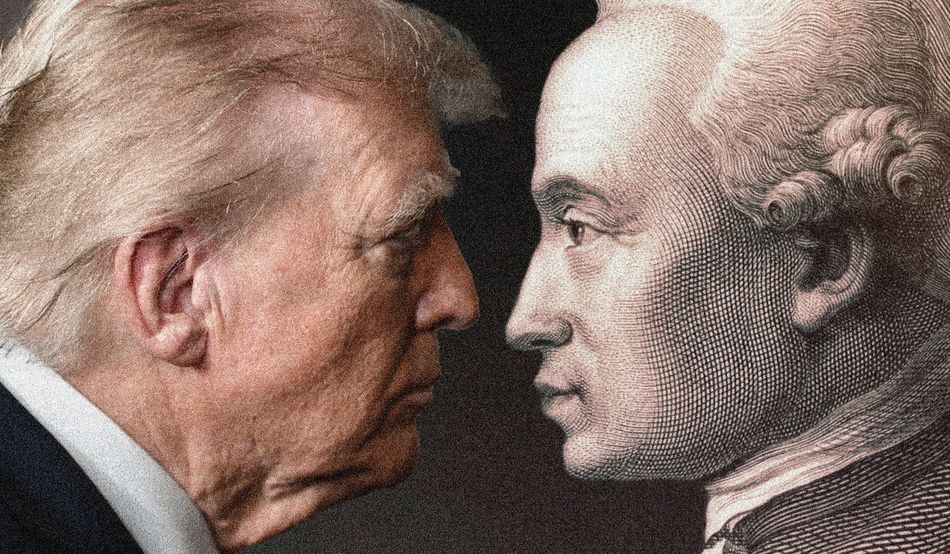
The second confusion is darker and pushes toward moral despair. When power is exercised ruthlessly, moral argument begins to feel quaint and out of place—as though one were quoting Kant at a bar fight. How do you apply ethical frameworks to leaders who openly reject them, who treat war as spectacle and legality as optional? Many suspect you can’t.
But this rests on the mistaken assumption that moral norms bind us only if we recognise them—that someone who rejects morality’s authority somehow places themselves beyond it.
Immanuel Kant, perhaps the most formidable moral philosopher of the modern era, would have found this idea absurd. Moral obligations do not depend on our endorsement. Their authority is objective. Refusing to acknowledge a moral constraint no more exempts one from it than disbelief in gravity allows one to float.
If morality did work that way, tyrants would have the easiest escape: they could declare themselves unbound by ethical limits and the rest of us would be obliged to agree. In truth, the opposite is the case. Refusing to recognise moral limits does not weaken them; it merely reveals the depth of the violation.
Why, then, does the temptation to abandon moral language arise so quickly in moments like these? Part of the answer is psychological. Moral outrage is exhausting. Recognising the gap between what is happening and what ought to happen requires sustained emotional and intellectual effort—and a tolerance for moral pain. One way to escape that burden is simply to abandon the standard itself.
This move often presents itself as realism. We are told morality belongs to a different realm from power politics—that applying it to cynical leaders is naive. “You can talk all you want about international niceties and everything else,” Trump’s deputy chief of staff Stephen Miller told CNN. “But we live in a world… that is governed by strength, that is governed by force, that is governed by power.”
Yet the history of political progress suggests the opposite. From the abolition of slavery to the development of human rights law, societies have worked to clarify and impose moral constraint in the face of the most brutal abuses of power. Just war theory—the tradition that underpins modern international law—emerged from this same impulse: the insistence that even the most violent activity is subject to ethical limits.
The alternative is surrender. When we say that morality does not apply to certain actors, we are not describing the world as it is. We are helping to create the world they want: one in which power alone determines what is permissible.
Trump and his allies appear to understand this perfectly. Their rhetoric revels in the rejection of constraint—no rules, no deliberation, no justification. War becomes a brute assertion of will, a televised display of dominance. The point is not merely to win but to demonstrate that no limits apply. The real danger, however, is that the rest of us begin to accept this premise.
Morality does not vanish when leaders ignore it. What vanishes, too often, is our willingness to insist upon it. And history offers little comfort about what happens next.