Fassbinder, Herzog, Wenders: from the 1960s onwards, Germany produced countless top-tier filmmakers. The most towering figure, though, was undoubtedly Alexander Kluge, who died this March at the age of 94. Little known outside his own country—“I would love to be accepted by an audience on the other side of the Atlantic,” he told an American interviewer in 2012—he was not only a director, but a film theorist, educator, behind-the-scenes advocate. A philosopher, too. “The invention of film, of the cinema, is only an industrial answer to the film that has its basis in the film in people’s minds,” he once argued. “The stream of associations that is the basis of thinking and feeling… this stream of associations has all the qualities of cinema.”
In 1945, barely a teenager, he witnessed the Allied destruction of his hometown Halberstadt. He studied law and church music, and later worked closely with famed social theorist Theodor Adorno, who believed cinema was not so much an art form as it was a cultural lobotomisation. Nonetheless, a stint assisting Fritz Lang on one of his last films, The Tiger of Eschnapur (1959), proved life-changing; Kluge, dismayed at how shoddily the Metropolis director was treated by his producer and various financial hangers-on, vowed to develop more independent ways of making films.
In the early 1960s, German cinema was in a sorry state. Many working in it had been Nazis. They happily churned out nostalgic, dumbly pastoral “Heimat” films that skirted any engagement with the society evolving around them. Kluge joined 25 other filmmakers in signing up to the 1962 “Oberhausen Manifesto”, which, partly inspired by the Nouvelle Vague, called for more experimentation and élan, and concluded with a patricidal declaration: “Der alte Film is tot. Wir glauben an den neuen.” (“The old film is dead. We believe in the new.”) That same year, Kluge and co-signer Edgar Reitz set up the Film Department at the Ulm School of Design, where they incubated generations of young auteurs.
Kluge’s own films from this decade are still electrifying. Brutality in Stone, a 1960 short made with Peter Schamoni, is an anatomy of fascist architecture, casting a clinical eye at the grounds of the Nuremberg Party Congress (where Leni Riefenstahl’s 1935 Triumph of the Will was shot). Other directors might have denounced the swooping steps, the neoclassical pillars and columns, buildings that were meant to be German and eternal; Kluge’s gaze is both more austere and ambiguous. He includes sketches of unfinished structures, samples Hitler Youth choirs. Is stone a tape that can record the violence of the past?
‘Brutality in Stone’ is an anatomy of fascist architecture
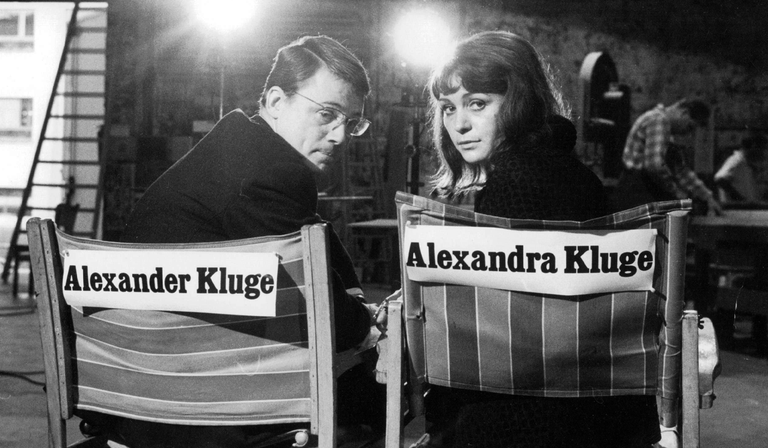
Yesterday Girl (1966) tracks Anita G (played by Kluge’s sister Alexandra), a young Jewish woman who moves from East to West Germany to start a new life for herself. She takes on jobs, steals, gets pregnant by a government official, wanders around with a suitcase, ends up in prison. So sad, so trad. But Kluge doesn’t ask us to pity or “feel” for her. He withholds key details about characters’ relationships and includes intertitles such as, “Truth is killed when it really appears”. The result is part-Brecht, part-Godard: a supremely jarring diagnosis of the alienation of arrival.
Kluge had a longstanding interest in science fiction and one of his most enjoyable, if least-known, films is The Big Mess (1969), a larky antidote to the solemnity of Kubrick’s 2001: A Space Odyssey. Set in the 2030s, it depicts a war in the Kruger 60 star system: the Suez Canal Company has colonised most planets and created a mobile underclass—smugglers, married scrap merchants, hippies—to pick up the pieces. Its visuals are a cross between the underwater films of George Méliès and a psychedelic happening the young Pink Floyd might have soundtracked.
Kluge never stopped working. He co-authored with Oskar Negt an enormous book about the public sphere. In 1987, he set up DCTP, a company that, in its battle against “the industrialization of consciousness”, succeeded in persuading German private broadcasters to give significant airtime to independent and avant-garde programming. He produced image-rich publications and essayistic films—on technology, history, militarism, speculative finance—that were dense, demanding, infinitely rewarding.
What to see? Germany in Autumn (1978) is a riveting portmanteau film (other contributors include Fassbinder and Reitz) that reflects on the legacies of both Nazi and Baader-Meinhof Group terror. News from Ideological Antiquity (2008)—over nine hours long!—revisits Sergei Eisenstein’s plan to film Marx’s Capital. Never not curious, his last feature, Primitive Diversity (2025), explores the impacts of artificial intelligence on our sense of history. Never a pessimist, he was looking, he said, for “every anti-algorithm that can bring the algorithmic world into a state of equilibrium”.