The opening gallery is small but fiercely splendid—as you would expect of a show about Spain’s golden age. An outsized St Peter upside-down on the cross, blood running down towards his ankles. A crucified Christ, torso heaving as the life ebbs from him.
Perhaps most affecting is the last of the three pictures in the room, a portrait of a monk who was born in Britain and who spent his life recovering Christians enslaved in conflicts with Muslims around the Mediterranean. His eyes are closed and his outstretched arms bound to two posts. There is a delicate sense of wonder about his clerical robes, their folds dramatically lit, just as there is an earthly humanity about the wrists that are all puffy and swollen from torture. The painting would have hung in a mortuary chapel where dead monks were prepared for burial, a reminder to all of what was truly important in life.
Francisco de Zurbarán was born in 1598 to a family of prosperous fabric traders in the sparsely populated region of Extremadura. At 15, he travelled to Seville, a vibrant port, grown rich on its ties with Spain’s colonies in the Americas. There he learned painting, carving and gilding. Along with his friend and fellow painter Diego Velazquez and, a generation later, Bartolomé Esteban Murillo, Zurbarán was known for his religious works.
The Catholic church believed that looking at painting encouraged devotion. Churches, cathedrals, convents and monasteries commissioned works to demonstrate how these were the natural institutional intermediaries between man and God.
Zurbarán served them well, building a sizeable studio with assistants and apprentices who occasionally helped fill in paintings that were destined to less discerning buyers, especially in South America. As an artist, he also expanded the idea of what painting can do. He painted figures that seem almost sculptural; his crucifixions are so three-dimensional you feel you can walk behind them. He transformed the painting of fabric, especially of white drapery, so it became an object of beauty in its own right. And he placed the great Christian subjects—Jesus, Mary, Mary Magdalene—in domestic interiors that felt both dreamlike and, at the same time, deeply human.
The exhibition brings together an array of grand works: portraits of senior clerics in sumptuous brocades and wide-brimmed red hats, scenes of evangelists and intercessors, of saints both male and female, and a recreation of a massive altarpiece that, like many of Zurbarán’s commissions, was always meant to be looked at in awe from below. Made for the Monastery of Jerez de la Frontera in 1636, it was later looted and broken up.
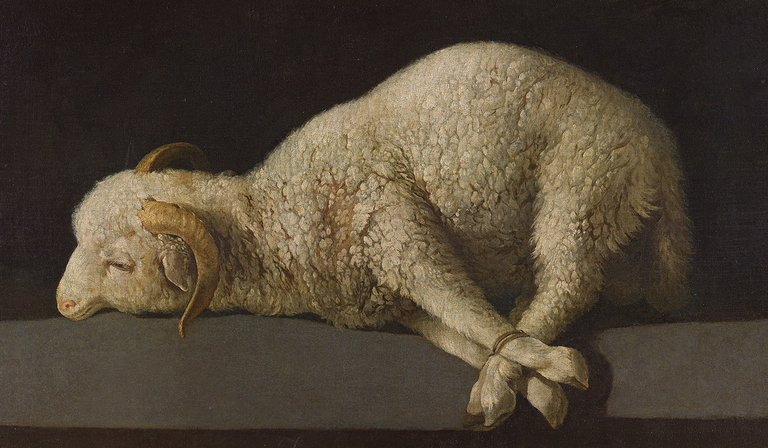
See the lamb with its legs tied together, its coat so woolly you can almost sink your fingers into it
But it is the simpler works that are the most touching, particularly the lamb with its legs tied together, the “Agnus Dei”, its coat so woolly you can almost sink your fingers into it, and the portraits of Saint Francis of Assisi barefoot and wearing a patched brown robe with a cord belt with three knots symbolising the vows of poverty, chastity and obedience.
As simple as these monochrome paintings are Zurbarán’s gloriously delicate still lives: the painting of lemons, oranges and a rose from the Norton Simon Museum in California and the National Gallery’s own little painting of a cup of water and a flower.
In an age of screens and social media, nothing beats seeing paintings in the flesh, how they shimmer and breathe. That we are able to do so is thanks mostly to the generosity of the museums that have lent works—particularly the Louvre and the Art Institute of Chicago—and a number of private collectors. Vital, too, to the show is the long relationship between Gabriele Finaldi, director of the National Gallery, and the Prado in Madrid, where he worked for over a decade in the early 2000s, curating several exhibitions on the Spanish Baroque. Some of the works on display from the Prado have never travelled before.
Two of the works, from a series on Jacob and his 12 sons, come from Auckland Castle in County Durham. They were acquired by Bishop Trevor in 1753 for his grand new dining room in recognition of his support for the Jewish Naturalisation Act that gave Jews in Britain the same rights as Christians. At a time of rising antisemitism in Britain, the curators missed a trick in not explaining the historical importance of these paintings, which have long been considered symbols of religious tolerance.
Don’t be put off by that omission or by what may seem to be excessive religiosity in this show. Come to learn about an artist who is rarely seen in Britain; stay for the sheer joy of looking at what he did with paint.
Zurbarán is at the National Gallery until 23rd August