This year marks the centenary of the birth of Marilyn Monroe. She was born on 1st June, a couple of months after Elizabeth II, and within a few weeks of David Attenborough and Mel Brooks, both of whom are still with us. But, of course, Monroe is fixed as a figure of the mid-20th century.
She is also fixed as a victim. One standard history of the movie business says that she “was never in charge”. And because of her early (most likely accidental) death, hindsight makes her film career look as though it was always going to end in tragedy. The Monroe story is one that many people feel they already know: a morality tale from our parents’ and grandparents’ times.
But 70 years ago, things looked very different. In 1956, Monroe was very much in charge, having taken on and defeated one of the great Hollywood studios. According to Time magazine, she “had brought to its knees mighty Twentieth Century Fox”. In a campaign that began in 1953, Monroe forced the studio not only to abandon holding her to an unfavourable contract—but also to offer her, on 31st December 1955, the most lucrative and advantageous terms imaginable.
Far from the popular image of her as shallow and lightweight, Monroe was a highly intelligent participant in the movie business, with a solid grasp of how to use leverage in negotiations and an understanding of the economics of her trade.
Sometimes, when a newly popular actor or musician seeks to renegotiate their contractual terms, there is a sense that a balance needs to be struck. The studio or the label invested in them, took a chance on them before they were famous, so, when a star occasionally emerges, that star should not be too demanding. They can seek better terms, but not too much better.
Monroe’s case was different. It was with the help of her friend and champion, the Hollywood agent Johnny Hyde—and not any studio—that she had landed small but stunning roles in two of the greatest films of the time, The Asphalt Jungle and All About Eve (both 1950). A seven-year contract with Twentieth Century Fox followed a year later, indicative of the studio’s eagerness to have Monroe on the books, but its financial terms—originally $500 a week, rising to $1,500 by 1953—also suggested that she wasn’t regarded as a potential leading lady.
She was then given a succession of films that are now only remembered—frankly—because Monroe was in them. The roles were largely stereotypical and light. Her growing popularity also owed less to the studio publicists than to her own efforts. She was becoming one of the most famous new actors in Hollywood by her own promotional work.
Monroe was ambitious. She wanted to do dramatic as well as straightforward roles, and her turns as a psychopathic nanny in Don’t Bother to Knock (1952) and as a murderer in Niagara (1953) indicated that she may well have become one of cinema’s great antiheroes.
With the 1953 duo of Gentlemen Prefer Blondes and How to Marry a Millionaire, Monroe showed she could also play a certain type of comic role—the endearing, gold-digging bombshell—well. But she wanted to put in other types of performance and have more control over how she was directed and filmed. Yet when she said that she wanted to play Grushenka in an adaptation of The Brothers Karamazov, she was ridiculed.
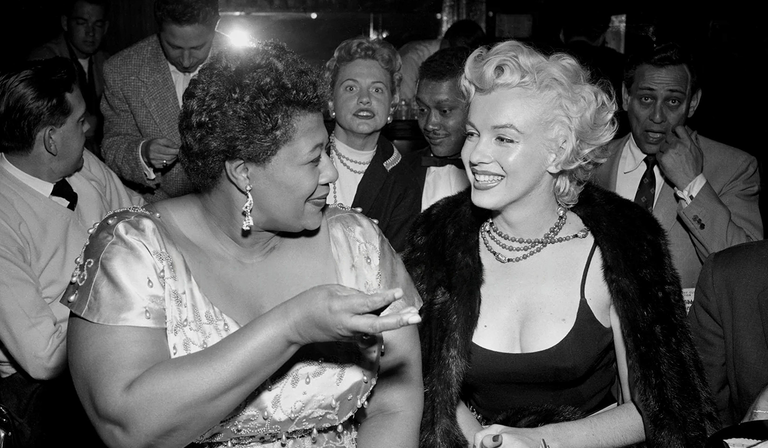
Monroe secured Ella Fitzgerald a booking by promising the reluctant nightclub owner that she would sit in the front seats every night
By the mid-1950s, Monroe was becoming more aware of how to negotiate. It was 1955 when, famously, she secured Ella Fitzgerald a booking by promising the reluctant nightclub owner that she, Monroe, would sit in the front seats every night. She also listened carefully to how her then husband, the baseball legend Joe DiMaggio, had leveraged his own value in his contractual dealings.
So when Twentieth Century Fox insisted, after Gentlemen Prefer Blondes, on still holding her to the $1,500-a-week terms of her current contract, just as she was becoming the most bankable star of the time, she knew this was unacceptable. For that successful and well-received film, Jane Russell had received $200,000, and Monroe just $18,000. When the studio told Monroe that her next film was going to be called The Girl in Pink Tights, she decided she had had enough.
In coming to this decision, Monroe was not dominated by her agents and lawyers. Indeed, she would discard such advisers if they did not accord with her wishes. Following DiMaggio’s thinking, she realised that she had a trump card: Twentieth Century Fox required more Monroe films in production. They needed her, and she knew it.
A helpful lawyer came up with a legal basis for her Fox contract not being enforceable: it seemed the studio had not renewed it at the appropriate time. The studio denied this, but—perhaps tellingly—they did not litigate the point. Monroe was even careful to return any cheques, lest she be caught out affirming the now-disputed contract. She knew how to outfox Fox’s lawyers.
The studio, for its part, was incredulous. How dare a contracted actor behave in such a way? Didn’t Monroe realise they had made her the star? And she was asking for directorial approval?! Never had they heard of such a thing.
The dispute dragged on, but Monroe stood firm and, by the end of 1955, the studio capitulated. She would get $100,000 for each picture. She could work for other studios as she wished. She would only be required to make four films for Twentieth Century Fox over seven years. She could approve the director on each film. It was an unprecedented deal, and an extraordinary climbdown by a major Hollywood power.
The newspapers declared: “Battle with studio won by Marilyn.” Monroe moved quickly to form a moviemaking vehicle called Marilyn Monroe Productions, which would soon co-produce a film in which she would star opposite Laurence Olivier. She could now pick and choose her roles and her directors—both at Twentieth Century Fox and elsewhere. She was in charge of her own career.
It is at this point, however, that the story changes direction. With the exception of 1959’s Some Like it Hot, none of her post-1955 films are comparable to those she made before achieving commercial and artistic freedom. She was not to fulfil the quota of four films for Twentieth Century Fox. The years after 1955 seem generally to be ones of drift.
The formidable version of Monroe that prevailed in her negotiations with Twentieth Century Fox may well have returned
Yet still, by any view, her death in 1962 was not inevitable. Other stars had long periods of downtime. The formidable version of Monroe that prevailed in her negotiations with Twentieth Century Fox, as well as in her more brilliant film roles, may well have returned.
Of course, there were external factors that put Twentieth Century Fox in a weak negotiating position at the time. The challenge of television meant that studios were in a new environment and needed star power to get people back to the picturehouses. And payment-per-film was a sensible option for a star who very much knew their own mind, so the new contract suited the studio too.
Which is to say, Monroe did not break the studio system. In terms of legal significance, what she did was less important than, say, Olivia de Havilland’s landmark 1943 case against how the studios treated actors under the terms of their contracts.
But what Monroe achieved should not be understated either. She knew her value and insisted that there be a more commercially balanced agreement to acknowledge it, eventually forcing the other side to accept.
That Monroe was not able to take full advantage of her triumph is another matter—though there is every chance that her artistic lull would have ended, had she lived on. The story that ought to be told on her 100th anniversary is that she was not always a victim of the Hollywood system.
Marilyn Monroe: Self Made Star opens at BFI Southbank on 1st June and runs until 31st July. The Misfits is rereleased in UK and Irish cinemas on 5th June. The National Portrait Gallery’s exhibition Marilyn Monroe: A Portrait runs from 4th June to 6th September