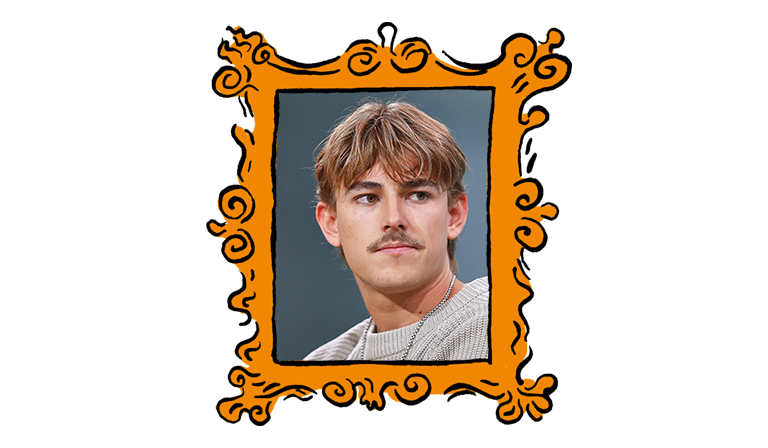
Nelio Biedermann is the hottest young author since Zadie Smith. Biedermann, a Swiss of aristocratic Hungarian descent, started writing Lázár when he was 16, and handed it to the publishers when he was 21. The novel, which narrates the decline of the von Lázár family during the first half of the 20th century, was the best-selling book in Germany for over half a year. The New York Times described it as “audacious, sweeping, sensational”, and the Guardian called it “captivating” and “vivid”. Die Zeit, with a nod to Thomas Mann, proclaimed Biedermann “The new magician”.
Steady, now. There are certainly similarities, particularly with Mann’s Buddenbrooks, but it’s rather premature to say that Biedermann belongs, or even will belong, to the literary pantheon. Lázár is a very enjoyable novel, but its quality can be uneven.
The first thing to note about Biedermann is his style. His voice is grand and sometimes mythic—but rooted in realism. He contrasts rolling prose with succinct sentences and one-sentence paragraphs. Symbolism abounds. There are dreams, ravens and the eerie forest within the family estate. On the front cover is an image of a white stallion, a central figure in Hungarian mythology.
Lázár is accessible and fast-paced even though it is mostly exposition, with little dialogue. Biedermann prioritises scene, motif and description. He is highly specific, especially when it comes to nature. Linden, cherry, chestnut, plane, pear, birch—if journalists are taught to always get the name of the dog, Biedermann always gets the name of the tree.
The novel, set mainly in Hungary, is a multigenerational saga that describes the fortunes of the eponymous family from the twilight of the Habsburg Empire to the 1956 Uprising, via the Nazi and Soviet occupations. Biedermann focuses on three generations of Lázár men—Sándor, Lajos and Pista—who are each nostalgic; whether for the monarchy, their manor house or the old ways. To keep the novel going at a good clip, he keeps characterisation to a minimum, and develops it mainly through narrative perspective:
“Everything had to sink, submerge, drown so that he [Lajos] could finally be free, his own person at last, unattached, without the noble title on his finger, the history on his back and the chain of ancestors around his neck.”
The Lázárs are interesting not because they have particular quirks or ideas, but because their lives are touched by tumult. Paradoxically, Bierdermann’s minor characters are not only more sympathetic, but more vibrant. The most memorable is the family’s chaplain, a Proust-reading Benedictine who “spoke so often about Marcel – he always used the writer’s first name – that one might think he were a close friend or even a lover”.
It is the narrator, however, who is the novel’s star character. Even though Biedermann’s writing is prone to cliché, his narrator soon becomes an old friend telling us a good yarn:
“Mr Telkes had contradicted his wife on only one occasion: fifteen years earlier when he had said he was not ready to become a father. ‘Yes, you are,’ Mrs Telkes had said, and when he shook his head she had walked off in her fur coat – and nothing else – and rung the doorbell of his best friend.”
The narrator can also do agony, and Lázár’s subject matter—which includes self-harm, the Holocaust and the secret police—gets darker as it progresses. When the Russians invade Hungary, there is an excruciating scene with a Red Army officer and a group of female refugees.
However, despite Biedermann’s frequent excellence, he is inconsistent. For instance, he provides redundant and inelegant explanations. When we learn that Sándor always reads the previous day’s newspaper, we don’t need to be told: “And thus the world he learned about always belonged to the past.”
The narrator’s straightforward lexicon can also turn hackneyed (“her words were a blow to the gut” and “her optimism and humour were infectious”). Biedermann has a penchant for 19th-century-style exclamation marks, and they’re almost always preceded by weaker sentences like: “But she did not love him for the money!” One paragraph even begins with “And so it came to pass…”.
Although Biedermann’s legato prose is usually beautiful, sometimes the author or his editors should have toned it down. A perfect example is the (almost) virtuoso first sentence:
“The snow of the dying century still lay on the edge of the dark forest when Lajos von Lázár, the translucent child with water-blue eyes, first glimpsed the man he would believe to be his father for his whole life and beyond.”
It’s a sentence full of promise and subtle symbolism (note the chiaroscuro, how the snow and the child contrast with the darkness of the forest), but its elegant rhythm is undone by the final six words. Cut them, and you’ve got a hell of an opening.
What’s frustrating is that Lázár’s shortcomings are easily fixed. The New Statesman, citing Virginia Woolf’s advice, suggested that Biedermann should have waited and published Lázár when he was 30. The novel would surely have been more refined, and yet I wonder whether it might also have lost some of its whimsy and folksy charm. Most contemporary literary fiction is immaculately written but can’t match Lázár for vitality.
A good novel, and perhaps even a great one, can include deficiencies. Zadie Smith, who began White Teeth while she was at Cambridge, acknowledges the story’s imperfections—its scattered treatises and its bagginess. It has sold over 6m copies. Similarly, Lázár often fails to meet the top standards of literary fiction. Moreover, it is written with great vigour and comfortably passes the most important test of all: enjoyment.