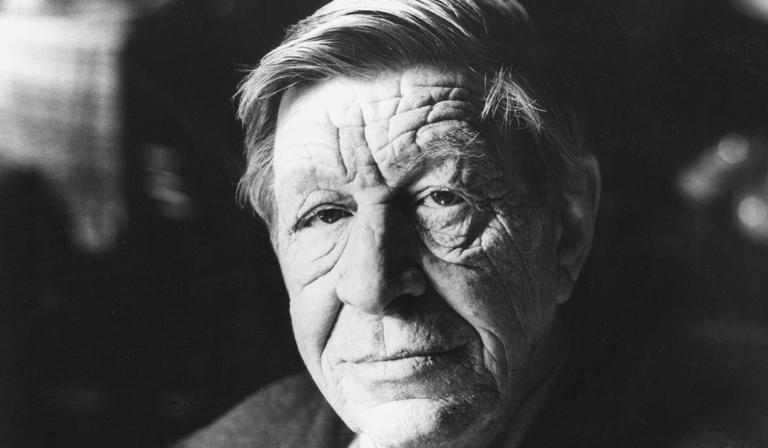
For all his highly cultivated eccentricities, there is a strong case to be made that, as much as any individual, Wystan (“to rhyme with Tristan”) Hugh Auden was the 20th century, or the 66 years of it in which he lived (1907–73). That, in his habits and the course of his life, he embodied his time.
Consider his addictions and passions: the dry martinis; the pill-popping; the cigarettes (15,000 a year by one contemporary’s reckoning, ); the Freudianism and therapy speak; the sexual freedoms (long before Larkin’s epochal 1963); right down to his love of crosswords and detective novels. In an airless, still-industrial era of gaslight, coal and pea-soupers, he had a strange childhood passion for mines and industrial workings, as well as the northern English landscapes that housed them. He travelled widely and saw much, from prewar Berlin and China to civil war Spain to Iceland, and called Oxford, New York, Ischia and Austria home. In the American century, he even went to the trouble of becoming a US citizen.
The affinity is clearest in the arc of his career, from leader of the 1930s generation of left-leaning poets—inheritors of the modernist cause that also included his sometime collaborator Louis MacNeice, as well as Cecil Day-Lewis and Stephen Spender—to a questing, doubting mid-century American-Anglican, and then, at his end, a prematurely aged don and slightly better class of Telegraph-reading reactionary, turning rightwards just as the United States and Britain began to do the same.
In Peter Ackroyd, Auden has an estimable biographer whose own career stands comparison with the poet’s for industry and commitment to his art. But while Ackroyd’s career shows steadfast continuities and a famed attachment to the great city of his birth—inspirer of his famous historical work, London: The Biography, and the best of his fiction (Hawksmoor, Dan Leno and the Limehouse Golem)—his account of Auden’s life is of one that was far more unsettled and footloose than its subject wished it to be.
As Ackroyd notes, Auden is a slippery subject, given to provocative sweeping statements and “genuinely didactic by nature”, in the words of Spender. “It would be unwise to be too tidy about Auden’s allegiances,” Ackroyd writes, “He was often seduced by a good line or an interesting image; sometimes he gets lost in a conceit, or misled by a rhyme. His opinions were often provisional, and might alter with the last interesting book he read.” Ideas were consumed at great volume and speed as fodder for the muse. He absorbed, assimilated—and moved on.
Regardless, Ackroyd gamely tries to pin his man down with some characteristically punchy declarations of his own. For instance: “he had faith in God because he had faith in grammar.” Or: “poets are particularly susceptible to belief in the occult because of the obscure origin and nature of their gift.” But while these statements do not ring hollow, and are evidenced (Auden really did believe in witch doctors), neither do they wholly ring true. There is always another Auden on the way. You can chuck any number of countervailing adjectives at him—slovenly, orderly, chaotic, punctual, bossy, awkward, lonely, gregarious, warm, chilly—and they all work as well as the next.
This makes it difficult to produce a seamless shortish life, and one senses the struggle throughout in making anything stick. At one moment, Ackroyd is telling us: “[Auden] was in general amiable and funny… a sympathetic host. In most circumstances, good company.” Thirty pages later—after he has Dorothy Farnan, the author of Auden in Love, an account of his lifelong companionship with Chester Kallman, describe being introduced to the poet: “he did not smile, but nodded and grunted… he made no effort to put me at ease,”—Ackroyd asserts, “This was a fair description of Auden’s manner in the world.”
One can’t help but feel these disjunctions. After all, Ackroyd is a writer dauntless enough to have ventriloquised Oscar Wilde (The Last Testament of Oscar Wilde) and inserted into his Dickens biography imaginary dialogues with his subject. He wrote a life of TS Eliot—Auden’s publisher at Faber and a great mentor and supporter—without permission to quote Eliot’s poetry. Perhaps a mature writer has no need to draw attention to himself; but perhaps also he has found a subject too unwieldy to cast any sort of net over in 400 pages.
It may be unsurprising that Auden saw the world in terms of opposites, declaring that “man’s nature is dual” and that “all the striving of life is a striving to transcend duality, and establish unity or freedom”. He also “suggested that poetry was a means of healing the divided self”. In his long poem “The Double Man”, he wrote:
To set in order — that’s the task
Both Eros and Apollo ask
For Art and Life agree in this
That each intends a synthesis
Fortunately, Auden was always around astute people who couldn’t help but record their impressions of him. The snapshots Ackroyd has assembled from across the ages give us a much better, if ineffable, sense of his character. Here he is as a precocious schoolboy staying with a friend, provoking the father with his “sham arrogance” and one morning declaring, “Mrs Carrit, my tea is like tepid piss.” Or later as a young teacher at the Downs school “striding about in a large black Flemish hat, waving an umbrella”. Or tearing round New York, the “tails of his old raincoat flying in the wind like wings… saying ‘you must learn to walk faster’ or ‘hurry up, Dorothy, don’t be such a slowpoke’”. Or in Ischia, “swinging a soiled string bag crammed with books and the day’s shopping”.
Ackroyd shows that, as well as a born poet, Auden was a born teacher—work which sustained him for much of his career. The poet and critic Richard Howard recalled a New York performance of Eliot’s The Cocktail Party, when one of the characters quotes from Prometheus Unbound:
Wystan Auden was sitting maybe six rows in front of us, and he turned around to the whole of the mezzanine and he said, ‘Shelley, my dears!’ He really sort of felt that he was still at Gresham’s school and he was telling us things that we ought to know.
He was an exacting tutor, as well as a creative and fun one. As Ackroyd writes, “He assumed an almost impossibly clever and well-read student”—in other words, himself. Imagine how the hearts of students at Michigan must have sunk at the following task: “Write a debate between JS Mill, T Huxley, Matthew Arnold, Carlyle and Cardinal Newman as to the meaning of [the following] parable.” He seemed to think that the only worthwhile education was the kind he had received. After the first Poetry International festival in 1971, he lamented that “there were some poets, notably [Pablo] Neruda, who obviously never were at a British Public School.”
This biography makes the case for revisiting all his work and not just the fragments that have endured in popular culture, such as “Funeral Blues” or “Night Mail”—which has had an unlikely afterlife on TikTok after featuring in the video game Roblox. This includes the long poems such as The Sea and the Mirror and The Age of Anxiety, and the “strange and uneven” verse dramas he created with Christopher Isherwood, such as The Ascent of F6 and The Dog Beneath the Skin. The latter gave voice to a highly stylised tendency in Auden that later found a more natural home in the opera librettos he wrote with Kallman. Their Rake’s Progress, a collaboration with Stravinsky (who described Auden as “the dirtiest man I ever liked”), endures today.
Throughout Auden’s career, Ackroyd writes, “metre was his line of beauty”: he knew everything there was to know about verse and could command every form going, from the limerick to the epic. Ackroyd has not enough space here to properly showcase Auden’s formal mastery; a few selections, however well chosen, do not allow Prospero to cast his spell. Instead, we have bursts of virtuosity, such as the following few lines from his Horae Canonicae:
The dripping mill-wheel is again turning;
Among the leaves the small birds sing:
In solitude, for company
It would have been helpful to have had more on his family, not least because Ackroyd shows that Auden was a product of his class—Edwardian upper-middle, high-achieving, hardworking and with an imperial missionary’s zeal and confidence of their place at the head of the world. These are traits he inherited, for all his personal anxiety and self doubt. He would also resume the Anglican faith of his youth, when he was known for bashing out hymns on any piano he chanced upon.
Auden also spent most of his life creating ersatz family structures and appeared to long for the kind of stability that perhaps only comes with deep conventionality. In the Brooklyn household he shared with Kallman and a rotating cast of, among others, the burlesque artiste Gypsy Rose Lee, Benjamin Britten and his partner Peter Pears, and Carson McCullers, Auden hired servants, would preside at head of table and collect payment for bills.
He saw his relationship with Kallman, a comparatively worldly and sexually voracious Brooklynite, as a true marriage, and was hurt immeasurably at Kallman’s constant infidelities and absences. For half the year they would be apart—Auden in the teeth of a New York winter trying to earn money, Kallman staying in Ischia or Athens. Yet their relationship endured and their bond was deep and real. The house they shared in Kirchstetten, around 50 miles from Vienna, later in their lives seems to have given Auden the closest thing to the domestic stability he wished for.
Auden more often lived, however, in a filthy mess that later descended into outright squalor. The book contains some lovely, happy pictures of him as a young or youngish man—setting off for China with Isherwood, or with Kallman in Venice. Which makes the image of the aged Auden alone in an ash-heap of a flat in Berlin even sadder: he looks like something awful out of Beckett or Pinter—the abandoned tenant of a windy junkyard. One wishes some grand public school had taken him in long before his old Oxford college, Christ Church, did in 1972.
Auden argued that living carelessly was necessary to focus on his work, but it may also have been a form of self-abasement, a punishment for failing to be a good son to his mother Constance, the dominant figure in his early life. He felt his homosexuality was a sin and, at times, tried to overcome it; he was briefly engaged as a young man; had affairs with women and proposed to a good many, including most pitifully, at the end, Hannah Arendt. (He also married Erika Mann, sister of Thomas, to help her escape Nazi Germany.)
One of his regular sayings was that “art is small beer”, but his life says otherwise: that he took his gift seriously and strived to extract the most he could from it. In his poem on the death of WB Yeats, he wrote: “poetry makes nothing happen: it survives / In the valley of its making where executives / Would never want to tamper.” In these lines is no disavowal of art’s significance, but a deep, ultimately morally serious belief in its inherent value—that it should stand alone and not be judged in the light of its creator.
Yeats once wrote that “Swift haunts me, he is always just around the next corner”: in Dublin, he heard constant echoes of the formidable dean of St Patrick’s. And one leaves this biography likewise haunted by Auden’s voice. He, too, is always round the next corner, holding forth in some common room or dive bar, chatting bossily away, ash spilling onto his blazer. We cannot easily define him, but nor can we escape him. For all the seeming impossibility of the task it has set itself, this book succeeds as a portrait—turns round and tells the entire mezzanine, “This is Auden, my dears!”