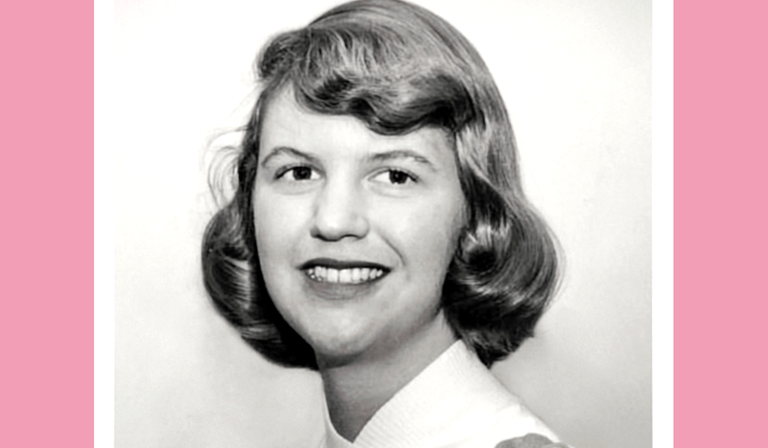
Imagine being able to read the poems of Sylvia Plath without knowing how she died. It’s a near-impossible thought experiment, given how her name and image have been reduced to what her daughter, the poet Frieda Hughes, called the “Sylvia Suicide Doll”. And not only in popular culture: her peers among the “confessional” poets in the United States of the 1950s collaborated in the myth of Plath as a poet writing unstoppably towards death, in tributes that clumsily claimed acquaintance. Robert Lowell, for example, who briefly taught and barely remembered her, introduced her superb posthumous collection Ariel (1965) with crude bravado: “these poems are playing Russian roulette with six cartridges in the cylinder.” Anne Sexton, meanwhile, a fellow student in Lowell’s class, wrote a chaotic elegy called “Sylvia’s Death”, which accused Plath of having taken “our boy”: “the death I wanted so badly”.
The contrast between Sexton’s lament, which bangs the gong of “I” and “me” eight times, and Plath’s own final lyrics is revealing. In the first week of February 1963—the last full week of her life—she wrote six immaculate and heartbreaking poems, in which the first-person singular makes a sparing four appearances. Plath, in other words, was not a “me, me, me” poet, even when composing in a state of mind that she described—in her last letter to her former therapist—as “on the edge of madness” and “very narcissistic”. Read the poems away from the letters, the journals and the blurbs, and the page clears to reveal jewel-like perception and virtuoso music.
It is this Plath that a new scholarly edition of her poems seriously and convincingly serves. “For decades,” write editors Amanda Golden and Karen V Kukil, “Plath has taught readers to love poetry”—a refreshingly simple and true claim about her continuing appeal. This was just as Plath hoped: poems, she said in 1961, “go surprisingly far—among strangers, around the world, even […] if they are very lucky, farther than a lifetime”. The editors quote these words in the conclusion to their introduction, which does not dwell on the end of that lifetime. In fact, her death is dealt with in a single sentence, unrelated to any judgement on the poems: “On the morning of 11 February 1963, Plath died from carbon monoxide poisoning.”
The Poems of Sylvia Plath tells the story of her writing life rather than her overwritten death. And it does so in the most unarguable way possible: through the thoroughness of its methods and materials. For more than four decades, readers have had to rely on the Pulitzer prizewinning Collected Poems (1981), edited by Plath’s husband, Ted Hughes. This gave the world her oeuvre from 1956 onwards (when she met Hughes, as a student at Cambridge), with an appended selection of 50 earlier poems classified as “juvenilia”. Golden and Kukil push the beginning of Plath’s poetic maturity back to 1953 (when she was 20), so that the main body of the book showcases a full decade of relentless development. Then, at the end, they add another 15 years of “Early Poems”. The resulting total of 542 poems almost doubles Hughes’s 274.
Vast as this expansion is, there is no new verse to rival the fame of “Daddy” or “Lady Lazarus”, the two late poems in which Plath gave voice most directly to her personal history of paternal bereavement, mental breakdown and attempted suicide. The new material here all predates Ariel, and charts her prolific formative years, filling in the blanks left by Hughes.
The year 1953 begins with a bang: three poems all written over 48 hours in the same demanding rhyming form, the villanelle, which Plath was trying for the first time. Villanelles repeat the same two alternating lines across three-line stanzas, in a kind of obsessively spiralling argument (if you have ever read Dylan Thomas’s “Do Not Go Gentle into That Good Night”, you will know how a villanelle goes). “God’s monkey wrench has blasted all machines” is not the greatest line Plath ever wrote—depending on your taste, it might even be one of the worst. But, as an image of apocalypse fixed in perfect iambic pentameter, it slides smooth as a piston into a villanelle called “Doomsday”.
The revealing new inclusion here is “Mad Girl’s Love Song”—apparently unknown to Hughes, but noticed, amazingly, by a young critic called Helen Vendler, who was Plath’s contemporary and a family friend. In 1954, Vendler wrote to Plath’s mother, calling “Mad Girl’s Love Song” “the only decent villanelle in the English language besides Dylan Thomas’s ‘Do Not Go Gentle into That Good Night’”. Vendler would go on to become a revered Harvard professor and tastemaker of 20th-century American poetry thanks to such authoritative pronouncements. Here, though, she is trying such rhetoric loosely on for size, and somehow overlooking the fact that WH Auden—who taught Plath at Smith College—had written several more-than-decent villanelles, which were clearly an influential example.
What is remarkable about “Mad Girl’s Love Song” is how closely it lands to the pitch-perfect union of verbal bravura and heartfelt directness that rings through Plath’s best poems (“crammed speech and music at once”, she called it). “The stars go waltzing out in blue and red / And arbitrary blackness gallops in: / I shut my eyes and all the world drops dead” is, in retrospect, a less subtle draft of these lines from the mournful title poem of her first collection, The Colossus (1960): “Counting the red stars and those of plum-colour. / The sun rises under the pillar of your tongue. / My hours are married to shadow.”
A pitch-perfect union of verbal bravura and heartfelt directness rings through Plath’s best poems
Having turned out these Swiss-watch verses with inspired swiftness, Plath lost no time in seeking readers, calling her new poems—as she often would—“the best I have written yet”. The editors’ notes reveal that Harper’s Magazine accepted two of the three villanelles, after initial rejection from the New Yorker. Such determination and self-belief is another foreshadowing of the Plath to come. “Daddy” and “Lady Lazarus” would be rejected by both the New Yorker and the New Statesman; undaunted, she sent them out again, to Stephen Spender’s magazine Encounter, which published them after her death.
Posthumous publication gave some of Plath’s most haunting lines a darkly prophetic resonance: “Dying / Is an art, like everything else. / I do it exceptionally well”; “Daddy, Daddy, you bastard, I’m through.” There is no reason, though, to think that she was being disingenuous when—in a set of introductory notes written for a BBC radio broadcast—she characterised her poems as having a “speaker” distinct from herself; framing them, that is, as dramatic monologues. “Lady Lazarus”, for example, “is a woman who has the great and terrible gift of being reborn. The only trouble is, she has to die first. [...] She is also just a good, plain, very resourceful woman.” With such comments, Plath pointedly warned radio listeners not to confuse her with the characters she was performing.
The Sylvia Plath Suicide Doll glues the dramatic mask to the human face. But accounts of her last days suggest it might have been otherwise. Plath’s desire to survive her depression seems to have been undermined by many things, including the side effects of medication; the coldest London winter of the century; and the struggle of caring for two small children after Hughes left her for another woman. If this “very resourceful woman” had somehow come through “reborn”, with the support she needed, we might be talking about these poems as a notably intense and difficult period in a life’s work that continued well into the 21st century.
The editors of The Poems of Sylvia Plath do not indulge in such sad speculations. But they do admirably resist the tendency to interpret the poems in light of the life, even on seemingly small points. Hughes’s editorial notes to the Collected Poems attempt to be restrained and impersonal, but his private knowledge of Plath quietly skews them. His only comment on a 1957 poem called “The Everlasting Monday”, for example, is the mysterious statement: “Monday held an ominous symbolic significance for SP.” But if we remember that 11th February 1963, the day she died, was a Monday, this becomes one of Hughes’s characteristically superstitious remarks about the fated nature of her death.
Golden and Kukil ignore such gloomy muttering from their predecessor, telling us instead that Plath herself interpreted the phrase “an everlasting Monday”—which she took from a German folk story about the Man in the Moon—in her private journal as “the Yeatsian idea of work, becoming, fused with static being: a work & a life of eternal Mondays, eternal launderings & fresh starts”.
Such editorial tact feels much more in the spirit of how Plath, even in her last poems, carefully filtered her feelings. The notes here show that “Nick and the Candlestick”, one of her poems about Hughes’s desertion of his young family, originally ended with a savage description of a candlestick shaped like a “brass Atlas”, which becomes a symbol of grotesque masculinity: “Where his phallus and balls should be – / A panther claw!” It would not have been lost on Hughes that “Pursuit”—the first poem Plath wrote after meeting him at a party and, famously, biting his cheek—figures “the dark forces of lust” as a panther.
But in the final version of “Nick and the Candlestick”, she cut the unbalancing anger of these stanzas and ended the poem instead with a loving maternal address that is movingly complete in its Nativity vision: “You are the one / Solid the spaces lean on, envious. / You are the baby in the barn.” When poets fall out, the best revenge is to write well.
As her literary executor, Hughes notoriously excised certain poems from the completed manuscript of Ariel that Plath left behind, on the grounds that they were “personally aggressive”, and added in others from her last days. His new table of contents arguably established the narrative that her writing was on a one-way ride to oblivion (“her final take-off”, as he put it). Plath’s Ariel ended with an image of rebirth: “The bees are flying. They taste the spring.” Hughes’s Ariel ended with “Edge”, the bleakly terrifying lyric that might have been Plath’s last. It begins: “The woman is perfected. / Her dead // Body wears the smile of accomplishment”.
It seems a foreshadowing of her suicide, six days later. But nobody actually knows if Plath’s last poem was “Edge” or “Balloons”, which she composed on the same day. “Balloons” has bleakness around its edges, but, at its heart, is another sweet, protective portrait of Plath’s children, playing with the leftover Christmas decorations, until the baby decides to bite one: “Seeming to see / A funny pink world he might eat on the other side of it”. The empathy here with the child’s joy and hope was just as much a part of Plath’s emotional world as her visions of “blackness – blackness and silence”.
Pink is the colour of life in Plath. It was also her favourite colour of paper for composition; somehow, she said, it made the work seem “special, rose-cast”. This capacity for happiness when holding a pen is something that emerges repeatedly from the editors’ scrupulously unselective presentation of all the verse she ever wrote. After the main body of poems and notes, we go back to 1937, for the five-year-old poet’s “Thoughts”: “When Christmas comes, smiles creep into my heart. / I’m always happiest when I’m skipping along or singing a song.”
At first glance, it seems cutely indulgent to give this carefree couplet its own page with notes. But the editors do so because Plath herself preserved it, aged 13, in a handwritten anthology of all her poems to that date. Two years later, she made another one, although, at the wise old age of 15, she left out “my silly little jingles” and selected only her “very good” teenage poems.
It therefore becomes effectively impossible to say when Plath began her life as a seriously self-developing artist: it’s all part of the story. Turn the page from “Thoughts” to the next poem, written around 1940, about a woman who sneezes, and it’s startling to see that it’s called “A-a-choo”—a comic-book onomatopoeia that Plath would reuse in “Daddy”, with its manically childish hammering on “oo” rhymes:
You do not do, you do not do
Any more, black shoe
In which I have lived like a foot
For thirty years, poor and white,
Barely daring to breathe or Achoo.
Auden thought it a bad sign if a young person wanted to write poetry because they had “something important to say”; instead, the promising poet is the one who likes “to hang around words and overhear them talking to one another”. Increasingly, Plath did have something important to say: about her experience of the treatment of mental illness and about her life as an ambitious and passionate woman in a misogynist world. But she was also a lifelong word collector.
One of the most fascinating gifts of this meticulous edition comes from the editors having combed through her copy of Webster’s Collegiate Dictionary for underlined definitions of words that appear in her poems. Another “oo” rhyme in “Daddy”, “gobbledygoo”, for instance, was her own nursery-rhyme variation on Webster’s “gobbledygook”: “inflated, involved, and obscure verbiage characteristic of pronouncements of officialdom”.
In 1956, shortly after she met Hughes, Plath wrote that “the most difficult feat for a Cambridge male is to accept a woman not merely as feeling, not merely as thinking, but as managing a complex, vital interweaving of both”. It would be unfair to assume that she included her new lover in this criticism; as letters quoted here show, Hughes was a diligently thoughtful encourager of her intensely felt and intelligent poems. But the selection his Collected Poems made of her early work can now be seen to have muted one enormously important aspect of Plath’s personality as a writer: her wit.
Among the verse she wrote in 1955, the year she graduated from Smith and travelled to England on a Fulbright scholarship, there recurs an exuberant comic voice. Lamenting that she’s never been lucky in love, one poem presents its speaker as a hapless screwball heroine:
You’ll recognise me by the frock
That should hang straighter;
Yes, I’m the lady in the stuck
Elevator.
This may seem like throwaway light verse, but its quick rhymes and clowning conceits hint at the dangerously mercurial razzle-dazzle that was to come when, for example, “Lady Lazarus” turns on “the peanut-crunching crowd” who have come to see “The big strip tease. / Gentleman, ladies // These are my hands / My knees”.
Plath understood the risks of experimenting with self-revelation as a lyrical superpower. These lines are often quoted from a late poem: “The blood jet is poetry, / There is no stopping it.” But, in a letter written a few days later, she reflected more carefully: “I write, at the present, in blood, or at least with it.”
The qualifications, marked by commas, sound a note of self-criticism. These poems are not simply blurted out onto the page “in” blood: it is the ink that she writes “with” and “at present”. By leaving the biography to the biographers, The Poems of Sylvia Plath restores this consummate literary artist to the life she lived so exactingly on paper.