I think of the poet JH Prynne—who died last month at the age of 89—every time I mow my lawn. This may come as a surprise to anyone who knows his reputation as a bafflingly abstruse writer. “His most persuasive advocates would rather embrace the difficulty of Prynne’s poetry than crack codes (whether or not there are any codes),” claimed the Telegraph obituary. But what has kept me coming back to Prynne over the years is an unshakeable sense that what he scrambles into words is a profoundly solid and precise apprehension of the world. And this paradox is well illustrated by his poem about a lawnmower.
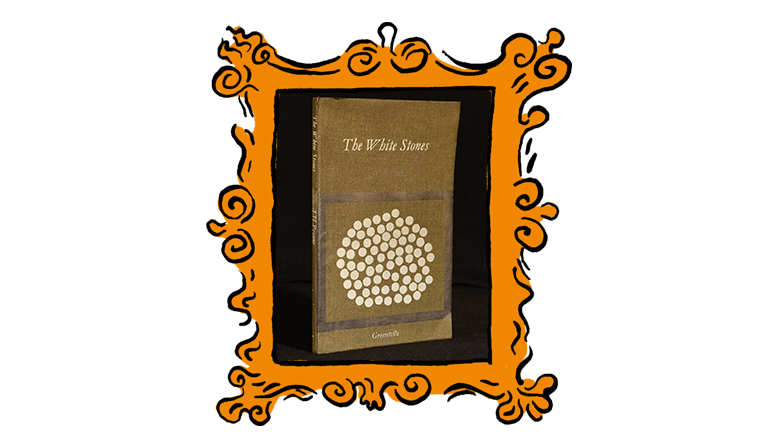
“Acquisition of Love”, from Prynne’s early collection The White Stones (1969), describes the process of fixing an old-fashioned push mower seized up with rust. Sitting on the garden step, “brush[ing] out the corroded / flakes with oil”, the speaker sees children “in the sun’s / coronal display”, who prompt thoughts about life, death, and—unexpectedly—genetic determinism. The poem’s meditative space intertwines the mechanical and the biochemical, so that the “two ratchets” that make the spiralling mower blades cut when pushed forward over the lawn become an implied metaphor for the inherited double helix of DNA.
DNA was discovered in 1953 in Cambridge by, among others, Francis Crick, whom Prynne came to know when he was appointed as a Fellow of Gonville & Caius College in 1962. “Acquisition of Love” is, literally, a poem of cutting-edge thought, which uses free-flowing verse to try to think through the implications of such scientific knowledge for our understanding of what it is to be human (“each linked / system & the borrowed warmth of the heart”).
The poem doesn’t come to a clear conclusion—but what poem worth reading does? Its delicately mysterious balance of different ways of knowing the world is why I come back to it. Another early poem about a power-cut ends: “A silver wire restores our certainty”. It’s a wry comment, cast in iambic pentameter, about how dependent our modern lives are on a functioning fuse box. But it’s also a reflection on how a fine string of words (such as a memorable iambic pentameter) can be mistaken for the truth.
Prynne’s work took its inspiration from the possibility that the music of poetry could be true to the fact that “we live / with sounds in the ear / which we shall never know”. In his critical prose, he sought metaphors for a dynamic vision of language as something more beautiful than “our credit-card view of the speech act”, in which meaning is transferred with maximum efficiency. An essay from 1994 on Chinese poetry, for example, begins, magnificently: “Within the great aquarium of language the light refracts and can bounce by inclinations not previously observed”. It then develops this image of words as things of glinting, fluid meaning with a deliberate ambiguity: “if you can imagine staff notation etched on the glass you can read off the scales”. Staff notation is how we conventionally represent music; but, etched on an aquarium, those “scales” become fishy, too.
The result, in his later poetry, was an increasingly refracted experience of words disappearing into the weeds. But however baffling a page of Prynne may look, when read slowly and aloud its syllables will start to “bounce” off each other with a strange life of their own. One of his specialist subjects as a lecturer in English literature was Wordsworth’s The Prelude, in which the Romantic poet wrote of listening to owl noises across a “watery vale” at night as an experience of the world that “carried far into his heart”. In “Heard Owls Hoot”, from Otherhood Imminent Profusion (2021), Prynne improvises an abstract variation on this scene. It begins:
Nearer than chill moonlight, willow clear wet
with dew risen by reed spears, would clatter,
spread where young birds forage; meet hunger
at the weir.
What I respond to first in these lines is how they sketch a natural landscape with quick touches of internal rhyme (near- / clear / spears / weir). There is also characteristic play between how words look and sound: the noise of the owls among trees would be a “wood clatter”; their driving motive as they hunt, a “meat hunger”.
Having set the scene with the first sentence, the poem then turns inward to the mind as it translates perception into understanding, and those “-ear” rhymes arrive at the ear:
Hear what you see, will soon be
in flicker abet to recognise, revision without
fear, surprise.
The mind seeks what it cannot pin down in the darkness, until the birds of the title make themselves heard:
anticipate by echo, follow quantum allow pair
bound to shadow, darkness; infringe evasion,
lesion torn abduction, these birds conversant
reply in clamant jargon.
As in Prynne’s meditation on a lawnmower, an apparently simple scene becomes complicated by the intermingling of cognitive processes (“anticipate by echo” catches the strange temporality of listening for a repeated sound) and scientific metaphor (“quantum” suggests the “pair / bound” owls behave like entangled particles in the darkness).
Wordsworth’s owls made a “jocund din”, and late Prynne is often din-like in its unlyrical diction. But like dissonance in music, this can itself be a compelling aesthetic experience. And to that kind of acquired pleasure as a reader I would add another. The poet-critic Donald Davie observed that “the structuring principle of this poetry, which makes it difficult… is the unemphasized but radical demands it makes upon English etymologies”. Difficult, but also delightful. Turning to “jargon” in the Oxford English Dictionary, for example, I learn that it originally meant “the warbling of birds”, and then later “a jingle… of rhymes”, and only more recently “any mode of speech abounding in unfamiliar terms, or peculiar to a particular set of persons, as the language of scholars or philosophers”. All of which apply here, in a way that suggests birds, poets and physicists are crying out (“clamant”) together in the darkness.
In a manifesto-like early essay, “Resistance and Difficulty” (1961), Prynne distinguished philosophically between “difficulty” as a solipsistic experience of mental puzzlement when apprehending the world, and “resistance” as its opposite: a positive imaginative encounter with felt substance (he cites the rich “etymological and phonetic resistance” of Gerard Manley Hopkins’s poetry). His argument concludes that it is from the resistant quality of real things that “we derive our most powerful and sustaining sense of the world, in all its complex variousness”. Over a writing life of more than 60 years, I don’t think he ever really deviated from this belief.