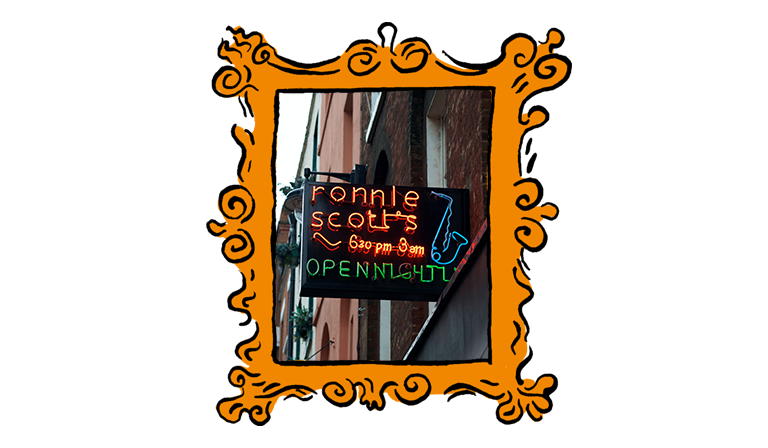
When the revered composer, pianist and bandleader Mike Westbrook died earlier this month, Richard Williams’s obituary in the Guardian reminded me that Westbrook’s Concert Band was the last group to take to the stage at Ronnie Scott’s “Old Place”.
The “Old Place” existed for about 18 months, between 1965 and 1967, after Ronnie Scott relocated his club from its original premises on London’s Gerrard Street to its current home on Frith Street. With time left to run on the Gerrard Street lease, he generously handed the keys over to a younger generation of musicians who needed a place to play—musicians more interested in knitting together jazz with free improvisation, rock grooves and composed forms than in the more mainstream offerings of his gleaming new club. The audience for that last night apparently queued around the corner, then applauded to the rafters Westbrook’s tasty gumbo of composition, improvisation and hat-tips to jazz of all styles and eras. This was a good night to have been in Soho.
On a Monday evening a few weeks ago, I stood outside Ronnie’s on Frith Street waiting to experience one of the club’s new classical music nights and couldn’t help but ponder what the club had once meant to me. The night after I moved to London in 1994, with all my belongings still in boxes, I headed to Ronnie’s for what, purely by chance, turned out to be a night that has gone down in the history. On the playbill: the legendary alto saxophonist Lee Konitz, who had performed on some of Miles Davis’s earliest recordings. Konitz took very great exception—and perfectly legitimately—to a drunk who had decided to sing along to his solos. Eventually he snapped. “It would help if someone would kick out the fucking drunks,” he screamed into the microphone as I looked on agog—so this is what jazz clubs are like.
Ronnie’s soon became my happy place of learning. I heard John Coltane’s onetime drummer, Elvin Jones, cross-rhythmic energy pulsing through his veins—I was one of about ten people who stayed for his last set of the night, beginning at 1am—also the great singer Betty Carter, who eyeballed me as she sang a characteristically abstracted “Body and Soul”. I also heard some jazz I didn’t care for at all, but that didn’t matter—there were things to be learnt from that, too.
During those formative visits, I was aware of another space, upstairs from the main room, where DJs played Latin music for dancing. I never ventured up there. But the club’s new “Close Up Classical” evenings take place in a refurbished space they’re calling “Upstairs at Ronnie’s”, so up I went, into a room with an interior design aesthetic pitched somewhere between Donald Trump’s bathroom and a branch of Søstrene Grene.
Close Up Classical is an initiative led by the violinist Lizzie Ball and club artistic director and pianist James Pearson. We’re told that the evenings offer “audiences intimate evenings of music and conversation with some of our best-loved VIP musicians, actors and personalities”. The series kicked off with an evening hosted by the actress Juliet Stevenson; it has also featured film composer David Arnold and a chamber ensemble rendition of Ralph Vaughan Williams’s The Lark Ascending. Future attractions include The King’s Singers and opera singer Kirsty McLean. The night I attended, Her Ensemble, led by violinist Ellie Consta, with pianist Junyan Chen and cellist Laura van der Heijden, played a featherweight programme of salon-like pieces by Florence Price, Amy Beach, Lili Boulanger and Reena Esmail.
Listening to chamber music as waiters take orders for drinks, with their trays clanging against the furniture, distracting from concentrated listening, was hardly ideal. The parched acoustic—Chen’s piano sounding curiously distanced from the rest of the musicians—didn’t help either. But more undermining of these evenings is the musical fare itself, so much Classic FM tweeness driving permanently along the middle of the road. Consta spoke out eloquently against the continued marginalisation of female composers and she’s right—it’s not good enough. But Price and Beach were at best middling talents, and where were the powerful women composers who really matter—Mary Lou Williams, Ruth Crawford Seeger, Gloria Coates, Priaulx Rainier, Elisabeth Lutyens, Nicole Mitchell and Liza Lim? Kept on the sidelines as usual.
Being even-handed, I’m dutybound to point out that the performance I attended, at 6.30pm, was sold out, as was a repeat show later in the evening. Ronnie’s has identified a target audience that it is successfully reaching, and the financial constraints on the club, that unremitting need to at least break even each night, means that artistic risk is a luxury that can simply no longer be afforded. Margins were tight enough when, back in the day, the club could steady the ship by booking Ella Fitzgerald or Oscar Peterson for a week, which might allow them to take a punt on Cecil Taylor (who appeared in 1990, with Joan Armatrading opening). Stories of bailouts—Charlie Watts playing residencies for free and paying his musicians himself—are legion. All of which is a musical ecosystem that no longer exists.
The reality of Soho today—as branches of Pret a Manger creep into every corner and scary-looking boutiques peddle single T-shirts for more than I earn in a month—is that any business remaining from more idealistic times must now behave as an “agile” brand too. So music is presented as entertainment, any difficulty or challenge airbrushed away. As Don DeLillo memorably phrased it in his novel Underworld, “Capital burns off the nuance in a culture.”
Mike Westbrook was my friend, and I loved him dearly. His interests ranged from Jelly Roll Morton and Duke Ellington to all forms of modern composition and free improvisation. His music grappled with making sense of it all, capturing the delirious confusion on paper as it exploded everywhere. He died a few weeks following his 90th birthday and was experimenting to the very end. During our last phone conversation, he told me about music he was writing based on the patterns of church bells, which meant devising synthetic scales, which had made him reconsider 12-tone composition. “We’ll see if this one makes a difference,” he sighed as we hung up, before adding, almost as a continuing credo, “We go on.”
We’ve come a long way from the days when premises in Soho might be handed over to musicians to explore and develop, simply on the mutual understanding that experimenting with the form was a healthy necessity. If the question arises, “On whose money do you experiment?”, then there are significant further questions to be answered about how our culture has become as homogenised and corporate as an overpriced Pret cheese baguette.