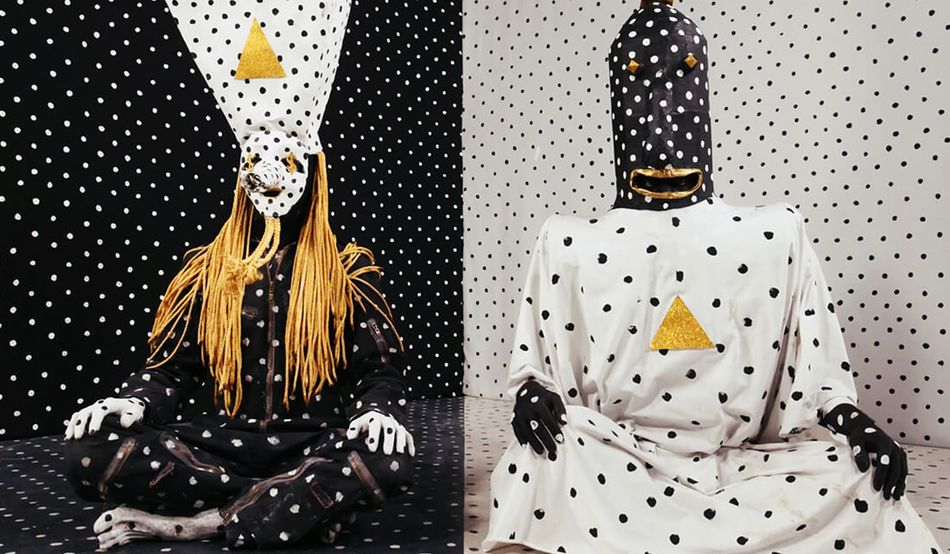
Earlier this year, a YouTube video began to make the rounds of social media and music blogs. It features two figures in black and white polkadots that extend from their clothing to cover their hands and feet, wearing giant, vaguely humanoid papier-mâché masks, and with one sporting an enormous trapezoid hat.
They play precise and strange music with a drum kit and a double-necked guitar. As the groove pivots from one time signature to another, the oddness of the melody becomes increasingly apparent. Both guitar necks—one conventional, one bass—have twice the normal number of frets, and the polyrhythmic interplay of looped basslines and riffs strays further from western traditions and deeper into microtonality.
Angine de Poitrine (named for a French medical term for chest pain) are unlikely stars for any era. While they are longstanding members of the music scene in Saguenay, Quebec, a small city north of Montreal, they have remained anonymous and speak to audiences in a monosyllabic alien language. Their music is groovy but difficult, and the sheer unexpectedness of their presence may be their secret weapon. Comment after comment on their breakthrough video celebrates the band’s uniqueness, declaring “AI could never come up with this” and “This makes me proud to be human”.
The war between humans and AI is here, and weirdness may be humans’ greatest asset.
The first college students to have had all their years at university shaped by AI are now graduating, and they’re not happy. With companies using AI as justification for job cuts amid a challenging market for new grads, in American colleges those graduation speakers who’ve celebrated or talked up the new AI economy have been soundly booed by graduating students.
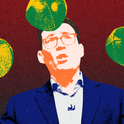
In a speech to the graduates of the Kansas City Art Institute, fashion designer Jeremy Scott took a different tack. After opening with a barrage of platitudes endemic to such speeches, Scott asked whether his remarks felt familiar. “It’s because it’s AI,” he explained, before ripping the script up and giving a speech about human originality. “You know what AI can’t do?… have an original idea. It can’t even differentiate… between a good idea, a unique idea and one that’s mediocre.”
While that’s a sentiment recent art school grads will enjoy, is it true? Is the creativity required to form an “interstellar” rock band—or give a memorable speech—out of reach for AI systems? And if so, for how long?
AI researcher Andrej Karpathy coined the term “jagged intelligence” to explain the counterintuitive phenomenon that AI systems highly competent at one sort of task might fail at another that is easy for humans to solve. A system capable of complex mathematical proofs might struggle when asked: how many “r”s in the word “strawberry”? Karpathy theorised that human intelligence tends to develop across different domains at more or less the same time. A person capable of advanced mathematics would almost certainly be capable of counting letters.
With AI, there’s no guarantee that having one skill correlates to possessing another. Instead, a system’s ability to solve a problem comes from whether similar problems are present within its training data. As a result, some of the most challenging problems for AI are ones that require everyday knowledge not worth transcribing into a Wikipedia article or an academic paper.
The tuning of AI systems requires clear criteria for success, which helps explain why AIs made their first big impacts in computer code. AI systems can test whether their code runs—whether a computer can execute it—and, with a bit more effort, whether it behaves as intended. Determining whether a graduation speech is the right mix of funny and poignant, for example, might be an entirely different sort of challenge.
Tuning AI systems on subjective metrics—whether a chatbot response strikes the right tone—requires human feedback, and enormous advances in chatbot quality have come from guiding AIs to answer questions in ways that meet a trainer’s preferences. But answering whether an essay is a great piece of writing—rather than whether it adequately answers a question—may be beyond most of the hourly-rate workers tuning AI systems. Perhaps, at long last, we have found a source of gainful employment for literary critics?
It’s clear that some generative AI systems are achieving artistic competence. Suno allows users to create whole tracks from simple prompts. Ask for “funky, polyrhythmic, microtonal math rock without vocals” and you’ll get something that sounds like the worst moments of Rush’s back catalogue… which may well be in Suno’s training data.
Whatever Suno produces is unlikely to go viral. Despite training on “medium- and high-quality music we can find on the open internet”—a practice that has dragged Suno into lawsuits from US record industry body the RIAA and German performing rights organisation GEMA—Suno’s outputs are not revolutionising the music world.
Music blogger John Strohm notes that, despite breathless press coverage, “breakout” AI music stars Breaking Rust, a country act that had a hit off a few thousand iTunes sales, and R&B act Xania Monet, who has fewer than a million monthly Spotify listeners, suggest curiosity rather than enthusiastic fandom.
Suno is a serious threat to composers who write background and incidental music. It’s not hard to imagine a podcaster or an advertiser spending a few dollars a month on Suno rather than licensing a track, much as AI image generators are damaging the market for professional illustrators.
But the displacement of original work by AI derivatives may ultimately limit these systems’ ability to improve, while an emergent societal backlash against AI may make this music uncool to the point where it cannot find an audience. (Already, teenagers use the phrase “that’s AI” as a way to say “that’s bullshit”.)
A more interesting question is whether tools like Suno could ever generate truly novel work. If a well-tuned system aspires to competence—the ability to complete a task—the artist’s goal is more complicated. Art seeks a new way of seeing or hearing, a form of communication that hasn’t been attempted before. The delight I felt at hearing Angine de Poitrine reflected not only their skill, but the surprise that something so unfamiliar could also feel groovy.
Academic research on AI and creativity is in its early stages. Many experiments test whether humans can distinguish between AI and similar human-made art. While these show that in many cases humans can’t determine which works are AI, it’s one thing to create a convincing Seurat knockoff and another to invent pointillism.
Other research suggests that while AIs can perform well on tasks designed to test creativity, like the “alternate uses task”, which asks for novel uses for everyday objects, humans and AI working together tend to outperform automated systems working alone. The authors of a meta-study on AI and creativity warn “current GenAI models often tend to recombine familiar elements across contexts rather than generating radically novel ideas”.
Indeed, while humans and AI working together were able to score higher on an individual creativity task, when ideas were compared across tasks the AI systems showed markedly less diversity.
All this raises a question: what do we really want these systems to do? AI poetry can’t be explained by a desire to corner the lucrative market for verse, and isn’t likely to better our lives. Those most excited about AI creativity may dream of artificial general intelligence—making a system that outperforms humans in every possible task.
One answer could be to learn from China, where AI adoption is more focused on profitable applications—from driverless vehicles to welding robots. Perhaps the dream is not an AI that invents new musical genres but one that does dangerous, dirty work, giving us time to add extra frets to our guitars.