How to revive the big two
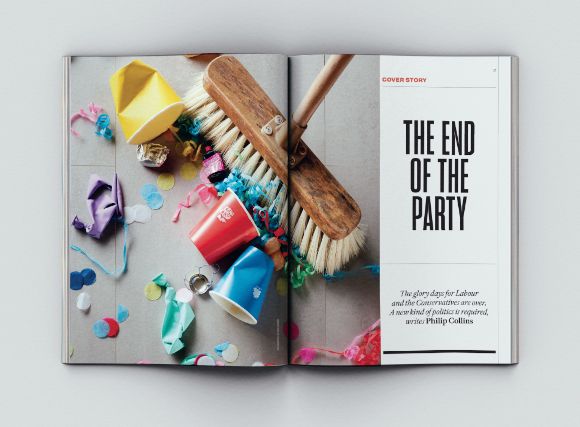
Philip Collins (“The end of the party”, March) is part of a tradition of claiming that the two-party system is coming to an end, dating from at least the 1980s. Undoubtedly the trend looks more visible now but this does not make it irreversible. In 2017 the combined vote of the two main parties was 82.3 per cent, a major rebound after years of decline and higher than in the watershed elections of 1979 and 1997. This was particularly notable in that the major political dispute, over Brexit, did not map neatly onto party divisions. Thomas Piketty’s analysis in Capital and Ideology suggests that Labour’s relative success in 2017 was due to a return to its roots, particularly a partial revival of the alliance between the poor and the highly educated.
The subsequent collapse of Labour support was caused not by extraneous social factors but by the people running the party deciding to alienate large sections of their voter base (“shaking off the fleas”). The collapse of the Tories had perhaps more complex reasons, but the common factor was that the leadership put control over the party ahead of winning elections.
So far as Labour is concerned there seems no obvious reason why this process should not be reversed. The main policy of new contenders on the left seems to be to resemble old Labour, and if the party itself adopted the same strategy it would likely have a built-in advantage. The evidence suggests that traditional social democratic ideas still have considerable appeal, with the mayoral result in New York a striking example. Undoubtedly, there are problems in marketing left-wing polices but it may be that the difficulties lie more on the supply side than the demand side.
Rory O’Kelly, Beckenham
It appears the main two political parties are a spent force. An increasingly cynical electorate thinks this is less because they have run out of ideas than that they are bereft of genuine passion and commitment. The general feeling today seems to be that there are far too many lacklustre career politicians. In many cases, scandals have been politicians’ undoing.
Another factor surely is the internet and social media, which have made the electorate far more—if not fully—politically informed. Engagement with (the more rational elements of) social media has given the public the confidence to challenge and debate opposing viewpoints. Before social media, what readily-accessible public forum existed for debating politics? Today, no British politician escapes public scrutiny. Their every word and action is now the subject of widespread analysis and critique.
It is unlikely we will go back to the old political order—at least until an alternative has been given a chance. Reform is leading in every poll, but not primarily because it has anything truly new to offer. It will need to absorb a few more seasoned Tory defectors to convince that it is more than just a tinpot anti-immigration party: even voters who want Britain’s borders strengthened might be reluctant to elect an outfit that has no solutions to a failing economy, crime, or threats from Russia and China (or Donald Trump, should he somehow secure a third term).
Yet the only way back for Labour and the Conservatives is likely to be after a Reform government crashes and burns, having proved incapable of converting its soapbox appeal and back-of-a-fag-packet policies into mainstream governance.
It may be time for both the Reds and the Blues to own their many failings and not worry too much about a Reform victory. They know that running a country isn’t remotely easy, and will be especially difficult for a relatively nascent party that appears to have only one policy.
Stefan Badham, Portsmouth
Bread and butter politics
Ben Ansell’s article (“How culture wars hurt the economy”, March) makes a persuasive case that both Labour and the Conservatives should avoid culture wars and focus on the economy. But in what sense is the economy “boring”? Granted, “traditional bread and butter of politics: taxes, spending, economic policy” are boring to most people. But that is not the only way to frame the main economic issues.
What most people care about is their ability to make ends meet—especially economic security, as Ansell says—and to have something left over for enjoyment. This is especially true of those in financial hardship, which is a large proportion of the population. Even many affluent people agree, for the selfish reason of wanting to live in a decent society.
Why not give priority to achieving economic security for all? As I write in my open access book Evaluating Economic Success, a good economy is one where its outcomes satisfy everyone’s basic needs, as far as possible—such things as livelihoods and housing of decent quality and security, and access to childcare, healthcare and social care.
This is the criterion of an economy’s success, which is widely supported across the political spectrum, and should be the focus of our public debate on the economy.
Michael Joffe, Imperial College London
The plot against bullies
Sasha Mudd is always deeply insightful and eloquent. Her column on American soft power (“Trump has destroyed American soft power”, March), however, stands out as the very best of the many pieces I’ve read on recent international moves made by the White House. It deserves admiration and commendation, even if its message will depress every good-hearted reader.
Brad Hooker, via email
The problem with Andrew Adonis’s recent analysis (“Rupture? What rupture?” Prospect online, January) of Mark Carney’s speech on the collapse of the “old world order”, and of Donald Trump’s recent behaviour around Greenland (“Why Greenland really matters”, March), is that he doesn’t recognise that when evil people threaten you repeatedly and make their objectives obvious, sooner or later they are going to act. His argument seems to be that they haven’t acted yet, so don’t worry.
If you encounter a huge, very aggressive man who is waving his fist in your direction, reassuring yourself by recognising that he hasn’t already hit you doesn’t really work.
The UK needs to take an urgent look at how to protect its long-term strategic interests. It cannot afford to be reactive. The United States as we knew it is never coming back, Russia will continue to be a gangster state and China will only respect strength. India, meanwhile, will over the coming decades also achieve greater power and influence. Let’s not wait until we’re punched in the face to act.
Wayne Gwilym, via email
The invasion of Venezuela and kidnapping of its leader was and is about oil, more oil and even more oil. Greenland’s sovereignty is threatened by what is blatant US foreign-policy immorality and criminality. Trump’s idea of creating peace is to tell one side that: “You’re not holding any cards.” The man’s a goof. Yet, many still admire him as some sort of genius that resists and challenges the Deep State. Since both Trump administrations have kowtow(ed) to Big Fossil Fuel, mostly via the loosening of environmental protections, he, far from trying to “drain the swamp”, wallows in it.
Frank Sterle Jr, White Rock, British Columbia, Canada
God vs Harold Macmillan
Peter Burden suggests that Christianity “needs to reform its perception and understanding of what is God” (Letters, March). But this proposal misunderstands both the origins and the coherence of classical Christian theism.
The Christian doctrine of God did not arise from primitive anthropomorphism later fossilised into dogma. It emerged through centuries of philosophical refinement that conceived of God not as a magnified human being, but as ipsum esse subsistens (being or existence itself). The claim that God is personal is simply equivalent to the scientist saying that ultimate reality is comprehensible. As Albert Einstein put it: “The eternal mystery of the universe is its comprehensibility.”
Mr Burden’s suggested alternatives—Spinoza’s impersonal substance and Jung’s interior archetype—are reductionistic and do not have the same explanatory power. As for Burden’s conjecture that the traditionally held view of God is “a humanoid… a little like Harold Macmillan”, my response is simply that if some lapse into childish images, that is a failure on the part of the subject, not a disclosure of what Christian doctrine actually teaches.
Regarding the suggestion that Christian doctrine rests on “conflicting and unreliable reportage”, this no longer reflects the state of serious historical scholarship. Over the past half-century, sustained work on oral culture, memory and textual transmission in antiquity has shown that the gospels belong to a highly controlled environment of eyewitness testimony. They appear within living memory of the events they describe, display extensive overlap of structure and material, and are densely populated with named individuals, specific locations and socially embedded testimony. All these features are strongly associated with eyewitness-based historiography rather than mythic invention.
Finally, to define faith as “no more than the capacity and readiness to believe the unbelievable” is a caricature of how Christianity has understood the relationship between faith and reason. Christian thought has always distinguished between what reason can prove and what reason can recognise as meaningful when disclosed. Faith is not belief against reason, but trust that goes beyond what reason alone can reach.
Revd Simon Jones, Barrow-in-Furness, Cumbria
Do we need to know what Peter Burden looks like to know what he thinks? The concept of the Trinity—Father, Son and Holy Spirit—reveals God to be not merely personal, but supra-personal: the famously irascible Harold Macmillan would not even have got an audition for the part. The existence of personality and consciousness within the universe derive from this nature of God, not the other way round.
It follows that God, who is love, is also purposeful as expressed in his creation. It is from him (not it) that his creatures in turn derive their freedom to create and love—a vision of God at least as rational as that to be found in the writings of Spinoza, Jung or anyone else. With their foundation in the Hebrew Scriptures, the multi-layered gospel narratives, along with the epistles and the rest of the New Testament, become the vehicle which over millennia have borne an explicitly Christian understanding of God and his offer of salvation to humankind—grounded in history and experienced by many millions of people.
Mike McCabe, Chinley, Derbyshire
Why the arts matter
I don’t know about Hinterland (March), but I am convinced that a society that doesn’t educate its members in the arts, especially music, is heading for trouble. It will create brutalised, insensitive people. Half of people’s potential will go to waste. Music is often an outlet for children who are less academic, as is sport.
These strengths should be capitalised on, not ignored by governments who see brainpower as the only worthwhile attribute to develop, especially when funding is tight. Look at what the Arts Council did to English National Opera— an organisation reaching out to schools and the young—under the previous government. A healthy society needs citizens with a rounded education, whose individual talents have been nurtured to give them fulfilment and self-esteem. A society that abandons that duty is storing up problems for down the line.
Derek Brundish, via email
Feminists against progress: an apology
The article “Feminists Against Progress”, published on 28th January 2026 online and in the March 2026 issue of Prospect, included a quotation falsely attributed to Louise Perry and her book The Case Against the Sexual Revolution. Because of this error, the article did not meet Prospect’s editorial standards and has been removed. We regret this error and would like to apologise to Louise Perry and to Prospect readers.
An article was published in the March 2026 issue of Prospect, “Feminists Against Progress”, that focused predominantly on our work. We wrote to the editors to raise a number of concerns about the piece, including selective quoting, inaccuracies, and what felt to us like ad hominem attacks. The gravest of the inaccuracies was the presence of a quote, attributed to Louise Perry’s book The Case Against the Sexual Revolution, which appeared nowhere in that book or anywhere else. Following an investigation, the editors of Prospect have taken the article down.
The fast pace of contemporary publishing, and perverse incentives of the online attention economy, make it challenging in the extreme to sustain a commitment to factual reporting. Prospect’s integrity on this front is rare and commendable. We would like to thank the editors for their responsiveness in addressing this matter.
Louise Perry & Mary Harrington, via email