
“The old world is dying, and the new world struggles to be born: now is the time of monsters.” Antonio Gramsci’s words, written in prison near Bari almost 100 years ago, ring out to us now. The political arrangement that has served capitalist liberal democracies for as long as anyone alive today can recall is irrecoverable. In the United Kingdom, the parties that have dominated politics for a century have failed to replenish their intellectual traditions and no longer represent stable social classes. The mists are yet to clear on the two-party system but, somewhere in the distance, a new system of two blocs can be glimpsed.
Like the last investor before the crash, politicians of the heritage parties carry on regardless. Every episode of Prime Minister’s Questions continues unabashed, as if the old parties were not the zombie organisations they have become. Kemi Badenoch expels the traitorous Robert Jenrick from the Conservative party, advancing his desire to be anointed as the successor to Nigel Farage at Reform UK. The gruesomely fascinating spectacle is conducted according to the old rules, by which the general election will define the victor clearly from the vanquished. But that is precisely what is now at issue: the rules have changed. The axis of politics has turned.
At the dawn of the last political earthquake in British politics, Stuart Hall magisterially captured the new times in his 1979 essay, “The Great Moving Right Show”. If he were surveying the scene today, his essay would surely be called “The Great Coming Apart Show”. At the time of writing, the British public splits five ways: Reform 24 per cent, the Conservatives 20 per cent, Labour 19 per cent, the Liberal Democrats 16 per cent, the Green party 14 per cent. This is virgin territory for British politics, and readings on the instruments used to plot a way forward have grown erratic. The old world is dying and the task is now to acknowledge the new one—and then to construct a liberal alternative to this time of monsters.
The desire of the political class to cling to the old parties will be tenacious, long after their reason for existence has disappeared. The Labour party is a surrogate church which inspires theological devotion. Even when some members believed their party, under the leadership of Jeremy Corbyn, to be controlled by an egregiously pro-Russian faction, most would not have countenanced a breakaway or a defection. The Labour party is a home from home, an institution that many of them will unironically, and without embarrassment, declare that they love.
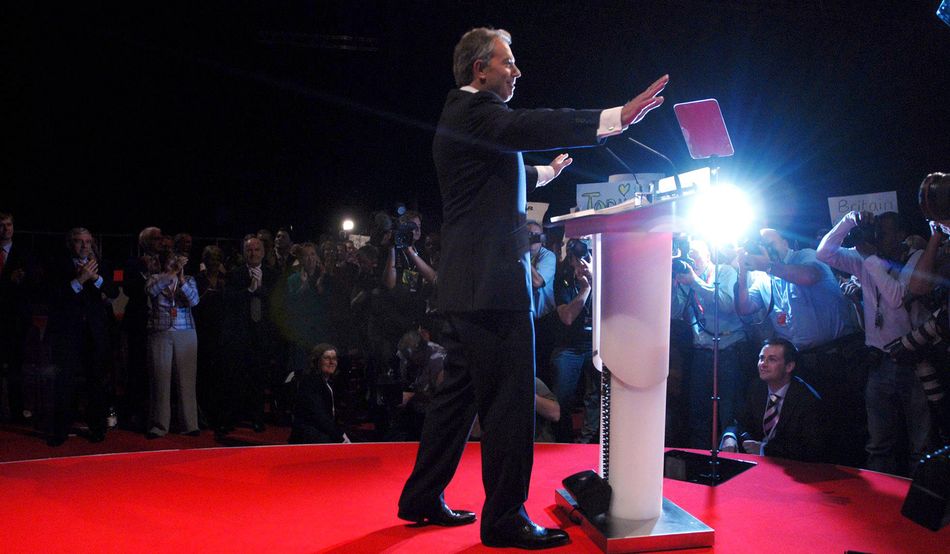
That strange claim of love for the Labour party takes me back two decades, to the Radisson Hotel, on the site of the old Free Trade Hall in Manchester. I am writing the speech for the final occasion that Tony Blair will address the Labour party conference. After a section which concedes the distance that always existed between Blair and Labour—the distance which, certainly in my view and probably in his, was the source of his political success—we concluded with this unlikely sentence: “They say I hate the party, and its traditions. I don’t. I love this party.” The melodrama seemed justified at the time. It was a final observance, for the prime minister, of what British politics demands: fealty to the party.
But the deeper truth was written into the forgotten part of that speech long ago. Its central argument, before the sentimental coda, was that globalisation, for all the rewards it had generated and spread, had nevertheless created a cadre of undeserving losers. The prosperity generated by global markets had been colonised by too few beneficiaries. It was a problem that would wash back into politics, soon. Blair knew that there was no future in turning to the past. The certainties of a generation before were no consolation. The task ahead was to recast globalisation—to consolidate its benefits but to give them a fairer distribution. The speech was long on diagnosis and short on advice. But what was visible to the prime minister in 2006 is now the common lament of 2026.
The settled state of politics has dissolved. The bedrock of the old parties—its class basis, its intellectual weight, its organisational prowess—has crumbled. Back in 1951, the year Clement Attlee relinquished power, British politics was hermetically sealed. More than 60 per cent of manual workers voted Labour. More than 70 per cent of the middle class voted Tory. Labour and the Conservatives between them won 96.8 per cent of the vote in the general election of October 1951. The subtle cracks appeared not long after. As more people began to own their homes, as more people had a fridge in the kitchen, a television in the living room and a car in the garage, skilled manual workers crept towards a Tory party they associated with getting on.
The class dealignment accelerated in the late 1960s. More people switched sides than hitherto, more people cited immediate issues, rather than chronic loyalty, as the source of their vote. Manual workers were increasingly prone to vote Conservative, especially for Edward Heath in 1970, and middle-class Labour support grew among public sector professionals. Margaret Thatcher’s 43-seat majority in 1979 was a decisive shift and, by the late 1980s, Labour’s share of the working-class vote, which was itself decreasing as the economy changed shape, had fallen sharply. Slowly, class was ceasing to be a primary source of identity, at least when it came to explaining how people voted.
At the same time, the idea of a distinctively British politics began to fall in on itself, the great chronicle of which was Tom Nairn’s The Break-Up Of Britain, published in 1977. Despite a Labour recovery in 2024, British politics can barely be said to exist any longer. In the 1950s, the Scottish Unionist Party—which would merge with the Conservatives in 1965—was the most popular party north of the border. Thereafter and until 2005, the Labour party dominated Scottish politics, regularly winning more than 50 per cent of constituencies. In the 1997 general election, Labour captured 56 of 72 Scottish seats with 45.6 per cent of the vote. Then, in 2015, Labour went bankrupt all at once, reduced to a single seat in Edinburgh South while the Scottish National Party (SNP) took 56 seats on 50 per cent of the vote. In 2017 the SNP won 35 seats to Labour’s seven and 13 for the Tories. In 2019 the SNP increased its tally to 48 with Labour, the Liberal Democrats and the Tories winning just 11 seats between them. Wales shows a slower but equally telling fragmentation. Plaid Cymru, the nationalist party, has slowly widened its base but the existential threat comes from Reform. The Labour party in Wales stands on the brink of meltdown, flanked on two sides by the nationalists and the populists.
Time was when the Tory party had its people and the Labour party had its people. The political contest was, essentially, the attempt to steal enough votes from the other side to form a government. This political dispensation produced two extraordinary vote-harvesters in the postwar era. The Tory incarnation was Thatcher, who projected the vigorous virtues of thrift and providence common in working-class homes. Labour’s genius for the vote was Blair, whose evidently middle-class charm brought over the prosperous voters while retaining the aspirational working class.
Once upon a time, both the liberal and the illiberal voter cast a ballot principally on their economic comfort. Not so now
Brexit, though, changed everything. The 2019 election was the first in which class was of no value at all in predicting the vote. Education predicted voting more accurately than occupation, age was a better guide than income and geography mattered more than class. Voters under the age of 35 overwhelmingly supported Labour, the Greens and the Liberal Democrats. Voters over 65 were disproportionately supporters of the Conservatives and the Brexit party; the latter was renamed Reform UK after the election. Labour won a clear majority among voters with university degrees, and the Conservatives won a majority among voters without formal qualifications. Metropolitan areas increasingly resemble one another politically more than they resemble their surrounding regions. London’s voting patterns are closer to those of Paris or Berlin than they are to the English shires. Meanwhile, post-industrial towns either swing between parties or withdraw from political allegiance altogether. Back in 1983, more than half of voters, according to the British Election Study, expressed strong identification with a political party. Forty years on, less than a third felt the same way.
British politics has changed, in a way that will shake the main parties. Both Labour and the Conservatives are trying to unite the liberal voter with the illiberal. The advocate of more open immigration with the person who demands the door be closed. The person who believes that gay marriage is a welcome extension of a conservative institution to all people with the person who believes the status must be the preserve of a man and a woman. The person who believes that anthropogenic climate change is an urgent crisis and the person who believes either that it is a hoax or that acting against it is all too expensive. Once upon a time, both the liberal and the illiberal voter cast a ballot principally on their economic comfort, so the question of their relationship to social liberalism was electorally irrelevant. Not so now. The only parties which have any intellectual coherence in these new times—when politics divides on a cultural axis—are Reform UK on one side and the Liberal Democrats and the Greens on the other. Just as Boris Johnson did in 2019, Keir Starmer won an unstable victory in 2024. Temporarily, the Labour party managed to unite younger, metropolitan, socially liberal voters with older, economically insecure, culturally conservative voters in their joint hatred of the Conservative party. But these people do not agree with one another, and their truce was never going to last long. This profound instabilty, more than the personal flaws of the government personnel, is why the Starmer administration is more unpopular than any of its predecessors at this early stage of the electoral cycle.
The historic parties of British politics, sustained by their social bases, developed an intellectual tradition to suit. Sadly, they are rather hollow affairs these days, as a cottage industry of books has set out, often with great relish. Peter Mair’s Ruling the Void (2013) is a foundational text. In it, Mair argues that mainstream ideological traditions survive institutionally but are hollowed out socially—parties without publics, shells without purpose. Bruno Maçães’s History Has Begun (2020) suggests that traditional western ideological categories no longer explain global politics. Zygmunt Bauman’s Retrotopia (2017) explains why political traditions increasingly look backwards rather than forwards. In Democracy and Dictatorship in Europe (2019), Sheri Berman also shows why social democracy once succeeded and why its enabling conditions no longer hold. Colin Crouch’s Post-Democracy After the Crises (2020) is a British version of the same point: that social democracy persists rhetorically but has lost leverage over power. In the comparative penury of government after the financial markets disaster of 2008, social democracy—which relied heavily on the disbursement of healthy tax revenues—lost its preferred model of change. Adam Tooze’s Crashed (2018) is the best guide to how the collapse of Lehman Brothers permanently destabilised the political economy which underpinned liberal democracy.
Tooze’s is the finest of many jeremiads. Patrick Deneen’s Why Liberalism Failed (2018) calls time on one tradition. In The New Leviathans (2023), the house obituarist of political thought, John Gray, calls time on all the rest. Gray argues that liberalism has fractured into rival, coercive moral projects—such as woke progressivism versus nationalist authoritarianism—and that therefore the project of classical liberal pluralism cannot survive. Gray may overstate his case, but he has at least a germ of a point. Has there ever been a time when the established parties have been so intellectually barren? Go to any anthology of the thought that is supposed to justify Labour and Conservative designs on power and ask: what is the most recent entry? After the obligatory RH Tawney, Robert Owen and Robert Tressell’s ragged trousered philanthropists, the Labour anthology might end with Anthony Giddens’s jejune work on the Third Way or Will Hutton on stakeholding. If it includes an international perspective, the anthology might stretch to Thomas Piketty. There has been no substantive revision to Labour’s intellectual resources since Tony Crosland’s The Future of Socialism. That was 1956, the year of the first IBM computer hard disk drive which opened a technological revolution. It was the year of Suez, too—the moment that confirmed the decline of British Great Power.
The stock has been sparse since then. The Third Way was a philosophy for good times. The argument that a liberal economy generates the buoyant revenues for social programmes works perfectly at the top of the market—but it fell apart in the financial crash of 2008. There has been no serious volume in the Labour tradition since which sets out how to be a vintage social democrat without money to confer on the demands of the needy. The reason that Blue Labour has gained such attention within the Labour party is not that it is a viable philosophical answer to the party’s problems; it is that it is the only one. This is why the Starmer government seems so bereft. The many twists and turns of purpose for which his administration is becoming renowned—winter fuel payments, welfare reform, inheritance tax, digital IDs—are all evidence of a party that is unsure of what it thinks. In a party without intellectual inspiration, the language of politics proclaims managerial virtues of mission, delivery and competence. Yet none of these secondary terms have any meaning unless they are attached to a subject. Mission to do what? Delivery of what? Competence in what respect?
There is a faultline running through the Conservative party. The faultline has always been there, but now it has opened and the party is falling in
Their opponents are not much better, though that may matter less. The Conservative party likes to think of itself as a less explicitly doctrinal party than Labour. The electoral elixir of the Conservatives was that, where Labour had ideological doctrine, they exhibited dispositions, prejudices and tendencies which were never fully articulated. Conservatives believed in continuity and in the mute wisdom embodied in institutions. They were suspicious of the application of abstract reasoning to politics and remained sensitive to shifts in the popular mood. This fabled flexibility—which its rivals find so frustrating—is written into the Conservative party’s sense of self. From George Osborne’s austerity, to Theresa May’s lukewarm tribute to Joseph Chamberlain, to Boris Johnson’s blend of state corporatism and boosterish patriotism, to Liz Truss’s uncritical neo-liberalism, to Rishi Sunak’s household budgeting, the Conservative party changed direction with the wind.
People on the left often accuse Conservatives of believing disgraceful things. Most of the time, the more accurate allegation is that Conservatives believe deeply in nothing at all. But in 2016, that all changed. Brexit has ruined many things, but the irony is that the Conservative party is high on the list of the wreckage. Brexit is the Tory version of George Dangerfield’s famous description of the 1906 Liberal landslide as a victory from which the party never recovered. Conservative politicians who were once vocal advocates of a single market—Thatcher’s achievement—found themselves arguing for protectionism; the intoxication of Brexit was too much for them. The contradiction between belief in the sovereignty of the nation state and belief in the primacy of markets, which David Willetts tried vainly to reconcile in Modern Conservatism (1992), broke apart.
There is a faultline running through the Conservative party. The faultline has always been there, but now it has opened and the party is falling in. Johnson’s election victory in 2019 bequeathed the Tories a glass menagerie of a voting coalition—both precious and fragile at the same time. The new Conservatives, in the less affluent areas in the Midlands and poorer parts of the north of England, had come to the party through the gateway drug of Brexit. But they wanted things that did not tally with the wishes of those shire Tories who remained, for the moment, loyal. The new Tories wanted spending on public services, the old ones wanted tax cuts. This is a party that no longer knows what it is for. Brexit flowed through the Conservative party, forcing some of its better members out and spawning a rival, in Reform, which could speak with a more authentic populist voice. Indeed, the right is the Conservative party’s only source of ideas. Under the banner of national conservatism comes a mimicry of the American culture war which has little to do with British conservatism as we have known it.
The two main parties in Britain have entered a long zombie status—but this is clearly a change that defines an era, the end of the time of optimistic globalisation, rather than a merely local problem. Indeed, in some countries the demise of the old parties is complete.
The ancien régimes of Europe have fallen one by one. In Germany, the Christian Democrat and the Social Democrat parties have both struggled to curb the rise of the nationalist Alternative for Germany on the right and the Greens on the left. In France the Socialist Party, which had won 29 per cent of the popular vote in the first round of the presidential election in 2012, fell to 6.4 per cent just five years later. On the right, Marine Le Pen’s National Rally has become the main contender for power. In Spain, the Socialist Workers’ Party and the conservative People’s Party have yielded to the left populists Podemos and the new centrist liberal Citizens party. The Netherlands’ political system has splintered. In 1960, the Dutch parliament contained six parties. By 2021, there were 17. In Poland, the post-communist left has fallen apart, to be replaced by the nationalist Law and Justice (PiS) and the centre-right Civic Platform. Fidesz, which Viktor Orbán has turned from a liberal conservative party into a vehicle for his authoritarian ambitions, has consolidated power in Hungary.
It is hard for Labour people to lament too hard the collapse of the Conservative party and the same is true vice versa. Witness the extraordinarily vehement campaigns currently conducted on the front pages of the Daily Mail and the Telegraph against the Labour government. The critique is not just about the policy choices. Their hysterical tone—on issues from the disastrous iniquities of VAT on school fees to the ending of the non-domicile status—seems to question the very legitimacy of a Labour government. Yet this lack of generosity—a rejection of the old rules of politics—might have baleful consequences. Maybe there is a necessary word to be said for the Labour party and for the Conservative party too, as institutions. Maybe the country needs a strong and serious party where Labour once stood, and a strong and serious Conservative party too.
Stable political parties have a vital democratic function. At its most elevated, the purpose of a party is defined in Alexander Hamilton’s Federalist Papers as a bulwark against the mob. If we do not want politics to descend into a plebiscitary confrontation between masses and elites, we need sophisticated political parties to slow it down. To turn disagreement into routinised competition. To rally disparate interests around a programme to which all can consent. To absorb radical tendencies and tame the extremes. Above all, the purpose of the political party is to prevent rule by charismatic adventurers.
In the preface to The End Of History and the Last Man, Francis Fukuyama complacently suggested that the riches offered by American capitalism would satisfy the amour-propre of the status-hungry megalomaniac who would otherwise come into politics. The example he gave, back in 1992, was the New York property tycoon Donald Trump. James Madison and Hamilton were no lovers of the political party, but they feared the prospect of what they called “Caesarism” even more. And recent years have shown that their fears were justified. In How Democracies Die (2018), Steven Levitsky and Daniel Ziblatt present an exhaustive account of the failure of the Republican party to play its allotted constitutional role.
In 1924 Henry Ford, the most famous and notorious man in the United States, made it plain that he intended to seek the Republican nomination for president. Ford was the man who brought the car within the budget of the workers. He had a better claim than most to the title of a democratic hero. He was also a notorious antisemite and immune to challenge or negotiation. The high command of the Republican party blocked him from making an official bid. In an age when mass media was still in its infancy, they did not feel they needed to bow before the pressures of fame. Indeed, they regarded themselves as having a constitutional obligation not to do so, as Ford would have disgraced their party, and American democracy in turn. Their successors, drunk on a toxic rivalry with a Democratic party that they had begun to demonise, did not feel the same in 2016. They had the same elevated constitutional imperative—to block a man who, quite evidently to all who knew him, was not fit to be the presidential candidate in a grand old democratic party. They ignored their obligation and failed in their duty.
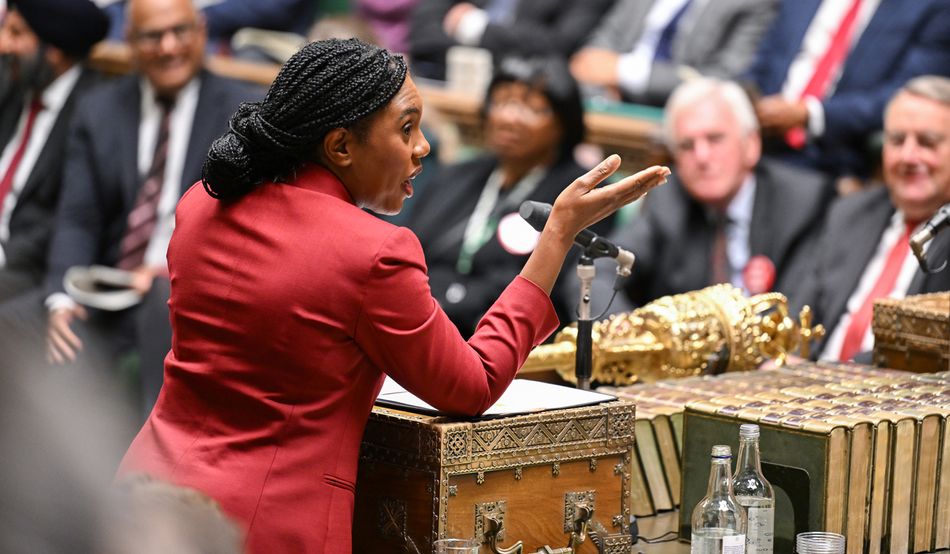
In the UK, the political parties are all but invisible in constitutional law. The Institute for Government thinktank has called them “the ghosts in the machine”. Ghosts, indeed—the parties, the Conservative party in particular, are beginning to mimic the failure of the Republican party to play its due constitutional role. We may look back on this period and see the collapse of sober, constitutional conservatism with profound regret.
The splintering of the Conservative party, which is threatening to be more serious than any previous instance since 1846, means that the historic, democratic functions of the political party are not going to be properly discharged. The members of the Conservative party, entrusted with the democratic task of selecting a prime minister, have already provided two grossly inappropriate candidates in Boris Johnson and Liz Truss. The party has always attracted a small minority of people who hold really nasty views; and within the Conservative party, where they were always outnumbered by decent people, was exactly the best place for them. It would be better for all of us, the Conservative party included, if Nigel Farage were still the member of the Conservative party that he once was.
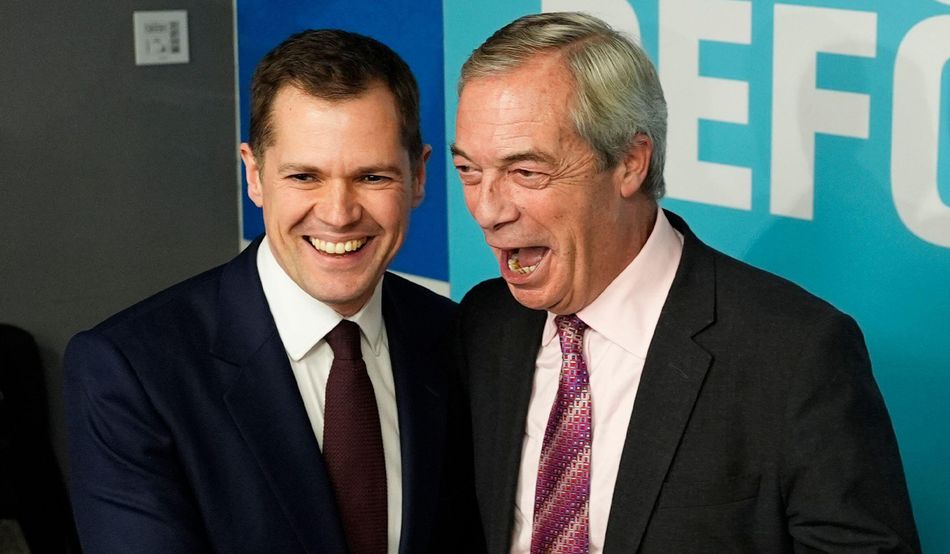
But he isn’t. He is the face and the supremo of his own show, dedicated to spurning and replacing the party he once joined. His latest ambitious recruit, Robert Jenrick, now proudly declares that “the Tory party broke Britain”. Whether or not that is true, Britain has certainly broken the Tory party and Jenrick is doing his best to help. As the leader of Reform UK, Farage seems to be succeeding where others have failed. He has created a new political party that looks as though it might work. The formation of a new party is a holy grail of British politics. Many have tried and almost all have failed, abjectly.
The most colourful attempt began at lunch at the Gay Hussar, a Hungarian restaurant in Soho, London in 1964. Tom Driberg, a Labour MP of rococo tastes, enlisted his friends WH Auden and Allen Ginsberg to try to persuade Mick Jagger, who brought along his girlfriend Marianne Faithfull, to be the figurehead of the new political party, which Driberg hoped would replace Labour. Jagger apparently noted ruefully that he did not quite see himself poring over policies to regulate the waterworks. Still, the ludicrous idea rumbled on until it reached Keith Richards, who declared it the most stupid thing he had ever heard, and no more was ever said of it.
The Jagger enterprise had been promised funding from Richard Acland, who had created the Common Wealth Party with JB Priestley during the Second World War. Though Common Wealth won a few byelections, it was contesting the same political space as the vastly more capable Labour party. Then, in addition to the new coinages, there have been parties splintering on the fringes of other traditions; the Communist Party of Great Britain in 1920 on the left and the National Front and British National Party on the right.
It is a catalogue of failure with two outstanding examples. In 1931, after he left Labour, Oswald Mosley founded the New Party because he believed that he alone had the answer to the economic depression. After a flurry of defections, the New Party ran aground and Mosley himself, ever more convinced of his own status as the necessary messiah of British politics, founded the British Union of Fascists a year later—which, following a few alarums and excursions into violence, collapsed.
The conventional wisdom is that new parties cannot work in the UK... Clearly, nobody has told Nigel Farage
But the parable of the new party in British politics, which purports to show that it cannot be done, is the breakaway from Labour in 1981 of the Gang of Four—Roy Jenkins, David Owen, Shirley Williams and Bill Rodgers—to form the Social Democratic Party (SDP). For a time, it looked as though the SDP might replace a Labour party that was at the time in the grip of its left. In alliance with the Liberals, the SDP won 25 per cent of the vote in 1983, though this translated into just 23 seats. Yet the residual loyalty to the recovering Labour party was too great. The expected breakthrough failed to materialise in 1987, and the SDP then began to fall into the acrimony and faction fighting that seems to be inevitable in new parties. The tale of Change UK, a footnote to the Corbyn tenure in the history of Labour, has a similar ending without any of the heights or optimism along the way.
The conventional wisdom is that new parties cannot work in the UK. The electoral system is too inhospitable; loyalty to the established politics is too great. Clearly, nobody has told Nigel Farage, who seems blissfully undeterred by the litany of failures. The fact that he is not put off, and that he is enjoying such success, is because he understands the fragmentation of British politics better than anyone else. He leads a party that, without any claim to intellectual profundity, nevertheless has a stark political clarity lacking in the other parties.
Farage has always had an issue around which to gather support. At first, with the UK Independence Party (Ukip) in 1993, it was the demand for a referendum on the European Union (EU). Then, the referendum having happened, the Brexit party (cofounded by Farage in 2018) demanded that departure from the EU be completed. Now, Reform UK has widened the sense of grievance, as the populist is always wont to do, to the wider political class. Farage is channelling discontent. The masses of the miserable huddle around him. From his position on top of the opinion polls, Farage mocks the idea that a new party cannot succeed in British politics. His is succeeding. That is because he commands the new tribe of those who take a broadly antiliberal, anticosmopolitan, closed view of the world. Farage has no opposition party to rival his clarity. If there were a single party that could unite voters across the left, no longer tethered to the legacy of the Labour party, it could be the open, cosmopolitan, liberal counterpart to Reform. This is the vacant space of British politics, simply waiting to be filled.
But there is no such party, and nobody is on the verge of creating it; at least, not before the next general election. This means that the act of creation will have to take place during the election, and immediately afterwards. The old pieces are moving apart from one another, but they are already beginning to settle in a new pattern. The politics of two parties is being replaced by the politics of two blocs. No longer Labour versus Conservative, but Open versus Closed. On one side, Labour, the Greens and the Liberal Democrats. On the other, the Tories and Reform. The latest British Election Survey revealed, as Peter Kellner points out, that voters are moving within these blocs. They are not moving between them.
During the election, the voter is going to need the tactical intelligence to vote for the party which is the best option for beating the candidates of the other bloc. Then, after the election, there will have to be talks. Benjamin Disraeli famously said that Britain does not love coalitions, which have tended to be wartime emergencies. Herbert Asquith’s coalition, formed nine months after the beginning of the First World War, collapsed because Asquith ignored the Conservatives in it, who promptly resigned and formed a new coalition with a minority of Liberals, under the leadership of David Lloyd George. The Second World War, of course, produced the nation’s most famous coalition, from 1940 to 1945, under the leadership of the Conservative Winston Churchill and the deputy leadership of Labour’s Attlee.
“Footfalls echo in the memory, down the passage which we did not take, towards the door we never opened, into the rose-garden,” wrote TS Eliot in “Burnt Norton”. The coalition is the passage that British politics did not take, apart from the incident in the rose garden. It was a signal of the politics to come when David Cameron and Nick Clegg confirmed their coalition agreement in the rose garden at Number 10 on 12th May 2010. The first hung parliament in 36 years had left the Tories short of a majority, and this was the first coalition in half a century. Despite many predictions of its collapse, the cabinet, made up of 16 Conservatives and five Liberal Democrats, governed for a full term.
The politics of the coalition already seem an age ago, the last hurrah of what was. In fact, they were the premonition of what was to come. The old habits will die hard. The zombies do not know that they are dead. Elections will still be fought as if the two grand old parties represented coherent alternatives. Leaders will still speak the language of “mandates” and “decisive victories”. Parliamentary ritual will continue unchanged.
Unless one party or another achieves a big breakthrough, we will have five-way politics, which means that the blocs will have to come together. Robert Jenrick’s defection from the Conservative party to Reform would be unedifying at any point but, in the time of fragmentation, it is stupid beyond reasoning. Jenrick used the press conference announcing his departure to insult his former colleagues by name. It is more than likely that Jenrick and Badenoch will have to make up and work together if either want to be in government. In fact, the politics of two blocs make Badenoch by far the most consequential person in British politics. The decision about whether to license Farage in Downing Street will probably fall to her.
These are new times and they will require conversation to replace rivalry. The foolish animosity that pervades the Labour party towards the Liberal Democrats and the Greens will have to stop. The political culture will somehow have to find the capacity for doubt and compromise. There will be negotiations and courteous disagreement among people in a different party but the same bloc. It is characteristic of the old political culture that there was hatred among near neighbours. The Labour right loathed the Labour left because its utopian promises vitiated the party’s claim to credibility. The politics of two blocs means that the old enmities will have to be laid aside.
None of this will be easy. It is usual for the participants in one era of politics to stumble reluctantly into the next. We will have to put up with politics populated by parties that make no sense and don’t have a great deal to say. The electorate will have to construct hybrids. One way or another, the new times need to be ushered into being. The alternative is the time of monsters.
This piece originally reported that the 1951 election took place in December. In fact, it took place in October.