Pausing Palantir
When Just Treatment surveyed our supporters on use of their health data one word reoccurred: trust. From concerns about
the confidentiality of GP appointments to worries that data might be turned into profits, it was clear that for many the trust essential to an effective health system was jeopardised by how new data-centred technology is being implemented in the NHS.
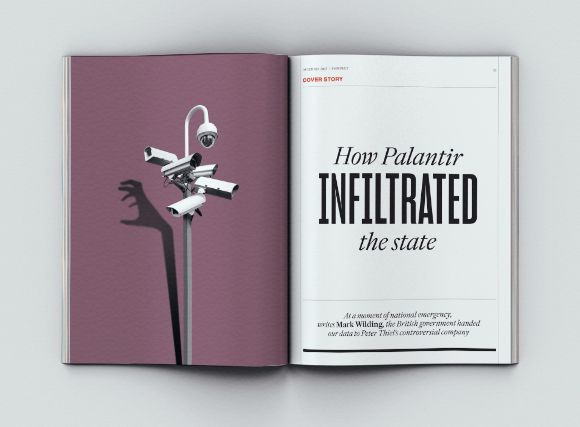
One company embodied these fears: Palantir, so we read with interest Mark Wilding’s detailed analysis (“How Palantir infiltrated the state”, December). We believe that, with its morally dubious track record in its work for the US and Israeli governments, it should have no place in our NHS. Technical experts have also raised serious questions about the efficacy of its product, and some NHS trusts are refusing to adopt Palantir tech. Having heard first-hand accounts of how tech lobbyists have bamboozled ministers, it seems clear Palantir’s lobbying operation is more consistent than its data services. Sadly, the government seems more interested in the perceived economic benefits of pleasing Big Tech than the risks its products present.
The NHS is founded on the belief we all deserve the best possible care. Palantir’s leadership stands opposed to many of the tenets underpinning this idea. If they and their worldview prevail, it will have long-term implications for our health service. And, with the well-documented efforts of Larry Ellison’s Oracle to capture the UK political establishment, this is not simply a Palantir problem. This is a power and democracy problem.
We urgently need to pause Palantir’s contract and enable the NHS to develop this technology itself. And the health system must be made far more accountable to patients, rather than allowing corporate lobbyists to pull the strings.
Diarmaid McDonald, director of Just Treatment
Palantir’s Louis Mosley claims that it is not interested in the UK digital ID scheme. But, as Mark Wilding shows, Palantir already provides key infrastructure to the British government—from the NHS to the Cabinet Office—making essential state functions dependent on these technologies and those who provide them.
As allegations about Microsoft withdrawing its services to the International Criminal Court in response to US sanctions show, the Trump administration will not be scared to leverage American tech infrastructure to bully those who displease it. Before Trump, the Snowden files revealed that the United States is also not scared to tap into its tech companies to place the world under mass surveillance. Putting Wilding’s article into perspective, it is rather naive to expect a procurement contract to address concerns over loss of sovereignty, loss of privacy and loss of security that result from our government locking itself into services provided by Palantir and other tech companies.
Of course, critics will say that our worries are misplaced. That Palantir’s sinister reputation is undeserved, and Mosley’s previous statements that they would “buy [their] way in” to the NHS to “take down political resistance” was just a bad choice of language on their side. Don’t mind declarations that it seeks to “build to dominate”; ignore the support it provides for Trump’s mass deportations: Palantir is just a company that helps “democratically elected governments in delivering [their] mandate”.
In other words, do not mind those shouting to the crowd that the Emperor is naked. Palantir has provided our politicians with the most magnificent clothes, and it is for the true believers and the deserving to admire their beauty.
Mariano delli Santi, legal and policy officer, Open Rights Group
Years of hard Labour
This government is not perfect, but it is the best we have had since Gordon Brown (“Labour’s long tortuous walk to 2029”, December). The UK is trying to pay off debt from Covid, our public services have been underfunded for the past 20 years, while welfare is now being paid to 6.5m claimants out of work. We are back in a Cold War, under constant cyberattack, particularly on our energy and communication undersea pipelines. Oh, and we left the EU, which costs us annually about 4 per cent of GDP. At the moment America can hardly be called an ally, and is undermining the world with highly volatile tariffs. Last but not least, there is immigration and the small boats crisis. Governing the country now is a very complicated juggle for Keir Starmer, or anyone else.
We voted for change, yet people seem to be blind to Starmer’s changes. Yes, he possibly errs on the side of caution and on what is politically acceptable, but the general direction is better. We are moving closer to Europe; net migration is falling and the home secretary, Shabana Mahmood, is adopting Denmark’s successful actions on migration. Wes Streeting is doing everything possible to get the NHS back on track. The railways are being nationalised. We are heavily -investing in net zero and Rolls Royce is building small nuclear power stations across the UK. New towns are planned and planning restrictions loosened so that more houses can be built faster. Defence funding is being expanded and more is going into defending sea cables and against cyberattack. There also does seem to be general agreement that Starmer is successful on the international scene. All this has happened in 17 months. I would say it is something this government can be proud of. Yes, there is more that needs to be done, but I doubt if anyone else could have done as much so quickly.
Rosanne Bostock, Oxford
Writing (presumably without any irony or sarcasm) of the incumbent Labour government’s “walk” to 2029, Ben Ansell states: “The party just has to hang on.” Those seven words might offer hope to the most intransigent Labour voter, but what do they offer the rest of Britain’s thoroughly fed-up electorate? Who wants to be governed by politicians hanging on until the next general election? If such an abysmal state of affairs isn’t reason enough for a complete overhaul of the political system, then nothing is.
It is bad enough when elected governments only half-heartedly try to solve the many problems we face; problems which, when canvassing for our votes, they promise that they alone can solve. But when all manner of controversial things that weren’t in a party’s manifesto are introduced then surely it is time to change a system that allows such deceitfulness to gain power.
Would Labour be in power if, pre-election, it had told the British electorate that it intended to give away control of the Chagos Islands, at a cost of billions to British taxpayers, or that it intended to infuriate the entire farming community with sweeping changes to inheritance tax? Or if it had even suggested it might capitulate so easily on introducing much-needed (and promised) welfare reforms as soon as backbenchers became uneasy?
Why not hold general elections every 12 months, or two years at the most? A reduced period in power would very likely focus minds, regardless of whether political ambitions are self-serving or public-spirited. Any proposed major and widely unpopular policy that wasn’t revealed before an election shouldn’t be permitted. And with each term in power more than halved, the public might not grow so weary or cynical of any proposed new policies by the next election, while being reassured that they don’t have to suffer an insufferable government for what feels like an eternity.
Stefan Badham, Portsmouth
Quaker oaths
How anyone could argue that the Quaker faith should be used as a religious fence enclosing assumed truth is beyond me (“Disagreement Among Friends”, December).
However, upholding the Quaker belief in the value of exploring the inner light in silence will inevitably mean continuing to set some boundaries for Quaker faith and practice and for the Society of Friends as an organisation. Further, it seems reasonable to expect that boundaries will be covered by the new Quaker Book of Discipline and this book will reflect the current state of Quakerism, just as its predecessors have done.
Faiths are characterised by boundaries, but these change over time and permeable ones are needed for movement.
No faith can be fully lived out within an enclosed organisation that is separated from society and other faiths. Pope Leo’s prayer for the international meeting for peace, religions and cultures in October 2025 put it like this: “May religions not be used as weapons or walls, but rather lived as bridges.”
Ralph Meloy, Saffron Walden, Essex
Everybody hates a tourist
Regarding JA Hopkins (“Cadaqués is sublime. Stay away”, December), this commentary risks veering into the worst kind of nostalgia and otherism—the argument that places that British people frequent as tourists should be “authentic”, “unscathed” and homogeneous in terms of class, language and ethnicity.
While zoning and economic diversification are important issues in Spain, it is better for this magazine’s readership, with its economic privilege and opportunity, not to succumb to a “wasn’t it better without electricity and without foreigners (except English-speaking ones like us)” narrative.
Dalí, Duchamp and Man Ray had wealthy sponsors and were seen as political outcasts in their own times. When they moved to Cadaqués, villagers would have seen them as just as strange as the “foreigners” buying property on the Catalan coast today.
Tourism can both benefit the local population and harm it—it can be done well and badly—but let’s not let the arguments against it descend into nostalgia for an idealised and culturally monolithic past which never actually existed: immigration has always been a key defining factor in this area.
OpenAlways, via the website
Excremental gains
Sasha Mudd, in her insightful, beautifully written piece (“The politics of the potty”, December) adds a further “P” in psychology, subjecting Trump to Freudian analysis. I read the article three times, the last two just to savour the elegance of the prose.
Many words describe Trump, potty among them but, thanks to Sasha, I thought I had discovered a word new to me, “excrementalist”. I turned, as one does, to AI and asked Microsoft Copilot to tell me about it. It replied in politician mode— answering a question that I didn’t ask by stating that “incrementalists” were those who seek to bring about change by taking small steps. Excrementalists, conversely therefore, should be those who seek to make major changes—exactly what Trump is about.
Chatbot AI acknowledged the word’s existence, but stated: “It’s not very common and won’t appear in most standard dictionaries.” Its meanings vary between the “Ps”, philosophy, psychology and political theory, and also art and literature. However, the political definition—“treats certain groups as social waste”—is also relevant to Trumpism, which makes it doubly appropriate as a descriptor.
From Sasha to Sarah (Joy of Lex, December): it’s a small step from philosophy to philology, but perhaps Sarah Ogilvie can use her lexicological influence to add “the opposite of incrementalism” to the word’s range of meanings.
Derek Turner, Bedford
On 18th October 2025, millions in the United States marched under the “No Kings” banner, protesting the creeping authoritarianism of Donald Trump’s second presidency. Trump responded with a 19-second AI-generated video where a crown-wearing version of himself flies a jet and drops brown sludge onto protesters below—all set to the Top Gun anthem “Danger Zone”.
At first glance, it was absurd political theatre. But it marked a turning point: synthetic media not as novelty, but as political instrument (“Why journalism is our best defence against confidently wrong AI”, December). The clip didn’t deny dissent—it mocked it. Seven million voices were reduced to a digital joke.
This is not the censorship of the past. It’s something more insidious: flood the public square with spectacle until meaning itself is eroded. When the powerful use AI not to clarify but to caricature, democracy becomes a stage set for derision. Trump’s video was grotesque not only for its imagery but also its logic. It revealed a future where mass protest meets mockery, and legitimacy is claimed not through policy, but performance. And that is perhaps the legacy of Trump’s AI experiment: not what he did, but the shape of what comes next.
Across Europe and Britain, regulators hasten to catch up with generative AI. Democracy is always a ceremony of witnessing. What happens when the witnessing itself is mocked, manipulated and monetised by the subject of oversight?
The question is no longer whether technology should be regulated, but how societies understand who is allowed to produce outrage, satire or dissent.
Pakhi Dixit, fellow of the Royal Society of Arts
Regarding Trump’s defecating fighter jet, the Back To The Future producer Bob Gale seems to have been prophetic in pairing Marty McFly’s nemesis Biff—whom he admits was inspired by Trump—with truckloads of manure. In the first film, Marty side-steps (or side-skates?) Biff and his co-pursuers to allow their open-top car to collide messily with a “manure hauling” truck. In the third film, an earlier version of Biff, his great-grandfather Buford “Mad Dog” Tannen, after being covered in fertiliser, spits out “I hate manure!”—a more entertaining version of what Sasha terms Trump’s “verbal emissions”.
Austen Lynch, Garstang, Lancashire