Rich in promise
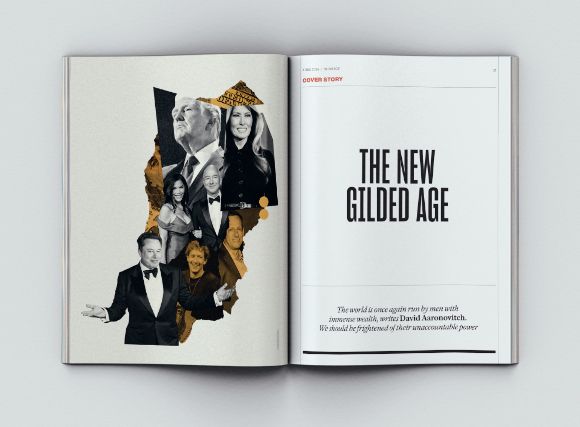
David Aaronovitch’s essay on the new Gilded Age (“The new robber barons”, March 2026) is a brilliant diagnosis. The historical parallels between Carnegie’s era and our own are vivid and unsettling, and the account of how tech plutocrats have entangled themselves with political power is forensic.
But the essay ends where the hardest work begins. Aaronovitch arrives at “the question raised for us is how to establish some accountability” and, understandably for a piece already rich in scope, leaves the question open. But the first Gilded Age didn’t end with diagnosis alone. It ended because people built specific institutional responses: antitrust law, progressive taxation, labour rights, democratic reform.
We need the same ambition now, and the tools exist. An annual wealth levy on extreme fortunes, starting at 1 per cent above £5m, would address the concentration Aaronovitch rightly identifies as the core problem.
Taxation alone isn’t enough, though. Universal basic income would break the link between insecurity and political manipulation. Proportional representation, donation caps and media ownership limits would sever the feedback loop between wealth and political power that Aaronovitch documents so effectively. At A Just Society, we have tried to show how these proposals work as integrated fiscal architecture, not as a wish list.
The comfortable fugue he warns against isn’t just failing to notice the problem. It’s noticing it and then deciding that the solutions are too radical to pursue.
Tanya Park, founder, A Just Society
In your March editorial, you noted that Prospect exists to define liberal answers to the “contaminating moral environment” of modern capitalism.
Just as globalisation’s champions once pointed to GDP growth as proof of success while downplaying regional decline and wage stagnation, there is a manufactured sense of inevitability—driven by winner-takes-all competition and the geopolitical race with China—that AI automation will transform our lives (“Escaping the tech hype cycle”, April). Automation-driven productivity gains are framed as both inevitable and desirable, assuming that the broader benefits will trickle down.
Governments, seduced by the likely economic growth, have cast regulation as a brake on progress rather than a necessary guardrail or precondition for sustained innovation. While the debate over the intended and unintended consequences of this hands-off approach continues, the impact of AI automation on the job market is already real.
An alarming “contamination” is being partly adopted by the media, which simply accepts Schumpeterian creative destruction as a response to concerns about AI. Journalists are framing this as a natural law, entirely ignoring the displacement window—the period before new jobs replace those lost, and a generational gap where productivity decouples from wages, similar to the 50-year “Engels’ Pause” post the Industrial Revolution.
The stakes are more than economic dislocation. When disruption outpaces what is necessary for social cohesion, it doesn’t just hollow out communities—it fuels political extremism and corrodes institutional trust. And we need not look far for evidence.
Ramin Absari, via email
I enjoyed Phil Tinline’s article on the US and the New Brandeisians (“Return of the Trustbusters”, April). It would have been interesting to see included the crucial antitrust work done in the 1970s and 1980s, which resulted in the power of IBM and ITT over their respective markets worldwide being taken on and competition introduced.
The EU and Japan worked together on introducing interconnected standards once that had happened.
Richard Nobbs, EU Commission (retd)
The vanishing voters
It is only possible to see Keir Starmer’s failure (“An open letter to Labour’s next prime minister”, April) as part of the factional politics of the party, and Peter Mandelson and Morgan McSweeney have to be part of the analysis. But as stats are unavoidable, the key issue is the decline of voting as measured by turnout. And this decline is rooted in New Labour.
From 1922 up to and including 1997 every election had turnout of over 70 per cent. 1997 was the last to do so, while the 2001 election had the lowest turnout since 1918 and recovery has been sluggish. At no election since 1997 has turnout risen to anything like 70 per cent.
Jeremy Corbyn is no leader—much like Starmer—so there is a question of why Labour cannot produce leaders. But the key data is that Corbyn got more than 10m votes in both his elections. Starmer got fewer than 10m despite getting more than 400 MPs and it never occurred to him that this made him a less effective politician than Corbyn, who was himself inadequate and will fail in his new party.
The key issue, though, is the number of folk who do not vote at all. The Labour party leadership should have realised the day after the 2024 election that they had a lower percentage of the vote than any previous party with a majority. That they did not do so has left the country without a political class that can be trusted.
And that is an unprecedented crisis.
Trevor Fisher, Stafford
Anti-imperial follies
What is happening in Iran (“Iran’s next chapter: succession, conflict or regime change”, Prospect online, March) is historic. The weakening and, we must hope, eventual downfall of the Islamic Republic will reshape the Middle East and the world. For 47 years, Iranians have resisted a theocratic state built on executions, censorship, gender apartheid and systematic repression. They have fought in prisons, universities, factories and on the streets. They have kept the dream of freedom alive, and never given up.
Yet much of the western “anti-imperialist” left has responded with hesitation, equivocation or silence, even now. Selective anti-imperialism is not a defence of universal human rights. It is the abandonment of millions of people oppressed by the “wrong” kind of tyranny. It is unflinching when condemning Washington or Tel Aviv, but restrained when confronting a regime that has executed dissidents and women, impoverished workers and entrenched repression.
In January, 30,000 Iranians were massacred during protests. The western “anti-imperialist” left offered, at best, a few grudging messages of generalised solidarity—and no meaningful support.
When the Islamic Republic falls, and the broader architecture of political Islam begins to fracture, I hope what follows will be a secular and humane system, worthy of the sacrifices made and the hardships endured by the Iranian people. The western left could organise, advocate and stand clearly with those risking everything. Instead, it finds its voice only when condemning US and Israeli strikes on regime targets.
I have worked with people on the Iranian left for more than 20 years. When Iran is free, there will be soul-searching within the western left. In reflecting on their silence, they should one day apologise to every person who has suffered under the rule of political Islam. Perhaps then the idea of the left as uncompromising in its pursuit of emancipation could be true once again.
Nora Mulready, London
Letters of the law
Henry Fowler (“Fowl Play”, April) was no doubt unduly prescriptive about the English language on occasion, but he was right to condemn the use of one word with a clear meaning in the place of another that hitherto had a somewhat different meaning. For example, consider the difference between “expecting” an inheritance and “anticipating” one by taking out a loan and buying, say, a house with it that the “expected” inheritance would pay off. The two words may be often confused, but we are all losers if the distinction is lost.
As I am an erstwhile lawyer some may presume me to be committed to pedantry, but that is to confuse pedantry with precision. Lawyers of my generation admired the refreshingly different prose of Lord Denning, which was almost always “direct, simple, brief, vigorous and lucid”, and we sought, not always successfully, to write similarly where we could. But even where one word has become synonymous with another, it may often be clearer to use yet another to ensure there is no ambiguity. At my school in the 1940s one staff member was liable to tell you to do something “presently”, meaning “at once”. Woe betide any child treating it as meaning “some time soonish”.
Fowler is much more open to criticism where he deals with style rather than meaning. Here usages are rarely right or wrong, they may though be better or worse as regards euphony and/or clarity. I may choose an unusual juxtaposition of words to create a particular effect. That may get other inapt effects instead, but that is for me to decide and not Fowler or anyone else.
Richard H Burnett-Hall, London
Post-structuralists on tour
Thank you for Alona Ferber’s profile (“Second wave seer”, April) and interview with Juliet Mitchell. I read her book Psychoanalysis and Feminism in graduate school, as well as Jacques Lacan, but also Sarah Kofman and Luce Irigaray. This was at UC Berkeley in the 1980s. All the French post-structuralists came to teach seminars: Foucault, Derrida, Lacoue-Labarthe, Nancy, Lyotard. They could make as much in a few weeks at Berkeley as in a year at their university jobs in France; plus the weather was good and the graduate students as adoring as temple novices in the presence of the gods.
We women graduate students supplemented the Lacan with the feminist writers as we could. I still have my grad-school copy of Mitchell’s book. Perhaps it’s time to get the new edition, which I learned about here.
Mira Kamdar, via email
Bollywood’s show and tell
Imaan Irfan’s recent piece on Bollywood and nationalist politics (“The Modi cinematic universe”, April) highlights something crucial, though the relationship runs deeper than recent alignment. Indian cinema has always shaped national imagination, not merely reflected it. What’s changed is that the state now openly treats film as ideological infrastructure.
The pattern is unmistakable. The Kashmir Files reframes the Pandit exodus of 1990 to support contemporary grievance politics. Uri: The Surgical Strike turns military action into patriotic spectacle, winning open praise from political leaders. The Kerala Story sparked fierce debate precisely because its portrayal of radicalisation felt like assertion rather than inquiry. These aren’t outliers but evidence of a trend where box office success becomes a referendum on patriotism.
What makes this potent is plausible deniability. These aren’t Soviet-style state productions but commercial entertainment that happens to align perfectly with government messaging. Critics get dismissed as attacking popular culture, not challenging ideology.
Internationally, this matters profoundly. The industry doesn’t just export entertainment; it exports a version of India that feels authentic through song, spectacle, and emotion. When that version consistently frames Muslims as threats, Hindus as victims, and dissent as betrayal, global audiences absorb contested political claims as cultural truth.
The industry remains diverse and contested. But when the biggest releases and loudest endorsements increasingly advance a particular ideological project, the concern is well founded. Indian cinema today operates as part of the country’s soft power apparatus, where fandom and state messaging converge.
Pakhi Dixit, via email
Speaker’s corner
Regarding Tom Clark’s piece (“The secret to a great parliamentary speech”, Prospect online, March), could I recommend the maiden speech by the SNP’s Mhairi Black in 2015, which has been nominated by many as one of the best by a new MP.
Lorraine Fannin, via the website
Tin man goods
Kiran Sidhu’s column (Lives, April) was a beautiful and moving meditation on grief in the light of what seems to be an incongruous and unexpectedly disturbing loss of a mysterious tin man sculpture. These sentences particularly resonated: “Although our hearts flutter when we’re in love or feel excited, I think we only really feel our hearts when they break. I have never been so aware of the location of my heart than in the period after my mother died—my heart hurt so much that I wished I didn’t have one.”
Thank you Kiran Sidhu.
Josie Glausiusz, via email