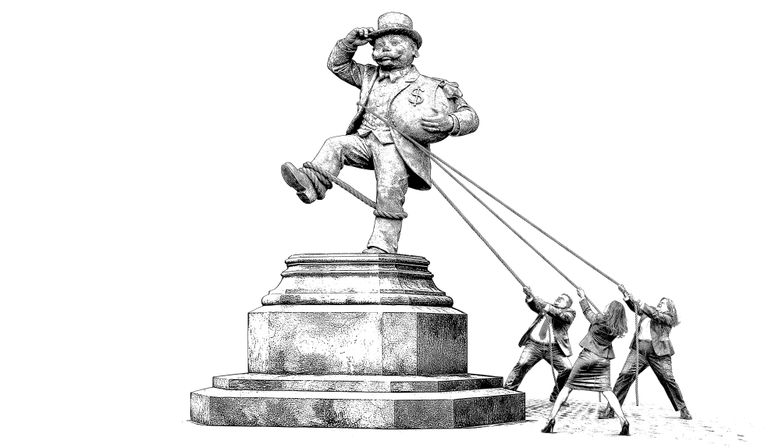
Donald Trump is flailing, and no wonder. He was not elected to shoot nurses or raise healthcare costs for ordinary Americans while cutting taxes for billionaires. Yet the Democratic party’s elderly, well-heeled high command seems unable to land a blow. They have no idea what to do, because they have no ideas—no alternative to Trump’s basic populist charm.
Trump twice rode to the presidency partly by preying on Americans’ sense of economic discontent and general disempowerment. Appealing to racists was not enough on its own. As research by the Progressive Policy Institute after the 2024 election identified, working-class voters did not necessarily think Trump was a saviour with all the answers. But, faced with a political mainstream that “can’t or won’t fix things”, it seemed worth rolling the dice on a leader who was ready to “shake things up”.
That’s one reason Zohran Mamdani’s unlikely election as mayor of New York City has generated such excitement. Here is a way of doing politics which starts from that same recognition that many ordinary Americans feel thoroughly exploited—but without inviting them to blame migrants. And it’s why two of his new appointments caught the eye: former Federal Trade Commission (FTC) chair Lina Khan, hired as co-chair of his transition team, and Samuel Levine, now commissioner of the Department of Consumer and Worker Protection in the city. Between them they embody a very American movement that’s as much a challenge to establishment Democrats as it is to Republicans.
The anti-monopolists—sometimes known as the New Brandeisians, after former Supreme Court justice Louis Brandeis—contend that the country’s basic problem is the concentration of private power. That across many sectors of the American economy, a few businesses dominate the market, pushing prices up and wages down, stifling innovation and squashing or buying smaller businesses (and politicians) that stand in their way. They want to use the power of the federal government to rein in how big corporations exploit this power and, if need be, to break them up.
It’s a curious movement, at once egalitarian and pro-free market, with supporters on both sides of the aisle. It’s deeply rooted in American ideals, yet it’s the sworn foe of economic orthodoxy, which it argues has been leading the country down a disastrous path for decades. Under Joe Biden, amid rising concern about concentration in general and the rising power of Big Tech in particular, this movement achieved a startling prominence—and provoked ferocious opposition. It may yet offer the Democrats the big new idea with broad appeal they need to galvanise mass support, seize the political initiative from Trump and—who knows?—perhaps even save America.
The movement’s founding father is a punchy former business journalist from Miami named Barry Lynn, who prides himself on getting up the noses of the orthodoxy’s pooh-bahs. In 1999, he was covering the brave new world of globalisation when an earthquake struck Taiwan. “Within a couple of days,” he told me, “all these factories in California and Texas and China and Japan and Germany shut down.” They were all reliant, it turned out, on a single Taiwanese semiconductor.
This, Lynn remembers, “was like a window opening”. The earthquake exposed the shaky foundations of a dominant way of thinking. Globalisation’s great boast was that it maximised efficiency. But corporations were being allowed to push this to the point of destruction, crashing through old government guardrails, growing as big and as powerful as they liked.
Lynn began to excavate the roots of this ideology in the economic arguments of the 1970s and in particular the work of one prominent conservative legal scholar. Robert Bork came to prominence during Watergate, when he proved himself willing to do Richard Nixon’s bidding and fire a special prosecutor after his more squeamish colleagues refused. His next contribution cast an even longer shadow. In 1978, shortly after leaving government, Bork published an influential book on business law which argued that what really mattered in competition policy was short-term effects on consumer prices.
This thinking came to dominate under Ronald Reagan, unleashing a carnival of corporate mergers. By the 2000s, as the long boom continued, it seemed common sense. But Lynn thought that it was nothing of the kind: “Our whole society,” he says, had “embraced an ideology that blinded us to the concentration of power.” And Bork’s ideas had overthrown a very different approach, which had shaped America for much of the 20th century.
Brandeis ended up on the Supreme Court, but was born the son of an immigrant grain merchant in 1856, in Louisville, Kentucky. Louisville embodied America’s decentralised economy—the kind of place where people like the elder Mr Brandeis could thrive. But Louis entered legal practice in the Gilded Age, as “robber barons” like the banking and railroad tycoon JP Morgan and the steel magnate Andrew Carnegie were hard at work concentrating economic power in ways the United States had never seen, corralling smaller firms into huge “trusts”. They grew powerful enough to coerce governments.
Brandeis joined the burgeoning “antitrust” movement, which fought for decades to redress the balance. This triggered a series of titanic battles between public and private power. The “trustbuster”, President Theodore Roosevelt, summoned the guts to block the untouchable JP Morgan from consolidating the western railroads. It took two full trials and a 5-4 Supreme Court ruling, but Roosevelt won—showing that the 1890 Sherman Antitrust Act, widely thought to be toothless, could bite.
Meanwhile, the fearless investigative journalist Ida Tarbell faced down threats in order to expose the oil baron John D Rockefeller, the man who had ruined her father. The “Mephistopheles of Cleveland” had flouted laws and strongarmed smaller businesses to sell up to his huge trust, Standard Oil, on pain of being crushed by ferocious price wars if they refused. Tarbell’s reports outraged the nation and gave Roosevelt an opening to take on Standard Oil. Investigations, revelations and, finally, federal and state lawsuits followed. At trial, the government called 444 witnesses. The battle took years, but finally in 1911, the Supreme Court approved the breakup of Rockefeller’s vast, impregnable trust into more than 30 smaller companies, affirming that the purpose of the Sherman Act was to stop concentrated corporate power instigating a new form of slavery.
But by 2008, Kanter had watched the American dream recede out of too many people’s reach.
Brandeis, making his name as the “people’s attorney”, took on JP Morgan’s New Haven Railroad. For this, he was widely mocked—until it turned out that the trust was cutting corners, causing people to be killed. An investigation revealed that it was also committing fraud. When the Justice Department threatened an antitrust suit, the New Haven broke itself up. In the presidential race of 1912, Brandeis shaped Woodrow Wilson’s call to break up monopolies, part of his winning platform. He was too controversial to appoint to cabinet, but played a key role in the creation of the FTC. This was charged with enforcing toughened-up antitrust laws, like the 1914 Clayton Act, which was designed both to stop huge mergers and stamp out the price discrimination used by big companies to favour each other and squeeze out their smaller rivals. And so, from the 1930s to the 1970s, tough anti-monopoly enforcement would play its part in the rise of everyday Americans to once unimaginable prosperity.
It was this interventionist model of antitrust that Bork worked so hard to overturn in the 1970s, abandoning the idea of restraining private power, because to do so stopped businesses maximising their efficiency. And it’s that old Brandeisian stance towards private power and democracy that, by overturning Borkism, the New Brandeisians have been striving to recover.
The catalyst was the 2008 crash. Wall Street banks, bloated by mergers, were taking ever-greater risks while regulators looked on—until, at last, the banks generated their very own earthquake. Huge bailouts rescued those deemed “too big to fail”, but not millions of homeowners at risk of foreclosure. As a young Democratic Congressional staffer, Matt Stoller took phone calls from desperate constituents—and started asking why, in response to a crash caused by a concentration of wealth and power, America’s politicians were “pushing even more wealth and power into the hands of the same people that caused it”. He came across Lynn’s 2010 book Cornered: The New Monopoly Capitalism and the Economics of Destruction. Meanwhile, Khan started working with Lynn on market consolidation at the New America Foundation thinktank.
Jonathan Kanter was an established lawyer who’d grown up among small businesspeople in Queens—he’s still “a big believer in the American dream”, he tells me. But by 2008, he had watched it recede out of too many people’s reach. He was disillusioned with the unrestrained rise of Big Tech and the way the legal world’s conception of antitrust had become a “very insular bubble built on assumptions about economic models”, with little relation to reality. He started talking to Stoller, then Lynn and Khan.
Initially, Kanter remembers, this was a movement with so few members that “you could count them on two hands”. When they buttonholed people in Washington about monopoly, “there was a lot of eyerolling… in polite company, it was improper to suggest that that system was broken”. Once they “got out of that bubble”, however, “it was not a hard sell”. From there, the group’s rise was remarkably swift.
Under Obama, the tech companies—still seen as the bringers of a bright new future—were largely allowed to buy up their challengers, as Facebook did with Instagram in 2012, then WhatsApp in 2014. But from 2016, Silicon Valley’s sunny image began to change. Senator Elizabeth Warren, who had come to prominence attacking the finance sector over the crash, was looking to broaden her campaign. Lynn was invited to meet her, and took Kanter and Khan.
That led to Warren denouncing the grip of giant corporations on everything from drugstores and groceries to beef production, squeezing the life out of the small-business middle class. During the presidential election campaign, even Trump made similar arguments. A few days after his first inauguration in 2017, Khan—by now at Yale Law School—published an incendiary essay called “Amazon’s Antitrust Paradox”, which contended that Bork’s whole approach was obsolete. Amazon’s low prices were not a signal that competition was working, she wrote. They were a means of establishing dominance.
That March, at a conference at the University of Chicago, the antitrust establishment came up against the anti-monopolists for the first time; it marked, Stoller remembers, “the breakdown of the consensus”. When the EU fined Google $2.7bn for abuse of its market dominance, that breakdown burst into public view. Lynn lauded the ruling on New America’s website, which outraged one of the thinktank’s donors, Eric Schmidt, who was also executive chairman of Google’s parent company. Amid the ensuing row, for reasons that were contested, Lynn was fired—and he and his team, Stoller among them, set up a new institute.
In 2019 Stoller published Goliath: The 100-Year War Between Monopoly Power and Democracy, which had as its hero Wright Patman—a forgotten Congressman who once sought to impeach the interwar oligarch Andrew Mellon. By this time, a House subcommittee had launched an investigation, summoned the new Mellons of Silicon Valley and started drafting new antitrust laws that might have broken up their companies. Big Tech launched an onslaught of lobbying and the bills fell. By then, however, Biden had won the 2020 election. The anti-monopolists’ decade-long war on the orthodoxy seemed on the verge of a breakthrough.
Stoller assumed that under Biden, “the old guard would still be running things”, though the anti-monopolists would perhaps “be heard a little bit”. He did not expect Khan to be appointed to chair the FTC, nor Kanter to lead the Department of Justice’s Antitrust Division. Legal scholar Tim Wu, an advocate of breaking up Facebook, became special assistant to the president for technology and competition policy.
In July 2021, Biden signed a broad executive order, cowritten by Wu, pushing federal agencies to tackle anticompetitive practices, saying “capitalism without competition” was “exploitation”. The US Chambers of Commerce complained that this was the “politicization of antitrust enforcement”. Which is a bit like complaining about the politicisation of government.
Kanter acted fast, assuming he only had one term to break the old orthodoxy. “We were taking an aircraft carrier,” he says, “and trying to turn it around at the speed of a Ferrari.” Accordingly, his method was not to wait for new laws but to enforce long-neglected old ones, underlining the anti-monopolists’ goal of restoring the original antitrust tradition. His division set about enforcing the Clayton Act’s century-old curbs on companies having directors on each other’s boards, and secured a conviction in a criminal monopoly case using a section of the Sherman Act which had gone unenforced for 45 years. Filing a suit against Apple in 2024 (for making it difficult for users to switch from iPhones to competitors’ smartphones), he invoked the justice department’s work breaking up Standard Oil 12 decades earlier—a precedent he says he had “front of mind”. His division blocked merger after merger, to the point where fewer were proposed. While all this met resistance, Kanter tells me that many in business privately agreed with his approach on the grounds that, “unless you’re the monopolist, you don’t like the monopolist”.
His biggest test, however, was taking on Google, twice. He inherited a case which sprang from the House antitrust subcommittee’s investigations, alleging the firm had monopolised the search engine and search advertising markets. As it finally headed to trial in 2023, Kanter reportedly encouraged government lawyers to emphasise that Google’s scale was in itself a form of market power—an argument similar to Khan’s critique of Amazon. The judge ruled that Google had indeed acted illegally; Kanter hailed this as only the second major win of its kind in half a century. Google is appealing. However, his team’s call for Google to be compelled to sell its Chrome search engine was rejected.
Khan was attacked relentlessly. But this is in the nature of challenging an orthodoxy
Kanter launched a second case, challenging Google’s advertising market practices. Like the first, he says, it “could and should have been brought ten years earlier”. The government won again, though the ruling on remedies was another disappointment and again, Google is appealing. Nonetheless, Kanter says, it was “absolutely essential to demonstrate that these kinds of cases can be brought and they can be won, and that the decision in the past not to bring them was wrong.”
Kanter’s division worked closely with Khan’s, revamping the guidelines on merger decisions, which had been left unchanged since 1982—two years before Mark Zuckerberg was born. Khan’s FTC filed its own big, controversial cases against Big Tech. The most spectacular alleged that Facebook’s purchases of Instagram and WhatsApp were anticompetitive. But when it finally came to trial last November, the judge ruled in Meta’s favour. Khan’s critics attribute this to unconvincing legal theory; her defenders say the case was started years too late and dragged on too long. Her FTC also tried to block acquisitions by both Meta and Microsoft, and lost both times.
Khan was attacked relentlessly throughout her time at the FTC. The Wall Street Journal had a go roughly once a fortnight. But this is in the nature of challenging an orthodoxy, and she insisted it was necessary to bring “hard cases” and risk defeat; over-caution “can lead to stagnation”. A more activist approach deterred dubious mergers; even defeat could bring pressure to update the law. She sued Amazon for monopoly behaviour—albeit not in terms as radical as those of her student critique—with more success. The FTC secured $2.5bn in civil penalties and customer refunds and an order to make the terms of enrolment in Amazon Prime clear, and to cease making cancellation unnecessarily difficult. (Amazon neither admitted nor denied the allegations, and insists it followed the law.) In a statement reflecting on her tenure, she highlighted other wins: stopping manipulative practices towards consumers and workers, clamping down on illegal use of customer data and blocking mergers—not least one between two of America’s biggest supermarkets.
The anti-monopolists’ goal is undoubtedly to achieve lasting change—but how much of their Biden-era labour has survived the return of Trump? The president made more anti-monopolistic noise in his 2016 campaign than in 2024, but there was some hope that his administration would maintain the changes introduced in between.
David Dayen, a journalist who has been reporting on antitrust issues for many years, suggests there are a few people in the new administration who “are interested in a more aggressive, more populist push against private power”, but concludes that such notions have been “swamped by big money”. Kanter’s successor, Gail Slater, who some hoped would continue the anti-monopolist turn as head of the FTC, has now gone. Before the 2024 election, future vice president JD Vance praised Khan—but in office, he has backed her Big Tech foes.
When the FTC’s case against Meta was defeated, there were relieved predictions that the anti-monopolist wave was ebbing. But the current FTC is appealing the Meta case, and Kanter claims there has been an underlying “tectonic shift”: Trump’s apparatchiks, he observes, “certainly don’t sound like Bork, or at least not all of them”.
But the most solid sign of a long-term change is that Kanter and Khan’s merger guidelines are still operating, particularly at state level, where there remains serious appetite for the fight. The California Justice Department filed a case against Amazon a year before the federal authority; like Kanter and Kahn, the head of its antitrust division reportedly wants to enforce the antitrust laws as they were written. In response to the proposed takeover of Warner Brothers Discovery by Paramount, run by David Ellison, heir to the Trump-supporting tech billionaire Larry Ellison, California’s attorney general has stressed the state has an “open investigation” of any such deal.
Private litigators are pursuing more antitrust cases, drawing on the new guidelines and other precedents set under Biden. The Trump-appointed FTC dropped Khan’s last-minute suit against Pepsi and Walmart over alleged price-fixing—but a class action has now been launched, making similar claims. Catherine Simonsen, an attorney who worked for Khan’s FTC in its final year, has set up a new firm in Los Angeles aiming to help cities, counties and states stop problematic mergers, and to bring class actions under the Robinson-Patman Act, which outlaws anticompetitive price discrimination by chain stores against small shops, with the aim of driving long-term change. She detects signs that Khan and Kanter’s work is influencing a similar turn among some of her fellow antitrust lawyers.
It may be that the anti-monopolists’ critics are right, and they have fallen as swiftly as they rose. The rival big idea circulating among Democrats is “abundance”, as spearheaded by the bestselling book of that name by Ezra Klein and Derek Thompson. This argues that progressives have become so keen on stopping abusive power that they’ve turned the state into a huge obstacle to business and to building anything new—notably, homes. In this context, the anti-monopoly movement looks like just another demand for regulation, another rant against business. One of its advocates, the journalist Matthew Yglesias, wrote recently that “corporate power” was a meaningless concept because it “doesn’t add up to anything measurable”.
Dayen suggests the advocates of abundance are furnishing mainstream Democrats with a comfortable new agenda that ignores the US’s glaring power imbalance—and “doesn’t involve them going after billionaires”. Matt Stoller suggests Trump’s aggressive use of state power has allowed Wall Street to insinuate that government needs to be constrained, whispering that if Democrats allow corporate America to run things, they will never have the problem of Trump-like economic chaos again.
Yet the two sides have much in common. Provided that it isn’t done to appease corporate donors, the idea of scrapping outdated regulations could be dovetailed with anti-monopolism. It was one of Mamdani’s campaign promises. Similarly, abundance advocates support the tech boom—and in his recent book The Age of Extraction, Tim Wu argues that it was anti-monopolism which laid the ground for that. Conversely, Marc Dunkelman’s Why Nothing Works is a key abundance text—but it’s not a simplistic attack on the anti-monopoly tradition. Rather, it calls for progressives to work to reconcile their contradictory instincts.
Breaking an orthodoxy is a long-term project, and history suggests anti-monopolism’s juddering pattern of advances and reversals is part of the process. In the 1920s, the original antitrust movement appeared to be ebbing away, but it rode the tide of popular anger at the Depression back to power, where it stayed for 40 years. This precedent also underlines the idea that anti-monopolism and abundance need not clash, provided they’re both focused on improving the lives of ordinary Americans. In the 1930s, Franklin Roosevelt’s administration built extensive infrastructure, transforming rural America without being thwarted by regulation, at the same time carrying antitrust interventions to new heights.
Either way, Stoller argues that “the biggest victory of the Bork consensus” was to say that fighting the giant forces of technology, globalisation and big business was like “fighting God”. He argues that the new anti-monopolists have shown that democratic politics is not quite so powerless—which “was always the goal”. The question is whether, having broken the psychological hold of the old orthodoxy, they can gain the support of enough fed-up, ground-down Americans to win power for long enough to build a new one.