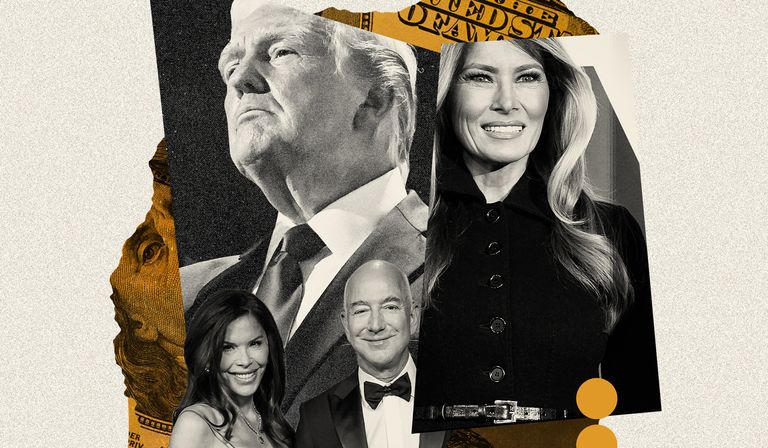
The final days of June last year were a wonderful time for vicarious lovers of bling. On the 22nd, the third season of Julian Fellowes’s lavish TV series, The Gilded Age, dropped on HBO. Just days later, viewers could enjoy what they were allowed to see of the wedding of Amazon tycoon Jeff Bezos to Lauren Sánchez—an affair which occupied a large slice of central Venice, commandeering just about all the smart hotels and prebooking all the water taxis.
For those who don’t know, The Gilded Age is a fictionalised representation of New York high society in the era of the “robber barons”. Its menfolk are disguised versions of the industrial moguls of the late 19th century and its women are their fabulously dressed wives and daughters—though there’s the occasional butler and secretary to leaven the glitz. A reviewer for the Guardian wrote that: “To watch it is to sink into a comfortable fugue and think mostly about the hats.”
The first series had contained a plot line taken from history. In 1883 Alva Vanderbilt, the wife of the railroad magnate William, threw a costume ball, ostensibly for her six-year-old daughter Consuelo, but in fact to announce her flamboyant entry into best society.
A contemporary report in the daily New York World estimated that the whole shebang had cost $240,000—including $11,000 on flowers, $65,000 on champagne and refreshments, $4,000 on hairdressers and $156,000 on costumes—the equivalent in today’s money of $7m. The next day’s New York Times told how the Vanderbilts’ home on Fifth Avenue “was like a garden in a tropical forest. The walls were nowhere to be seen, but in their place an impenetrable thicket of fern above fern and palm above palm, while from the branches of the palms hung a profusion of lovely orchids, displaying a rich variety of colour and almost endless variation of fantastic forms”.
Mrs Vanderbilt herself had been dressed as a “Venetian princess” (an anachronism, since Venice didn’t have princesses at that time), in blue satin embroidered with gold and wearing a cap on which sat a miniature peacock made up of coloured jewels. Other guests came as Marie Antoinette, Joan of Arc and the goddess Diana (a cheaper option, one would have thought, unless furnished with a bow of actual burning gold).
In the real Venice in 2025, the island of San Giorgio Maggiore was sequestered for the Bezos-Sánchez ceremony, Matteo Bocelli sang for the couple and, over several days, themed parties (including a Gatsby party) were thrown for guests including the inevitable Oprah Winfrey and Leonardo DiCaprio, various Kardashians, Ivanka Trump and her husband Jared Kushner (briefly spared from the job of bringing peace to Gaza) and the longevity guru Peter Attia, who popped up the other week in those notorious files, swapping lewd emails with Jeffrey Epstein. “Pussy is, indeed, low carb. Still awaiting results on gluten content, though,” he wrote. (Attia has since apologised for these comments, saying he “regret[s] putting myself in a position where emails, some of them embarrassing, tasteless, and indefensible, are now public”.)
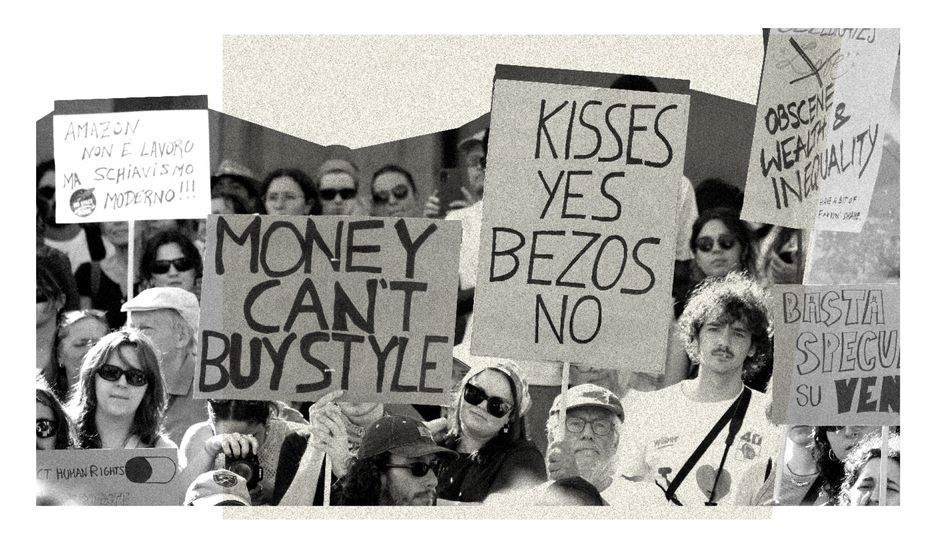
During the three-day party period, Sánchez reportedly wore 27 different outfits, from gowns through to a cocktail dress decorated with 175,000 crystals. Shades here, too, of the conspicuous consumption of the Gilded Age in which Mrs Vanderbilt’s great rival, Mrs Astor, was once described as a “walking chandelier”.
Sitting off the lagoon somewhere was the Bezos yacht, Koru. Though, as was pointed out to the journalist Evan Osnos by a yacht vendor, Koru isn’t a yacht, it isn’t a superyacht, it isn’t even a mega-yacht, it’s a 126-metre-long gigayacht. Alongside it would have been the world’s largest “shadow yacht”, Abeona, which boasts a helipad from which Sánchez, a trained pilot, likes to fly her helicopter.
The Gilded Age tycoons also liked to travel in sequestered style. In 1910 the coke and steel baron Henry Clay Frick bought a private railway carriage and decked it out for the modern equivalent of $3.1m, so that he could travel between his various residences and resorts. Like Bezos (who is believed to own a very expensive Picasso), Frick was an art lover who amassed a stupendous art collection including three Vermeers, a Bellini, a couple of Rembrandts and a Turner.
No one for their own sake needs a 126-metre yacht, a party costing $7m, Ivanka Trump at their nuptials, their own railroad carriage or a peacock headdress. In The Theory of the Leisure Class: An Economic Study in the Evolution of Institutions, published in 1899, the economist Thorstein Veblen analysed the “conspicuous consumption” of the Gilded Age as being entirely concerned with status. Some subsequent economists argued that Veblen’s interpretation had applied to the specific age in which it was published, not any subsequent era. But they never met Jeff Bezos.
Like the tech bros of 21st-century America, the magnates of the Gilded Age were both heroes and villains to their contemporaries. As the historian Charles Morris wrote, they “tapped into the national predilection for speed, the obsession with ‘moving ahead’, the tolerance for experimentalism, to create one of history’s purest laboratories of creative destruction”. To many of their compatriots, they represented the spirit of the nation.
Men like Frick, Andrew Carnegie, John D Rockefeller, Jay Gould and JP Morgan made prodigious money for themselves and created prodigious wealth for their country. In the years between the Civil War and the end of 19th century, national wealth had grown sixfold. The United States had become the world’s greatest producer of steel and coal, wheat and cotton, surpassing the empires of Britain and Germany. Productivity had been raised by 250 per cent and the average working day reduced from 11 hours to nine-and-a-half—thanks to the work of labour unions rather than the moguls. Railroads crisscrossed the country.
The US innovated. But if life expectancy rose for the average American, so too did inequality. By the time Alva Vanderbilt put on her peacock cap, the richest 10 per cent owned more than 70 per cent of the nation’s property, but the poorest 40 per cent of the population owned none.
For middle-class Americans, experiencing the abundance that came with the industrial production of goods once made by hand and therefore far more expensive, the “robber barons” were heroes of the age. And they were barons in scale, writes the historian Jill Lepore: “There were big businesses: big banks, big railroads, Big Oil. US Steel, the first billion-dollar corporation, was formed in 1901 by consolidating more than two hundred companies in the iron and steel businesses.”
Some see the second Gilded Age as having belonged to the financiers and moneymen of the era of globalisation, those whose hubris led to the crash of 2008 and their discrediting. But there’s a better argument, I think, for believing that we’re in it now and that it is the great US tech companies and their bosses who are a much nearer match for the Rockefellers and the Fricks.
Growth in the US, like most growth around the world, is much lower now, but it is powered by the “magnificent seven” tech companies—Amazon, Meta, Alphabet (formerly Google), Microsoft, Apple, Nvidia, Tesla—which have had the capital accumulation to invest hundreds of billions in the digital revolution. In the first half of 2025, over 90 per cent of US GDP growth was accounted for by investment in AI data centres and related technology. And some of their great leaders are the planet’s richest men.
Like their Gilded Age predecessors, the tech magnates are not great believers in the virtues of competition. If they can squeeze it out or else buy it up, for the most part, they will. In the late 19th century, the big industrial companies acquired their competitors and then did deals with the other big companies. “What a blessing it was,” said Rockefeller, “that the idea of cooperation, with railroads, with telegraph lines, with steel companies, with oil companies, came in and prevailed.”
Few tech bros spell it out as clearly as Palantir’s Peter Thiel. In a book from 2014, written with venture capitalist Blake Masters, Thiel argued that successful capitalism required monopoly. Only a monopoly, which “owns its market, so it can set its own prices”, he wrote in the Wall Street Journal, could avoid the waste of time and resources brought on by dealing with competitors. Then its leaders could “finance the ambitious research projects that firms locked in competition can’t dream of” and usher in the next technological revolution.
Wealth is power, of course; but politics is more power. In 1892 the steel baron Andrew Carnegie and his colleague Henry Frick faced a strike at the steelworks in the town of Homestead, Pennsylvania. The issue was pay and part of the workforce was unionised.
When the works were successfully picketed, Frick employed 300 men from the Pinkerton detective agency, armed with Winchester rifles, to sail up the Monongahela river on a barge, take possession of the works and break the strike. Strikers, some armed, defeated the agents, though ten of them died in the process. The detectives withdrew and Frick then enlisted the help of the state’s governor. He sent 8,000 armed state militiamen who accomplished in short order what the private detectives had failed to do. Lesson? For all your wealth, make sure the politicians are onside.
Forty years later, Franklin D Roosevelt, in the midst of a depression and campaigning for a second term in office, used a speech to look back at that period when, “privileged princes of these new economic dynasties, thirsting for power, reached out for control over government itself…” Meanwhile, “Throughout the nation, opportunity was limited by monopoly. Individual initiative was crushed in the cogs of a great machine. The field open for free business was more and more restricted. Private enterprise, indeed, became too private. It became privileged enterprise, not free enterprise.”
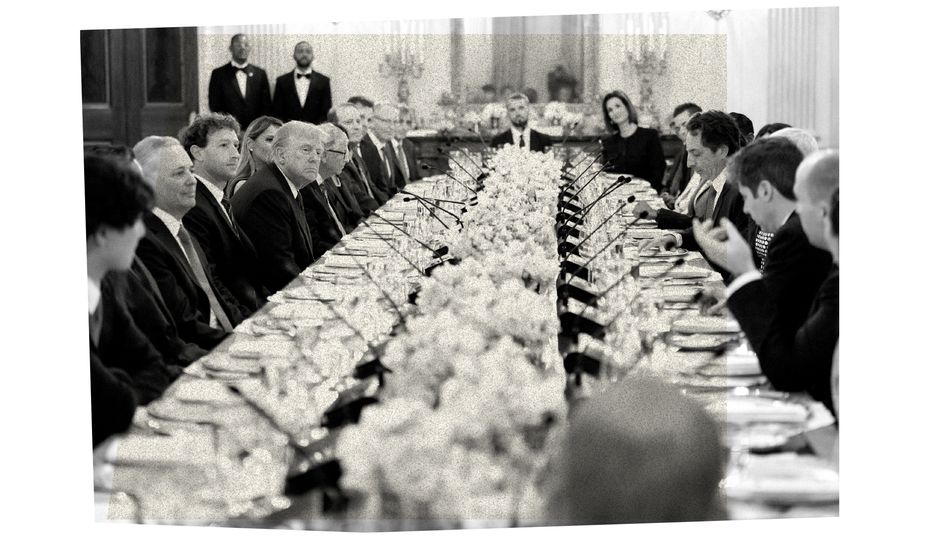
In January last year, in the privileged front rows at Donald Trump’s indoor inauguration, sat the titans of tech: Bezos of Amazon and the space company Blue Origin, Elon Musk of Tesla, X and SpaceX, Mark Zuckerberg of Meta, Tim Cook of Apple and Sunder Pichai of Google/Alphabet. All except Musk’s firms had donated to the cost of the celebrations.
There was no way in which the Melania film could do anything but lose money. But profit was never the point
The arrangement marked the victory of transactionalism over service, just as it had in the Gilded Age—a victory that the tech bros had apparently prepared for. Bezos bought the Washington Post in 2013, insisting that he would provide the investment to allow the newspaper to flourish as a strong independent media platform. But in 2024, with a Trump victory looking likely, Bezos personally pulled the Post’s editorial endorsement of Trump’s Democratic opponent, Kamala Harris.
Weeks after the election, in an interview, Bezos said he had discovered a Trump who was “calmer” than in 2016 and who had “grown a lot”. An accommodation had been reached. Bezos had already agreed that Amazon should pay $40m for the rights to a “documentary” about 20 days in the life of Melania Trump. She is rumoured to have received $28m personally, while $35m was earmarked for publicity.
There was no earthly way in which the Melania film—a vacuous blingfest from which nothing could be learned about the First Lady from above the ankles—could do anything but lose money. It was as cold as marble and as impenetrable. But that was never the point. The film was directed by Brett Ratner, who was accused of sexual misconduct in 2017 (allegations he has always denied) and who, on the day Melania was released, popped up in the Epstein files in a photo where he and Jeffrey sit draped around two much younger women, whose faces have been redacted. Shortly after, he told Fox News that he never had a personal relationship with Epstein, and that one of the women he is pictured with was his fiancée at the time.
By agreeing to the documentary, Bezos had done the necessary. Meanwhile, days before the inauguration it was seemingly Mark Zuckerberg’s turn to kiss the ring. The independent factcheckers that Meta had been using to combat disinformation on its platforms were being fired. Suddenly Zuckerberg found he agreed with Trump and other Republicans that the factcheckers had been “politically biased”.
The relationship between Elon Musk and Trump had become far more direct. In the 2024 election cycle, Musk donated around $290m, mostly through his own fundraising “super PAC”, to support Trump. Then he poured more than $20m into an unsuccessful campaign to prevent a Democrat being elected to the Wisconsin supreme court. After falling out with Trump over the Doge costcutting fiasco, Musk said he would end his political donations, only to ramp them up again at the end of 2025. Today, he’s spending once more—including a donation of $10m to back a Republican in November’s Kentucky Senate race.
Since Trump’s re-election, his family have apparently acquired around $2bn in personal gifts, deals and more
Peter Thiel, who supported Trump as far back as 2016, put his money into the campaign to get his protégé JD Vance elected to the Senate in 2022, and then was instrumental in persuading Trump to nominate Vance as his running mate. As of today, Vance is favourite to succeed Trump as the Republican presidential candidate in 2028.
All four of these tycoons benefit from large government contracts. In this White House—which is run by a man whose family have, since his re-election, apparently acquired around $2bn in personal gifts, deals, legal settlements and crypto, according to the Center for American Progress thinktank— government helps fund their most cherished and expensive products. In April 2025, for example, Palantir signed a contract to help the ICE agency to create a platform to track the movement of migrants in real time. Thiel has also won a $795m contract to provide the Department of Defense (sorry, Department of War) with AI software. Bezos’s Blue Origin also has contracts with the federal government.
Then there’s the tax. For most of the last decade, Amazon has posted huge profits while paying little tax. In 2022, as the US looked to fund a post-Covid-19 programme, the Biden administration imposed a new minimum corporate tax of 15 per cent. This was reversed in the first few months of last year, with companies now being able to offset tax against investment in one year, rather than spread out over several. This had the effect of reducing Amazon’s corporate tax bill for 2025 from $9bn to $1.2bn (Amazon argues that over time this will even out). On income, Amazon’s pretax profit in the US rose by 44 per cent, while its federal and state income tax fell by more than half. Alphabet saw its pretax domestic profit rise by 33 per cent while its income tax liability declined by 37 per cent.
The companies, of course, argue that this is all a huge incentive to invest more in the coming generation of tech. In the current year, Amazon plans $200bn of capital investment in AI and robotics, but also announced that it was laying off 16,000 existing employees.
The recently late Tom Lehrer took his songs out of copyright because he didn’t feel he needed the money. One of my favourites is “The Old Dope Peddler”, part of which runs:
It’s the old dope peddler
Doing well by doing good
He gives the kids free samples
Because he knows full well
That today’s young innocent faces
Will be tomorrow’s clientele
The tycoons of the first Gilded Age claimed that life was better for almost everyone thanks to their labours. Carnegie summed it up in his 1889 essay The Gospel of Wealth: “Today… the poor enjoy what the rich could not before afford. What were the luxuries have become the necessaries of life. The laborer has now more comforts than the farmer had a few generations ago. The farmer has more luxuries than the landlord had and is more richly clad and better housed. The landlord has books and pictures rarer and appointments more artistic than the King could then obtain.”
Back in the noughties, the motto at the top of every Google masthead was “Don’t be evil”. The idea conveyed was that of my old school motto “Rather of Use Than Fame”—the company was about public utility, not about profit or growth. If the public benefited from what it did, then those things would follow.
Tech innovators have certainly included genuinely socially concerned people in their ranks. Sebastian Mallaby’s new book about DeepMind’s British founder, Demis Hassabis, The Infinity Machine, tells readers that Hassabis, “unlike his rivals”, aims not for “wealth and power but scientific enlightenment”.
But DeepMind was bought by Google in 2014, and by 2018, the Google motto had been dropped. It is hard to see in Tesla’s handling of whistleblowers, Amazon’s treatment of its warehouse staff, Thiel’s contract with ICE and just about everyone’s relentless algorithmic imperialism, a concern by these companies or their bosses for other human beings.
At the end of F Scott Fitzgerald’s The Great Gatsby, the narrator says of the wealthy characters, the Buchanans, “They were careless people, Tom and Daisy—they smashed up things and creatures and then retreated back into their money… and let other people clean up the mess they had made.”
In the 1880s, Henry Frick and some friends founded a hunting and fishing club in the hills, 20 miles above the steel town of Johnstown in Pennsylvania. Near the club was a lake created by a nearby earth dam–the largest such dam in the world. Despite warnings, the club neglected repairs to the dam and even lowered it by almost a metre.
In May 1889, after heavy rains, the dam gave way. The result was a flood in which more than 2,200 people were killed in and around Johnstown. The plutocrats responsible paid out substantial sums in flood relief and reconstruction and acted to hush up their part in the disaster. None of them ever spoke in public about it and their carelessness went unpunished.
The plutocrats of the modern era haven’t been so careless or culpable, but their actions have had major social consequences. When Jeff Bezos bought the Washington Post in 2013, like most newspapers in the days before online subscription models, it had been losing money. He told Post legend Bob Woodward that he had “finally concluded that I could provide runway—financial runway—because I don’t think you can keep shrinking the business. You can be profitable and shrinking. And that’s a survival strategy, but it ultimately leads to irrelevance, at best. And, at worst, it leads to extinction”.
He was as good as his word. Until, that is, the Post began to get in the way of other business. In February 2025 came Bezos’s second big intervention in the editorial process when he decreed that “every day” the paper would write “in support and defence of two pillars: personal liberties and free markets… viewpoints opposing those pillars will be left to be published by others”. Given that what constituted defence and support might be a matter of opinion, this felt to some like a clear guide towards excluding “progressive” views.
The Post lost an estimated 200,000 subscribers when the Harris endorsement was shelved. By the time the Bezos-funded Melania was premiered in January, the paper was losing $100m a year and swingeing cuts were announced to its budget: out went the books section, the sports section and over half the foreign correspondents, including the one in Kyiv. All told, just under half the paper’s editorial staff were fired. In Bezos’s words, it was a survival strategy but one which looks likely to “lead to extinction”. It was, said former Post editor Marty Baron, a “case study in near-instant, self-inflicted brand destruction”. David Remnick, editor of the New Yorker magazine, pointed out the effect on communities of binning sports coverage. Sports, he said, are a glue that hold people together.
Yet, as we know, Bezos could have funded a far softer process for the Post, had he wished. Thirteen years into his ownership, how much does he really care about the paper and those working for it?
In mid-February, Mark Zuckerberg was in court to defend Meta against the charge that his company had tried to attract young users, resulting in them being damaged by inappropriate content. Meta had already put in place a bar to under-13s accessing platforms and maintains that it has taken action to protect children, but a 2019 email showed Zuckerberg questioning these “unenforced” restrictions. In court, Zuckerberg said that Meta had got better at identifying underage users since then, and expressed regret that it had taken the company so long to do so. He also claimed that some had lied about their ages. But again, one cannot help but ask: how much does he really care about the consequences, for some users, of his firm’s practices?
But for apparent carelessness no tech bro can match Musk. In late 2022, he purchased one of the world’s leading platforms for information exchange, renamed it X and furnished it with an algorithm that apparently privileges his own posts and those of people he favours; on it, he personally promotes divisive and sometimes incendiary material. He doesn’t seem to worry in any way about the accuracy of that material. And in January 2026 action was taken in Europe and elsewhere against his Grok AI platform, which was being used to create sexualised images based on real people, including children. Somewhat belatedly, Musk had the practice banned.
However, even the man who has everything doesn’t have everything. He still wakes in the middle of the night, knowing he’ll die. He may be able to look down from his private jet and see humanity as Harry Lime saw it from the Ferris wheel in Vienna, as just so many ants, but he was once himself an ant. For the most part denied the consolation of a belief in the afterlife, the tycoon of either Gilded Age has some notion of his human precarity.
Some ultrarich people have had themselves frozen after death in the hope of full resurrection. Some, like Peter Thiel, have invested in properties in New Zealand, an Anglophone country that combines gentleness and huge distance from centres of insurrection or atomic war, as an apparent hedge against the apocalypse. Musk has also fathered an estimated 14 children by four different mothers in an effort to tackle what he sees as “underpopulation”—and perhaps to ensure his eternality.
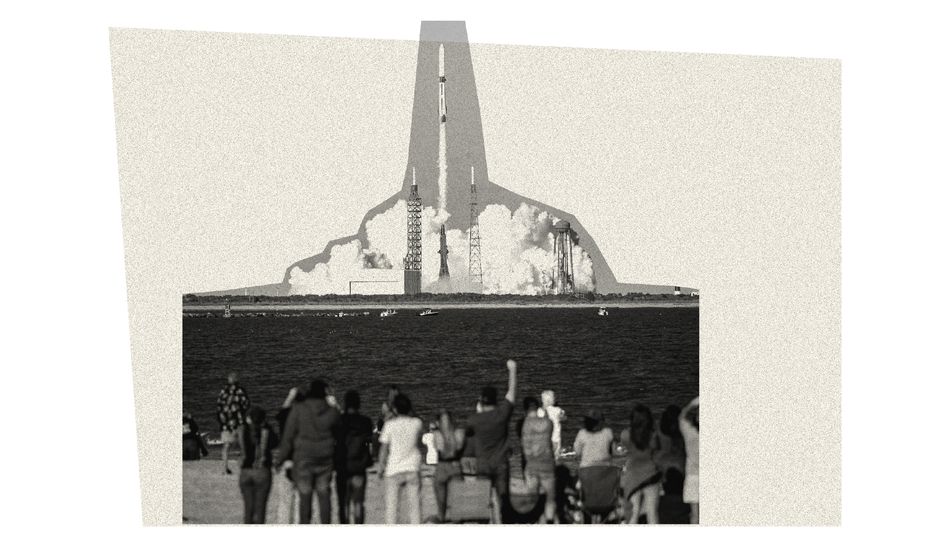
Musk and Bezos have both invested in space exploration, in Musk’s case planning to set up whole new Elonian civilisations on other planets. It speaks to a combination of monstrous ego and crushing anxiety.
There has always been much to be anxious about. In 1883, five months after Alva Vanderbilt had drowned her guests Marie Antoinette and Diana in champagne, a Massachusetts textile worker called Thomas O’Donnell gave testimony before the US Senate Committee on Education and Labor regarding conditions for working people.
“There are so many men in the city to work, and whoever has a boy can have work, and whoever has no boy stands no chance,” O’Donnell told the senators. “That is what leaves me in poor circumstances. Our children, of course, are very often sickly from one cause or another, on account of not having sufficient clothes, or shoes, or food, or something… My wife never did work in a mill, and that leaves me to provide for the whole family. I have two children.
“And another thing that helped to keep me down: a year ago this month I buried the oldest boy we had, and that brings things very expensive on a poor man. For instance, it will cost there, to bury a body, about $100…”
Q. How much money have you had within three months?
A. I have had about $16 inside of three months.
Q. Is that all you have had within the last three months to live on?
A. Yes, $16.”
Andrew Carnegie recognised the dangers. In “The Gospel of Wealth” he wrote: “The problem of our age is the proper administration of wealth, so that the ties of brotherhood may still bind together the rich and poor in harmonious relationship.”
True, unparalleled wealth had been created for the country, but the price to be paid in social cohesion was great, Carnegie allowed. “We assemble thousands of operatives in the factory, in the mine, and in the counting-house, of whom the employer can know little or nothing, and to whom he is little better than a myth. All intercourse between them is at an end. Rigid castes are formed, and, as usual, mutual ignorance breeds mutual distrust. Each caste is without sympathy with the other, and ready to credit anything disparaging in regard to it… Human society loses homogeneity.”
Three years later, during the Homestead strike, Henry Frick was nearly killed when an anarchist, Alexander Berkman, forced his way into the magnate’s Pittsburgh office, shooting him twice in the neck and stabbing him several times. Carnegie’s fears were being realised.
Suddenly, pictures of Luigi Mangione, who has been charged with the murder of United Healthcare CEO Brian Thompson, come to mind. For his 2025 book on the super-rich, The Have and Have-Yachts, Evan Osnos spoke to the founder of LinkedIn, Reid Hoffman, about the possibility of a backlash against Silicon Valley if AI leads to job losses. “I’ve heard this thing from a bunch of people,” said Hoffman, “Is the country going to turn against the wealthy? Is it going to turn against technological innovation? Is it going to turn into civil disorder?” As Osnos pointed out, in the years since 1990 the number of billionaires in the US had increased from 66 to more than 800, while the median hourly wage had risen by just 20 per cent.
For Henry Ford, at the height of his fortune after the First World War, the spectre that kept him awake at night was communism and, behind communism, the Jews. He spent a lot of money trying to convince Americans of a Judaic plot. For Peter Thiel, on the other hand, writing in 2009, what disturbed his slumbers was the realisation that capitalism and liberal democracy were antagonists. In fact, he wrote, “I no longer believe that freedom and democracy are compatible.” Feminised democracy was antagonistic to the Ayn Randian superhero of the tech revolution. In that battle, Thiel was for freedom.
Andrew Carnegie’s answer to the threat to social cohesion posed by his own success was massive philanthropy. He gave away around 90 per cent of his own fortune and built more than 2,500 libraries all over the world. “The man who dies thus rich,” he wrote, “dies disgraced.” Of today’s billionaires, Bill Gates—who previously knew Epstein, something he has said he regrets—has given away up to 40 per cent of his wealth, and the investor Warren Buffett has pledged 99 per cent. Bezos has promised to give away most of his fortune too. The others, not so much. Their money is for space, or AI, or gigayachts, or getting the right people elected.
Then there’s distraction. In the first Gilded Age, much of the anger around wage cutting was deflected away from the tycoons and onto immigrants, in particular the Chinese. In 1879, after virulent populist campaigns, Congress passed the Chinese Exclusion Act, which was finally signed into law in 1882, banning all Chinese immigration for 10 years.
For the past two years, Thiel—the political philosopher among the tech bros—has been giving a series of lectures warning of the coming of the antichrist, whose interests turn out to be embodied in supranational institutions like the EU, which might seek through regulation to hold back the march of technological progress.
Thiel’s ideas appear to have come, at least in part, from two different sources. One is the 20th-century German jurist Carl Schmitt, whose cardinal concept was that “the specific political distinction to which political actions and motives can be reduced is that between friend and enemy”. Once you have discerned this, any action taken to help a friend or thwart an enemy becomes morally justifiable. This led Schmitt to justify Hitler’s extrajudicial murders during the Night of the Long Knives in 1934. In its most acute form, it is a specific repudiation of the rule of law over political leaders.
The second was a French literary scholar-turned-“theological anthropologist” called René Girard, who taught Thiel at Stanford in the early 1980s. Girard was a Catholic convert and pessimist who believed human beings were animated by “mimesis”— an Ancient Greek term interpreted by Girard as the desire to have what the other possessed. Given this deplorable characteristic, the only way in which societies can cohere is by creating a “scapegoat” for everyone to blame and cast out.
In our moment, it isn’t hard to see who the scapegoat is: Thiel recently delivered a series of lectures in Cambridge at the invitation of the theologian James Orr, recently appointed policy adviser to the anti-immigration party Reform UK. Over on X, Elon Musk predicts civil war in Europe as a result of immigration, and attempts to boost the prospects of far-right parties such as the Alternative for Germany and far-right activists like Tommy Robinson. Here, the Monaco-based tax exile Jim Ratcliffe talks of Britain being “colonised”.
You could argue that we hardly need distraction, when we are so adept at distracting ourselves. The Epstein scandal tells us a lot about the networking and loose morality of a section of the elite. Even if the files don’t yet show other powerful men participating in his pre-2008 sexual abuse of girls and young women, they certainly indicate both that many had knowledge of and connived in his exploitation of young women, and that they were utterly indifferent to those women as people.
The sexual element in the case of Epstein provides an easily comprehended focus for our dislike of wealthy elites. It’s repulsive, but if it’s the structure of unaccountable power that we’re worried about, Epstein barely touches that. Our own lives and our children’s futures are being shaped by decisions made and bartered by stratospherically rich and powerful men, who these days think nothing of flattering, some might even say bribing, their way to contracts and favourable regulation. The simultaneous release of the Melania film and the Epstein files reduced the movie to a footnote and foregrounded the sexual abuse, but it’s the former that tells us more about the true nature of the elite of the Second Gilded Age.
The robber barons of the first Gilded Age were reined in, eventually. The Pendleton Act, preventing the effective selling of public offices to political cronies, was passed in 1883, the same year as Alva’s peacock cap graced her preposterous party. Over the next 40 years, a series of regulatory acts came into effect in the US. The unaccountable power of the plutocrats was to some degree curbed.
Now the question raised for us, particularly in Europe, is how to establish some accountability so that the activities of the US tech plutocrats suit our notions of how societies should function, not those of Elon Musk, Peter Thiel or Jeff Bezos. That battle is just beginning.We cannot afford that “comfortable fugue”.