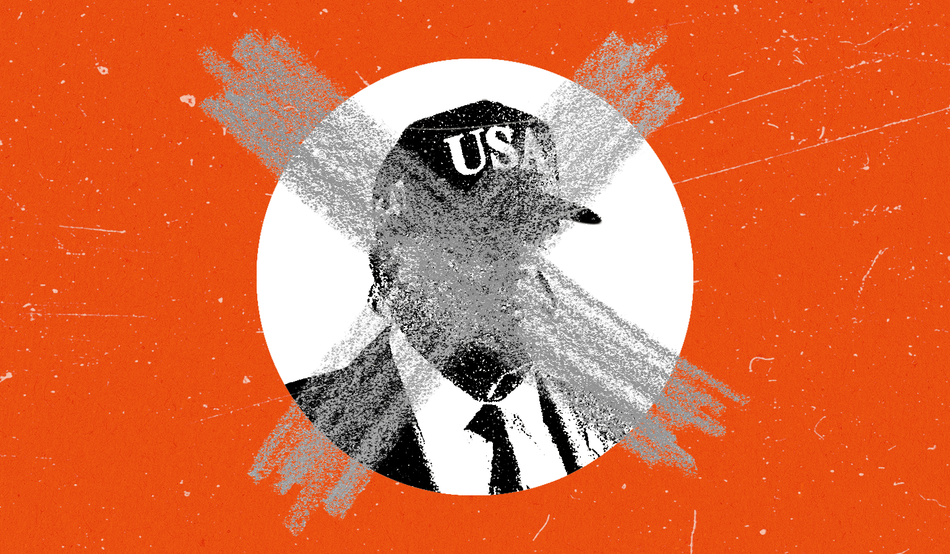
Last year, for this magazine, we put forward an unfashionable argument: that the Trump administration isn’t fascist. This was based predominantly on the president’s domestic policy. While he certainly exhibits authoritarian tendencies, some of the major tenets of fascism—such as centralising power in the hands of the state and working to bring about societal transformation—are absent. Instead, the Trump administration has systematically defanged government regulatory agencies, defunded entire government departments and routinely abandons or ignores the legislative and judicial branches. Its priority appears to be enriching the commander-in-chief (and his wealthy backers).
In the time since then, the president has been especially active in foreign policy. So we thought we would return to our original line of investigation: do Trump’s actions outside the US fit the patterns established by past fascist regimes? Many commentators and critics certainly think so. If anything, what’s happened in and around Greenland, Venezuela, Ukraine and now Iran has redoubled their attributions of fascism to Donald Trump.
We disagree. Let’s begin by setting out what baseline characteristics one might expect of a fascist foreign policy. Based on our collective expertise in fascism and US foreign policy, two stand out. First, fascist regimes typically have an overarching ideological framework for international relations and, by extension, use ideological justifications for foreign policy measures—for example, Mussolini and Hitler preaching war as vital for national regeneration. Second, fascist regimes tend to disregard international institutions and hold them in contempt.
As for Trump? The short version is that his approach to international relations is driven by instinct but is ideologically vacuous; while, far from casting aside international institutions, he appears, in fact, to be desperate for their recognition. Instead, his foreign policy looks to be shaped by two key forces: personal enrichment and glory-seeking. Now here’s the longer version…
Personal enrichment
Recent events in Venezuela and Greenland, in particular, merit closer scrutiny, especially in view of how Trump himself characterised them. Following the capture of Venezuelan president Nicolás Maduro in January, Trump claimed that the operation was a revival of the Monroe Doctrine, a US foreign policy position dating from 1823 that opposes any foreign interference in the Americas. With his famous self-effacement, he referred to his updated version as the “Donroe Doctrine”, telling reporters that “American dominance in the western hemisphere will never be questioned again”. And yet, despite these claims, the Mon- and Don- versions entail a key difference, that of national interest versus personal interest. Whereas the earlier one was designed to prevent European imperial entanglement in the western hemisphere, the new one is decidedly self-serving—or, as Trump himself admitted, prior to intervening against Maduro, “They took our oil rights—we had a lot of oil there. As you know they threw our companies out, and we want it [sic] back.”
There are more clues to Trump’s intentions. After Maduro’s abduction, he proudly announced that the US would “run” the country. The injured party, he adamantly maintained, was US oil companies previously “robbed” of their stakes by Venezuelan nationalisation of the petroleum sector. By his own admission, Trump gave advance warning of the operation to his associates in the oil industry: “We’re going to be taking a tremendous amount of wealth out of the ground.” In a revealing moment during a press conference following the attack on Caracas, secretary of state Marco Rubio handed a notecard to President Trump. Mistakenly reading its contents out loud, Trump relayed, “Go back to Chevron, they want to say something.” These are not the actions of a fascist dictator, but of an oligarchic mob boss seemingly uninterested in maintaining even the pretence of responsible governance.
Much the same goes for Greenland. Just one day after the seizure of Maduro, Trump turned his attention once again to this autonomous territory of Denmark. Despite the president’s repeated emphasis on the island’s importance to national security, an authoritative report published earlier this year by the Center for Strategic and International Studies (CSIS) points to its relative abundance of rare earth elements—Greenland ranks eighth in the world on that front, with 1.5 million tonnes—as the prime motivators. Those elements would open up lots of lucrative mining opportunities, thereby benefitting various US industries, from tech to defence.
These patterns persist in Trump’s diplomatic manoeuvres to conclude Russia’s invasion of Ukraine. Far from ending the war in 24 hours, as he had repeatedly claimed he would during his 2024 election campaign, his latest boast, one year into his second administration, is the “big business” currently being planned with the Kremlin post-war, so that America can “make a fortune”.
In the same vein, Trump’s vaunted “Board of Peace”, an entity set up to dictate reconstruction in Gaza, is under his own personal direction as the body’s chairman for life. No less than $10bn in US taxpayer money has been unilaterally pledged by the president—all without congressional authorisation. A further $7bn has been promised by other member states. Given the president’s dubious track record for responsible stewardship of federal funds, the question is warranted as to whether Trump will dedicate this sum to the declared task —or have these funds diverted into generous contracts for friendly companies.
Glory-seeking
This second driving force behind Trump’s foreign policy becomes clear when we take a closer look at the international diplomatic crisis triggered by Trump’s threats to annex Greenland. During his speech at the World Economic Forum in Davos on 21st January, Trump reversed his position, promising not to use force to take the island. At the recent Munich Security Conference, however, Danish prime minister Mette Frederiksen stated her belief that Trump’s desire to take over Greenland remained “the same”. Far from being over, the issue of Greenland’s sovereignty is still in a state of dormant tension, ready to flare up again at any time.
In an interview with VICE News in mid-January, former Danish foreign minister Per Stig Møller explained Trump’s interest in occupying Greenland by pointing to the Monroe Doctrine. The New York Times observed in November 2025 that “top administration officials have been explicit that their overarching goal is to assert American dominance over its half of the planet”. Møller also suggested another reason: Trump’s “vanity”. Indeed, when asked in early January by the New York Times “Why is ownership important here?”, Trump replied: “Because that’s what I feel is psychologically needed for success.” When the New York Times’s White House correspondent, Katie Rogers, followed up with, “Psychologically important to you or to the United States?”, Trump’s answer was revealing: “Psychologically important for me.”
The threat to annex Greenland is not about American security; it is about Trump’s personal craving for recognition. If Greenland were to become part of the US, it would constitute the largest territorial expansion in the country’s history, surpassing the 1803 Louisiana Purchase. This no doubt appeals to a president who seems to be profoundly fixated on his legacy and his place in the history books. In October last year, Trump claimed that, during a discussion with US Border Patrol officials, he’d been told that he was “the greatest president overall that we’ve ever had”, and that he’d then asked if this included Abraham Lincoln and George Washington, to which an official replied, both times, “yes”.
In a letter sent to Norway’s prime minister, Jonas Gahr Støre, in January, Trump explicitly linked his aggressive rhetoric towards Greenland and Denmark to his failure to win the Nobel Peace Prize. “Considering your Country decided not to give me the Nobel Peace Prize for having stopped 8 Wars PLUS, I no longer feel an obligation to think purely of Peace,” he wrote, adding that his objective was “Complete and Total Control of Greenland”. (The Nobel Peace Prize is in fact awarded by the Norwegian Nobel Committee, a private body whose decisions are independent of the Norwegian government.)
Of course, fascist leaders of the past had their psychological reasons for pursuing particular policies—that’s a fundamental part of politics at any level, of any persuasion. However—and crucially—their framing was different: these political goals were justified and expressed as supposed needs of the “people” or the “nation”, not as personal needs of the leader as an individual. By the same token, fascist leaders may have acquired substantial personal wealth during their time in power, but they did not advertise this as their principal motivation.
Which brings us to Iran. In justifying the ongoing military campaign—which, of course, entirely lacks congressional approval—Trump points at everything from the Iranian government’s mass killing of its own civilians to its nuclear weapons programme. These claims are not convincing. While daily Russian air attacks terrorise and murder civilians in Ukraine, Trump contemplates lucrative deals with the aggressor.
The truth is more likely to be contained in, as it happens, one of the president’s Truth Social posts, written during the first hours of the bombardment. In this post, Trump implicated Iran in his broader conspiracy narrative of electoral interference in his 2020 defeat to Joe Biden. Fascist? No. Self-centred? Very much so.