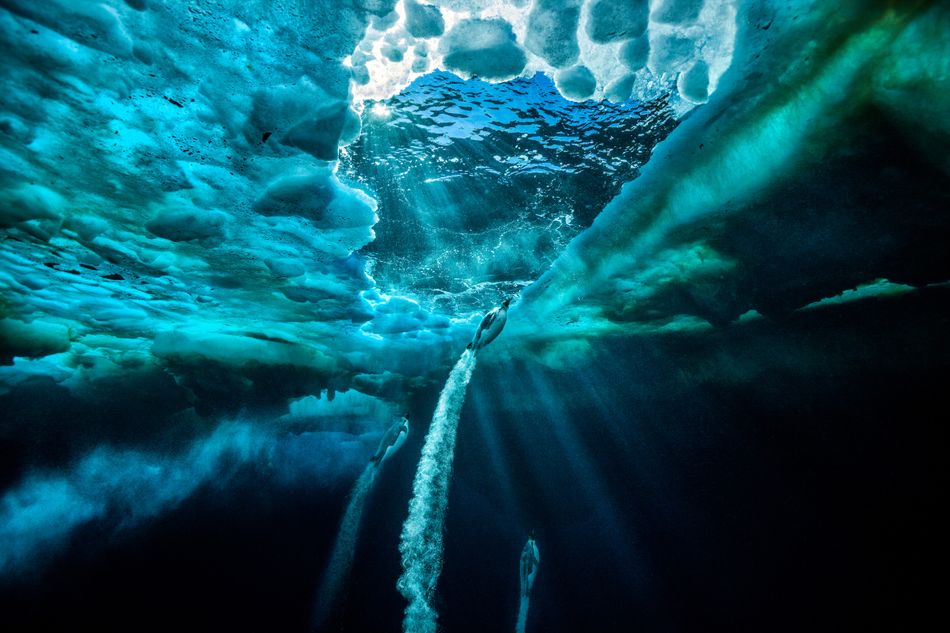
The frigid, life-threatening water, deep beneath the thick sea ice of Antarctica is the last place most people would want to find themselves. But for Paul Nicklen, a photographer and filmmaker who dares go where others fear to tread (or swim), it’s a wonderland. “It’s amazing,” he tells me. “If you’re in the Ross Sea, the visibility could be up to 300 metres. You’re underwater, looking at an iceberg that’s going down 1,000 feet deep, and then you see emperor penguins rocketing from the open sea, diving down, and coming up against the iceberg. It’s one of the most beautiful things I’ve ever experienced, seeing the blues and hues. But many people don’t even know it exists.”
The penguins’ fragile Antarctic home, threatened by climate change and overfishing, is just one of many locations on our planet in need of urgent attention. “It’s out of sight, out of mind, and people don’t know it’s in trouble,” Nicklen adds. “We’re only going to react when the sea level is rising in New York, London and everywhere else, but by then it’ll be 200 years too late.”
Nicklen, a National Geographic veteran, does this work with a pioneer of conservation photography, Cristina “Mitty” Mittermeier. Together they have travelled to the ends of the Earth, from the Arctic to Antarctica, Ecuador to Indonesia, using their photography to rally support for the protection of the natural world. It’s thrilling work, which often brings them eye to eye with polar bears, sharks and enormous blue whales, or alongside orca at a baitball feeding frenzy.
But their image-making has a serious mission. “Sometimes I have to pinch myself that this is my job,” admits Mittermeier. “It’s so wonderful. But this is not recreational diving. It’s sometimes very, very dangerous—very remote, very wild. And it can be very depressing. You’re on the frontlines, seeing terrible things: whales that have been hit by ships, sharks that have been finned, sea turtles tangled with debris… There’s a lot of death happening underneath the surface that people don’t see. I have nightmares about our oceans dying.”
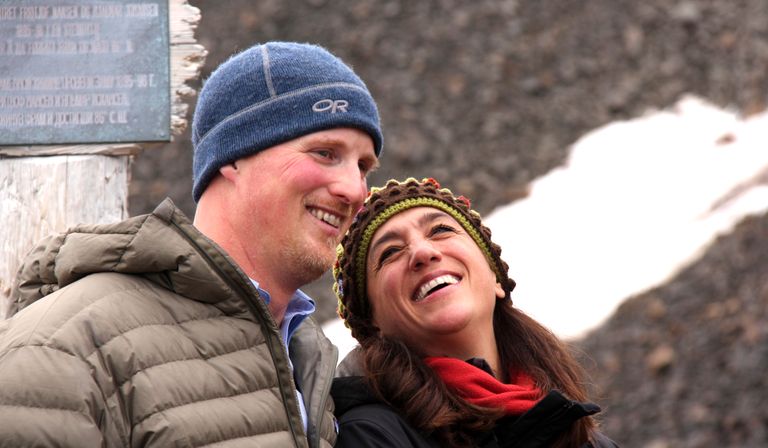
Personal and professional partners, Nicklen and Mittermeier are speaking from their home in British Columbia, between expeditions. Shelves around them are stacked with heavy photography books, alongside masks, statues and other artefacts collected from their travels.
Their images of indigenous peoples, landscapes and terrestrial creatures, as well as marine life, have appeared in outlets including CNN, the Washington Post and the New York Times. One of Nicklen’s photos, “Ice Waterfall”, was even used as the cover image for Pearl Jam’s 2020 album Gigaton. They count the late Robert Redford, Justin Timberlake, Jennifer Garner and basketball player LeBron James among their friends and supporters, and Mittermeier has worked with Will Smith on his show Welcome To Earth.
The husband-and-wife team are an obvious fit, each having grown up with a deep connection to nature and a background in science. They both believe that visual storytelling can help bring about material change in the world. Two new books of their photography—Nicklen’s is called Reverence, while Mittermeier’s is called Hope—are named after states of mind they consider to be in short supply.
Nicklen was born in Saskatchewan, Canada and grew up on Baffin Island, home of the Inuit, within the Arctic Circle. “I learnt survival skills and how to be tough in a cold environment,” he recalls. “I also loved trying to capture what was going on. By the time I was 10, my mother had a darkroom in our basement. I’d watch her take [photos of] the Inuit culture and turn her images into beautiful black-and-white prints. I was blown away.”
Later on, he studied marine biology and worked as a wildlife biologist for the government of the Northwest Territories, Canada, before starting out as a freelance photographer in 1994. He made his name with boundary-pushing work for a 2006 feature in Antarctica, including an encounter with a giant female leopard seal who tried to feed him penguins. In total, he says he completed 22 challenging National Geographic assignments during his career, often enduring long, patience-testing shoots in gruelling conditions, including ice, snow and cold water.
At the magazine, “I was known as the photographer who could probably freeze and be more miserable than anyone else,” he laughs. “With [my] coastal wolves story in British Columbia, I only saw the wolves for five days out of 90 days. For 85 days, I sat there seeing nothing. Not many photographers would have that level of patience.”
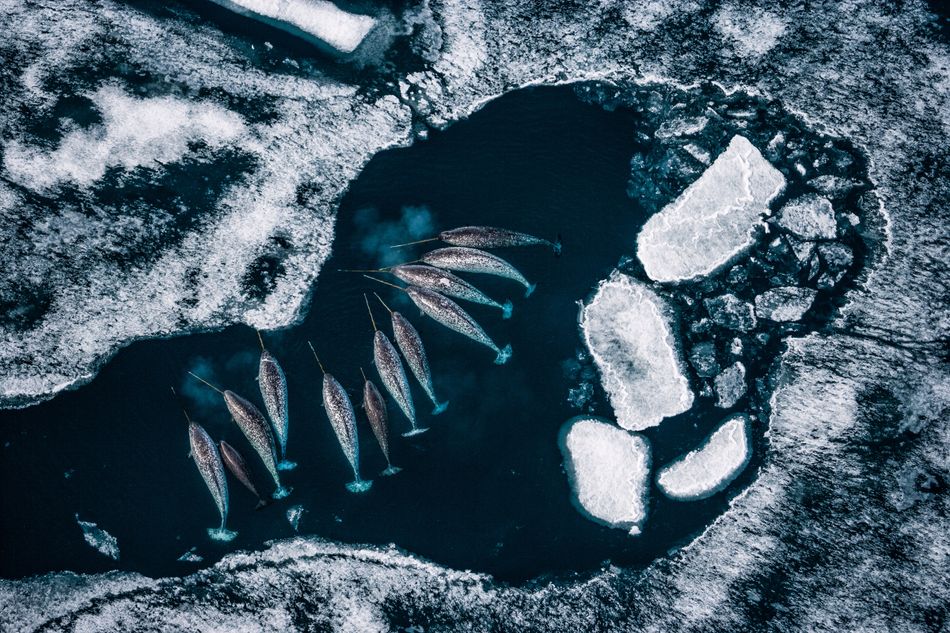
He also spent five years searching for narwhals in Nunavut and got one day of shooting: “Then I fell through the sea ice and dislocated my shoulder, which ended the shoot. After you’ve been doing this all your life, you realise that a 98 per cent failure rate isn’t too bad. It’s also about that 2 per cent—you’re trying to find those moments of success.”
Nicklen has lost friends who, like him, went to extremes. “Back in the day with National Geographic, you were only as good as your last story,” he explains. “You were willing to risk your life to come back with a set of images the magazine could publish. I’ve blacked out from running out of air underwater. On another shoot, I developed a hole in my lung by holding my breath too long. I crashed my airplane into an Arctic lake up in the Yukon and flipped upside down—a wheel came through and cut my leg. I was trapped in the cockpit. I should’ve died.” But, he says, “there are a million amazing moments for each scary one. My mind is filled with sitting in the forest with spirit bears [also known as kermode bears] or watching a mother grizzly bear teach her cubs to hunt.”
Mittermeier was born in Mexico City in 1966 and spent her early years in Cuernavaca. Her love for the ocean came from reading adventure books by the Italian novelist Emilio Salgari, including stories about pirates, many involving female heroes.
She studied biochemical engineering in marine sciences at Mexico’s Technological Institute of Monterrey and intended to work in the fishing industry, until she witnessed firsthand the scale of waste, death and destruction on industrial fishing boats whose harmful practices included bottom-trawling. “The scope of death is monumental,” she tells me. “Many tons of marine creatures are pulled out every time the nets come up. I thought: ‘Nobody sees this. People are completely unaware of the ecological price for the food we eat.’”
The experience pushed her into a life of environmental work, including for the charity Conservation International Mexico. Borrowing cameras from her husband at the time, conservationist Russell Mittermeier, she found photography “sparked something in me.” One of her earliest projects, in 1994, focused on the indigenous Kayapó people in Brazil, who were set to be displaced by the construction of the Belo Monte hydroelectric dam.
Mittermeier went on to set up the International League of Conservation Photographers (ILCP) in 2005, serving as director for six years. “I didn’t know how powerful photography could be—I was guessing at it,” she says. She remembers seeing photographer Peter Dombrovskis’s work in Tasmania, which was instrumental in preventing the damming of the Franklin River in the 1980s, and the work of Michael “Nick” Nichols: “They were nature photographers, but taking their photos and making sure the people making policy decisions would be informed by their work.”
Although she’s no longer involved with the ILCP, it was through the organisation that she met and started working with Nicklen. The pair soon became a couple. “Paul had an anger about what was happening to nature,” Mittermeier says, “The more we worked together, the more we realised we had an enormous passion for the ocean, that it is an invisible ecosystem to most people, and that we have the skills and the passion to do so much.”
In 2014, they set up SeaLegacy, a non-profit organisation focusing on ocean conservation, often working with local communities, NGOs or government agencies to fight against plastic pollution, overfishing or oil drilling. They also support initiatives such as the creation of new Marine Protected Areas. “When I was a scientist, I thought I could compel people to feel the urgency through science, just by showing them the data, the graphs,” Mittermeier explains. “I realised very quickly that most people don’t speak ‘science’. We identified a huge gap in the ability for organisations to communicate issues. Photography is a great way to invite people into the conversation. If we’re going to solve the big issues of our planet, we need everybody to participate.”
Nicklen, Mittermeier and their colleagues often travel to remote parts of the world on SeaLegacy 1, their 62-foot, custom-built, expedition catamaran, sharing their visuals online. Mittermeier has 1.6m followers on Instagram, while Nicklen has more than seven million. “Rather than do a story in a magazine that takes one or two years to shoot, now you can put up stories on social media every day,” he says. “We can reach millions of followers on our channels. We use the power of visual storytelling to galvanize a global audience to take action.”
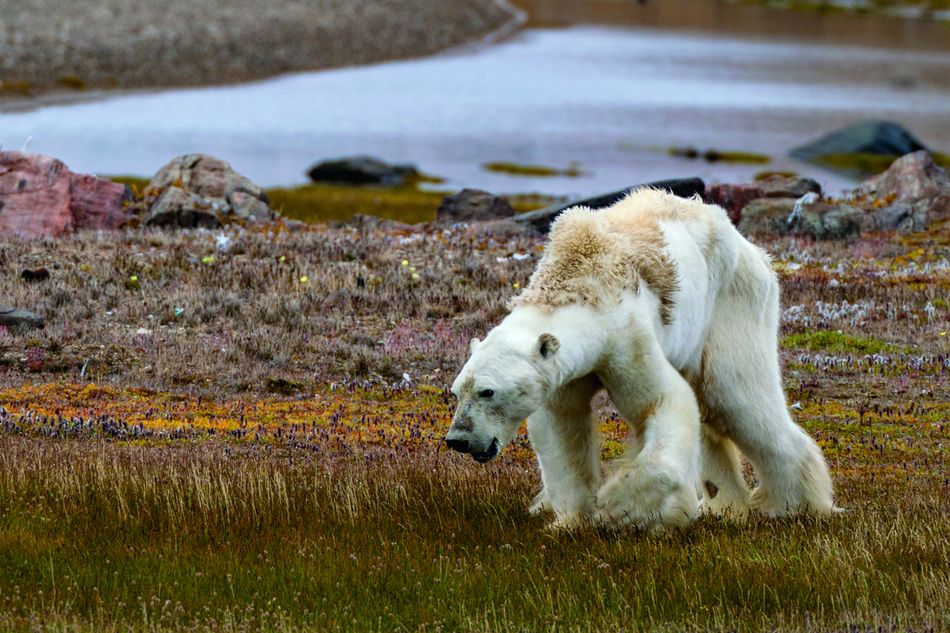
The couple’s images can be hard-hitting. One of Mittermeier’s shots of an emaciated polar bear in the Arctic, also captured on video by Nicklen, went viral and was adopted as a symbol of climate change, though the causes of starvation were unknown. But, more often, they highlight the beauty and wonder of the natural world, life on Earth as it should—and could—be. “We have to show the future we want to achieve,” says Mittermeier.
But can photography and video bring about genuine change? “100 per cent,” Nicklen says firmly. “When we found mile-long death nets targeting swordfish, which we shouldn’t be eating anyway, off the coast of Los Angeles that were indiscriminately killing sharks, whales, dolphins and turtles, we used photography.” The horrifying images brought much-needed attention to the issue. The California State Senate would go on to vote overwhelmingly in favour of banning the nets.
In Lofoten, Norway, they were part of a campaign against planned seismic blasting and oil drilling, which threatened a feeding ground for 2,000 orcas, as well as blue whales, humpbacks, sperm whales and fish. “We were able to keep Big Oil out of this really rich area,” he says, “I’m proud of those moments. Nothing feels better than a conservation win. All you have to do is draw a line on a map and protect it, and nature will take care of itself.”
The creatures they’re trying to protect don’t always appreciate their efforts. On a beach in South Georgia, an island in the South Atlantic Ocean, Nicklen was attacked by a breeding male elephant seal, keen to ward off any potential threats to his harem. “As soon as he saw me, he tried to kill me,” Nicklen says. “They rear up five metres tall in the air and lunge at you. It’s like someone trying to smack you down with a pickup truck.” He narrowly made it out alive.
Mittermeier has her own stories of close encounters. “I used to think I’m so lucky and that I have a special energy that means animals relax around me. But it’s not true,” she laughs. “I was almost killed by a southern right whale in Australia. These are really wild animals. They’re not used to seeing humans. A mother got spooked when her baby got too close to me, and she threw her fluke [or tail’s end] at me. She would have decapitated me, had I not been horizontal.”
‘A male elephant seal tried to kill me. It’s like someone trying to smack you down with a pickup truck’
There are many more times, though, when the two photographers have been welcomed into the animal kingdom: walking with pumas or elephants, enjoying playtime with seals and baby sperm whales, witnessing daily life for creatures great and small. Diving one night in the pitch-black water of Raja Ampat, Indonesia, Mittermeier found herself alone with a small, curious squid. “The lights on my camera seemed very exciting, so it started flashing colours,” she tells me. “Its skin, covered in special cells called chromatophores, shifted colour and seemed to be lit from within. When it got a glimpse of its reflection on the surface of my dome, it really got excited. Its fins were dancing wildly and its eyes grew larger. Everything about it made me think of extraterrestrial life. Weeks later, I still had to pinch myself at the beauty and complexity of this creature that most people will only ever know on a plate, covered in mayonnaise.”
Many of their favourite images from across the decades are presented in their new books. For Reverence, Nicklen revisited his archive of 2.5m images and selected the ones which prompted the strongest emotional reaction for him, including his famous work on leopard seals, narwhals, spirit bears, walruses, penguins and whales, with a surprising number of lions, elephants and gorillas. Its foreword is written by Nicklen, adopting the voice of Mother Earth, who suggests that the planet will survive but humans may not. “It allowed me to really say what I wanted to say,” he explains. “For me, there’s incredible sadness and grief watching all these animals and ecosystems die.” Global wildlife populations have dwindled by more than 70 per cent since 1970 and 90 per cent of large fish are gone, “yet we’re still fighting over who’s going to get all the oil.”
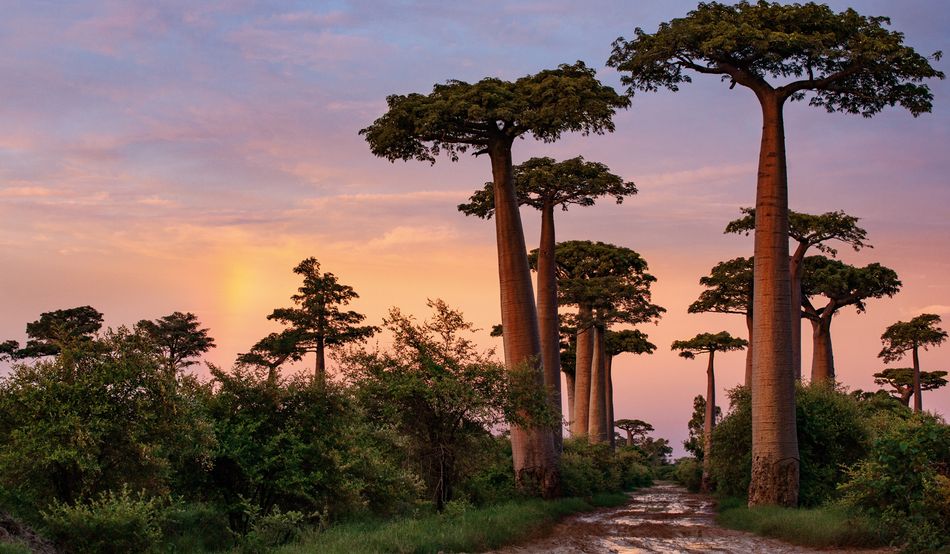
Mittermeier’s book, Hope, brings together the varied strands of her work, including underwater and terrestrial wildlife, natural landscapes, such as baobab forests, and communities from Ethiopia to Brazil. “With indigenous people, it’s not a ‘hocus pocus’ knowledge that they have,” she says. “It’s a system of values that’s pretty universal across the globe and that goes back thousands of years, about how to tread lightly on a planet that has finite resources.”
In the face of demoralising statistics and headlines, hope requires resolve, says Mittermeier. “For those of us close to the everyday avalanche of bad news about the environment, mental health issues are a real concern. I can’t help feeling a deep sense of despair and personal pain. But my job is to be inspiring and to speak about solutions.”
SeaLegacy will continue working on projects around the globe. But Nicklen and Mittermeier, both approaching 60, are currently going through a transition and life is about to become a little warmer. Often thought of as “the polar guy”, Nicklen has become obsessed in recent years with Africa, and plans to buy land in Kenya and a small plane. He’d like to spend more time there and get involved in projects such as anti-poaching, ranger training and rhino relocation work. They also plan to spend more time in, and perhaps move to, Mexico, Mittermeier’s home country.
Both are fed up with the neglect and dismissal of the science on biodiversity loss and global heating, and with world leaders failing to adequately tackle the climate crisis. Nicklen admits to being a little battle-weary. “I’m not giving up, but I want to be a little selfish at times,” he says.
Their fight is far from over, though. Mittermeier believes powerful imagery is needed to communicate the severity of the crises now facing the planet and that it is already “bringing people around” to conversations about how to respond. “There are so many people who want change.”
“We’re winning important battles but we’re losing the war when it comes to nature,” Nicklen adds. “That is what gives me that sick, dark feeling in my stomach. We’re on a very dangerous, destructive path. Everything dies around us, and the situation has become politicised and polarised. I want to be optimistic. But if we’re really going to save ourselves and our planet, we need the whole world paying attention.”
Reverence by Paul Nicklen and Hope by Cristina Mittermeier are both published by Hemeria. See paulnicklen.com and Instagram @paulnicklen, www.cristinamittermeier.com and Instagram @mitty, and www.sealegacy.org and Instagram @sealegacy