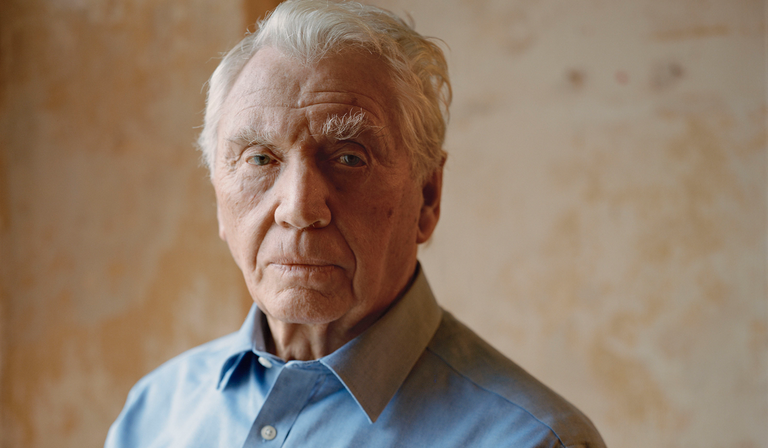
It’s late winter in Somerset and, in true February fashion, the weather doesn’t know what to do with itself: intermittently it’s thrown up blue sky, scuds of grey clouds, patches of rain, a buffeting wind. It’s Don McCullin’s favourite sort of weather. “These are the kind of days I’d go out and do landscape photography,” he says, as we saunter towards the art library run by Hauser & Wirth in Bruton. “You’re standing there helping yourself, free of charge, to the sky, the elements. It’s hard sometimes, because you’re frozen to bloody death.” It’s certainly true that if you were to look out of the window at any point on the train between here and Bath—where McCullin currently has two simultaneous retrospectives, at Hauser & Wirth and the Holburne Museum respectively—you’d spot a dozen scenes straight out of his photographs: glasslike puddles cut into muddy fields; old wooden fences snaking off into the cleave of some rolling hills; barren trees twisted and gnarled into little knobbly fists, clenched at nothing.
For the past four decades, this former north London boy has made his adopted home in the West Country one of his principal subjects, a far cry from the haunting images of conflict, suffering and death that continue to define him and his work in the popular imagination. Yet if McCullin’s second life of landscapes looks unrecognisable to us from his first as a hardened war correspondent, both remain integral to understanding him as a photographer. Perhaps more than any other kind of creative practitioner—McCullin loathes the term “artist”—the lives of photographers are tightly bound to their subjects: by necessity, they must confront the very thing they are trying to capture in real space and real time. Even now, at the age of 90, every time McCullin seeks out his next picture he is making a decision. How he comes to that decision tells us a lot about how he has produced some of the most powerful photographs in recent times, just as it says something about who he is as a human being.
McCullin is fond of one anecdote about his first camera, a twin-lens reflex Rolleicord he bought for £30 in the 1950s. He was leaving a café on north London’s Blackstock Road, where he’d been photographing his gangland friends off the back of his first successful commission for the Observer, when a police car rolled up and told him to get in. “They thought the camera was stolen,” McCullin says. They asked him to prove he had bought it himself or else he’d be off to the station. Fortunately, McCullin had kept the receipt. They drove him home where he went in and returned, triumphantly, with the crinkled piece of paper. “Can we drop you back to where we first found you, sir?” the policeman said, sufficiently cowed.
It was, above all, a vindication. But it was also confirmation of a more deep-seated fear of his own: that it was simply not possible for a person like McCullin to be a photographer.
McCullin was brought up in Finsbury Park at a time when the area was notorious for its poverty and gang violence. The McCullin family, which besides Don and his parents included two siblings, all shared a single bedroom. “I grew up in a really rotten tenement house with four families living above us, and no indoor lavatory or bathroom,” he says. To wash, they had to go down to the public baths once a week. Most of his friends were in gangs; confrontations with the police were common.
McCullin’s father died when he was 14, which marked the end of his brief dalliance with further education at the Hammersmith College of Art. (“It wasn’t much of an art school,” he says—despite earning a scholarship to go there, he claims it was a place for those “without much potential”.) Dyslexic and partially colourblind, young yet now in the unenviable position of family breadwinner, he spent a year working as a pantry boy on the steam trains going between London Euston and Liverpool. It was his first taste of travel. “Those train journeys opened my eyes to the Industrial Revolution,” he says. “Seeing those satanic cities that hadn’t been scrubbed up with pumice stones and washed down years later. That was a fantastic piece of education.”
After the railways came a stint at an animation studio in Mayfair, WM Larkins, then national service in the RAF, where he helped develop reconnaissance photographs taken by bombers coming back from Kenya during the Mau Mau uprising. It was these two occupations that taught him how to use a camera and develop film. Where he might next apply these newfound skills was unclear: his friends were more than happy just to have their picture taken, but McCullin himself was less sure. One day his mother asked him what he’d done with his Rolleicord, to which he told her that he’d pawned it; she marched to the shop and bought it back with her own money. It was the decisive moment of McCullin’s life.
‘It’s not about just being a photographer. It’s about being a person who can translate with your emotional eyes onto a piece of film.’
Then in 1959, aged 23, came the surprise acceptance of some photographs he’d sent to the Observer—a paper he never read and approached purely on a whim—and with it a commission to take more, for a photo-essay on youth gang violence. Thus began his career as a photojournalist, first for the Observer and then the Sunday Times, which for more than 20 years would take him across the world to document some of the most brutal conflicts of the 20th century, in Cyprus, Vietnam, Lebanon, Biafra and elsewhere. “If I’d have been a much more intelligent, sophisticated person,” McCullin says, “I don’t think I could have taken on the wars and the tragedies and the dying children. I think I would have crumbled.”
A Turkish-Cypriot woman lamenting her husband as he lies in a pool of his own blood on the living room floor. A group of Phalangist boys on a bombed-out street in Beirut, one of them, with a sinister grin and holding an oud, “serenading” the corpse of a Palestinian girl. Policemen in Derry with batons raised, some of them smiling, as a horrified woman looks on from her doorway. A portrait of a young man in South Sudan with thick, undulating keloids ripped across his forehead. Matter-of-fact description goes some way to explain what makes these pictures so harrowing, but gives only a fraction of the story in isolation. There is what Harold Evans, McCullin’s former editor at the Sunday Times, called his “innate artistry”; always shot in black and white, McCullin’s pictures are unusually high contrast, which—together with their dramatic composition—lends them a particularly stark quality. But more than even this is something beyond the purely visual: McCullin’s empathy.
“It’s not about just being a photographer,” he says. “It’s about being a person who can translate with your eyes, with your emotional eyes, onto a piece of film.” McCullin has spoken often of this need to “feel” photographs as opposed to just taking them, to do justice by the people he encounters with every shot: he will not take a photograph, however good it may be, if he feels that to do so would strip his subject of their dignity. “I make my own rules and I stick to them,” he says, which is also why he invariably works alone.
This deep empathy was little solace when it came to the dilemma inherent to making a living off the suffering of others. He tells me about a time he went to be interviewed by the BBC and a technician who was to help with the recording refused to show up. “He said, ‘I’m not going to be here when that bastard comes in, that bastard who earns his money photographing dead people,’” McCullin says. “I thought, fair enough, if that’s the way he feels.” Most of the time, though, McCullin has felt his guilt keenly— “I have to live and sleep with all these memories”— which is perhaps only exacerbated by the fact that, deep down, he enjoyed going to war zones. “I like being in a war, I like being there because it’s a great adventure for me,” he told one reporter back in the 1960s. “But my duty is to be there for a reason, not just for a bloody good time.”
He strikes a similarly ambivalent note now. “Everything I’ve done in photography I’ve enjoyed doing,” he tells me. “I’ve enjoyed the process of taking photographs, processing the film in my darkroom. It’s given me a broader sense of the world I live in. But I don’t really feel I’ve achieved very much.”
By the 1980s McCullin was still a self-confessed “war junkie”, but the British media landscape on which he depended for assignments was changing. In 1981 the Times and Sunday Times were bought by Rupert Murdoch, with Evans squeezed out less than a year later. His successor-but-one at the Sunday Times, Andrew Neil, brought a fundamentally different philosophy to the paper. Neil was less interested in the hard-hitting stories that used to be a trademark of the Sunday Times magazine, preferring what McCullin calls “fruit salad” journalism: puff pieces about money, luxury and celebrity gossip, something more palatable to look at over brunch. McCullin soon followed Evans out of the door.
But at home there was an even greater tragedy unfolding. With the Times still going through the tumult of regime change, McCullin had left his wife for another woman and moved to Somerset; before the divorce papers could be filed, his wife was diagnosed with incurable brain cancer. She was found dead on their son’s wedding day. “I thought, ‘Am I being punished? Have I done something wrong?’ And the answer was no, it wasn’t me who was being punished. It was my wife. She was the unfortunate person who died that day. I knew then that all the things I had photographed in other people’s wars had appeared in my own house.” Just as in war, he felt guilty about being the one to come out the other end alive. The equivalence was too much to bear. He needed a different subject to photograph. And so came the landscapes, and much more.
Amid McCullin’s war pictures at the Holburne is one never before exhibited, of a sculpture uncovered in Crowther’s Reclamation Yard in Isleworth, in 1963: a naked woman sits on a pedestal while a male admirer suckles comically at her knees. It’s tawdry in the extreme, but it holds the seeds of an idea that McCullin would only explore at greater length in his later years.
Also at the Holburne are a selection of those works, all of them Roman statues from collections across Europe. A broken Venus crouching, as if cowering from the light above; a headless Amazon, on a headless horse, rearing threateningly over a wandering barbarian.
The statues appeal to McCullin for the same reason he is drawn to landscape: they come with no moral quandary. “They can’t refuse me,” he says. “They can’t remonstrate or talk to me. I’ve got them to myself. I own them for that moment.”
It’s an impressive series, not least for the technical prowess on show: although McCullin photographed each statue in situ in the museum, they appear to emerge, shining and isolated, from a black abyss, an effect he has achieved entirely in the darkroom. But whenever I try to direct McCullin onto these “loftier” aspects of his work, he grows coy.
“Why did you want them on these black backgrounds?” I ask.
McCullin frowns. “So you can see them better!” he says. “People are always asking me this, and I never know why.” (I think about the time Evans said McCullin was “incapable of pretence”.)
Likewise, when it comes to the question of what interests him about the Roman empire, he avoids any grand statement. “Oh, the Roman thing,” he says, about a project on which he’s toiled away for over 20 years. Inspired after a trip to Algeria with his late friend Bruce Chatwin, he says, “I went to [publisher] Jonathan Cape, and said, ‘I want to do something about the Romans.’” Just like that. He has now done three books on “the Roman thing”, leading him to photograph the frontiers across Africa and the Middle East—including Palmyra in Syria, before its partial destruction by Islamic State—then photographing Hadrian’s wall in winter, now this latest turn towards statuary. “It’s a bit of a cheat, a boy from Finsbury Park with no education…” he pauses. “It was always at the back of my mind, maybe at the front of my mind, saying, ‘What would those sods at Oxford say about this upstart?’ Because that’s the home of the classics. I got the Bodley Medal last year,” he adds. Before I can congratulate him, he exclaims: “Someone from Finsbury Park! Someone, you know, totally a thicky, with the Bodley Medal, which is meant for writers of the literary world! Sometimes I laugh at that. I think it’s laughable, really.”
And so we’ve come back to that class shame, that same guilty conscience that has plagued McCullin his entire life. Of his achievements, he is disparaging (“I’ve been overrewarded”); of his impact, dismissive (“I don’t feel as though I’ve made any dents in the unpleasant side of our world”); and of his social standing (he counts Queen Camilla as a close friend), permanently unsteady: “I’ve always watched the ice to see how thick it is under my feet.” The impression McCullin gives in these moments is of a man who has gone to extraordinary lengths but never truly arrived; of a man, as John le Carré once said of him, “deeply ill at ease with the world’s condition, and his own”.
It’s a reflexive self-criticism that only grows more acute as McCullin ponders his own mortality. “I’m going to die in a couple of years’ time,” he says. “And my photographs will be forgotten.” The chemicals of the darkroom are becoming too hazardous for his health. Recently, he had a cancerous tumour removed from his face; he points to a faint ringlet of a scar under his right eye. “I spent years doing landscape around here and I can’t climb over those farm gates anymore. One day, I got so tangled up with barbed wire I had to take my trousers off to get out!” He pauses again. “Now I’m going to say something really profound.” He waits to make sure I’m ready. “You can lose your life in a war, or you can fall over a farm gate and break every bone in your body at the age of 90.”
With the scope for future work narrowing, it’s maybe only natural that McCullin’s thoughts would turn more to his legacy. This doesn’t mean, however, that his prognosis is correct. It’s the dullest platitude to say that nowadays we have become numb to scenes of human suffering, that war photography—in the words of Michael Ignatieff—is now a “nightly banality”. To look at any of McCullin’s pictures is to remind ourselves of the broad human capacity to be moved, how deeply affected we still are by the world around us in all its complex guises, wherever we are and whatever it throws at us—whether it’s a devastating conflict or a silent wintery scene.
Don McCullin: Broken Beauty is on display at the Holburne Museum, Bath, until 4th May; Don McCullin. 90 is on display at Hauser & Wirth, Bruton, until 12th April