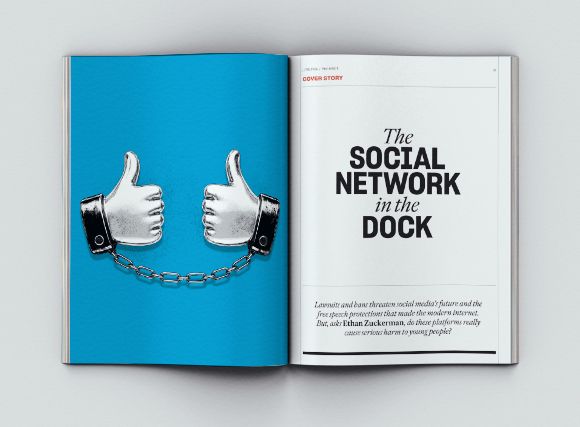
The anxious generations
Ethan Zuckerman’s well-researched feature (“The social network in the dock”, June) had an administrative focus, but I am more alarmed by Office for National Statistics figures showing that in the UK there are nearly one million Neets (“not in education, employment, or training) aged 18 to 24. As a former training manager of a large group of companies, I see this as a real tragedy. A high proportion of our young aspirants have been rendered incapable through chronic anxiety combined with negligible employment opportunities. Think five to 10 years ahead, when this generation will be having families. What will be the future for their children?
Zuckerman quotes research indicating that the argument of Jonathan Haidt’s The Anxious Generation was overplayed. But that is not my feeling, nor is it that of the claimants in the United States suing for deeply disturbed young adults affected by the addictive nature of social media. I cannot match a study of 350,000 adolescents, but I can report on colleagues and friends seeing how social media conditioning can change someone’s character, making job-seekers less employable: self-centred (not selfish), lacking communication skills, undisciplined, uncomfortable with teamwork and unaware of wider organisational purpose. AI will simply compound this social catastrophe.
We must not let this generation down. This is not just an economic issue but an urgent shared social necessity. It is also a global problem. My suggestion is to establish an International Convention on Responsible and Ethical Guidelines for the Development of all Digital Communication, which aims to balance technical innovation with social enrichment.
Julian Parker, Harpenden, Hertfordshire
What’s unsettling is not that Meta and Google dominate, it’s how normal digital dependence has made that dominance feel almost invisible to everyday users.
This kind of platform power conversation is becoming impossible to ignore. I’ve seen the software firm Colan Infotech touch on similar concerns about where dominance of tech infrastructure slowly turns into silent control.
charlesadam, via the website
Google and Meta et al are as American as insatiable greed and superfluous profit-wealth. Meanwhile, a large and growing number of people are increasingly too overworked, tired, worried and rightfully angry about unaffordability and thus insecurity for themselves and their family to sufficiently criticise or boycott Big Business for the societal damage it causes. I doubt that this effect is totally accidental, as it greatly benefits the interests of insatiable corporate greed. The more that such corporations make, the more they want—nay, need—to make next quarter. The media will implicitly celebrate their successful greed, or “stock market gains”.
It really seems there’s little or no moral accountability when the biggest profits are involved. “We are a capitalist nation, after all,” the morally lame self-justification may go.
Here in Canada, many consumers even hold the erroneous notion that they live in a nation with truly competitive and therefore consumer-fair markets. But in reality, big corporations are able to get unaccountably even bigger, defying the very spirit of rules established to ensure healthy competition by limiting concentrated ownership—especially in regards to corporations profiteering from the necessities of life, notably food. Those rules, however, are largely unenforced.
Frank Sterle Jr, White Rock, BC, Canada
Breathing space
While I very much enjoyed Isabel Hilton’s informative article (“The new space race”, June) I have always been very uncomfortable with all interference by mankind in that which lies beyond the Earth. Who really wants to look up at the moon and know that humans are living on it, tampering with it, damaging it and looking back at us? Certainly not me.
Anybody who cares about the Earth, the moon, Mars and anywhere else either terrestrial or extraterrestrial should be strongly opposed to space exploration. It is obvious that the US for one intends to colonise the moon and Mars. This is an outrage. America doesn’t own them and nor does any other nation. Yet the so-called superpowers continue bulldozing their way around space, staking their claims in an extension of what they already do on Earth. Meanwhile, the rest of the world claps along, praising this desecration and polluting of space as progress. But on whose authority other than their own do humans blast off into space to mess around with it?
Just think how much junk is floating around up there already, and what malevolent purposes some or most of it might be used for. We might be under surveillance every second of every day by any number of spy satellites. Only those doing the watching really know.
How much damage to the ozone layer have all those monstrous rockets caused every time they burn their way through the atmosphere? And if the US, Russia or China do ever colonise the moon and Mars, then how long before one of their enemies develops a nuclear missile powerful enough to reach and obliterate a faraway planet and its human colonists?
And just think what problems here on Earth might have been eradicated, or at least ameliorated, if all the trillions spent on sending rockets to collect some extraterrestrial mineral samples and take a few photographs of nothing very much had instead been used to try to end starvation, disease, poverty and war. If it had instead been invested in preserving and improving a planet already abundant in water, oxygen, flora and fauna, rather than searching millions of miles away for even the tiniest sign of life?
If there is life on Mars then it should be left alone. It’s all here already, everything we require. All we need to do is make the most of it; manage it so that everyone has enough of what they need in order to exist. Why on Earth do we need to look any further than Earth?
Stefan Badham, Portsmouth
Citizen lords
The most interesting idea in Tarunabh Khaitan’s piece (“Britain’s electoral reform debate is too narrow”, Prospect online, May) is buried in its final paragraphs: a proportionally constituted upper house with statutory appointment, staggered long terms, and a genuine checking function. He is right to identify prime ministerial patronage as the Lords’ central pathology, and right that any serious reform must remove it. But a chamber elected in proportion to parties’ first-choice votes in general elections simply trades one problem for another.
A party-proportional Lords is still a partisan Lords. The prime minister can no longer stack the chamber, but the upper house becomes a second arena for party competition, with all the incentives that entails. Minority parties seek leverage, leaderships manage their blocs, and the chamber loses precisely the independence from the political cycle that makes it worth having.
The more coherent answer is to remove party politics from the upper house entirely. A chamber composed of three groups, namely citizens selected by civic lottery; nominees from registered charities, trade unions and professional associations; and time-limited expert members would not inherit its legitimacy from electoral politics. It would derive it from deliberative representation: people and expertise rather than parties and votes. That design eliminates patronage not by redistributing it proportionally but by dismantling the conditions that make it possible.
This is not an untested idea. Ireland’s citizens’ assemblies have demonstrated that sortition produces serious, evidence-based deliberation on contested questions. Applied to a permanent scrutinising chamber with clear powers of revision and delay (but no confidence function), it offers something Khaitan’s design does not: genuine independence from the executive and from the party system simultaneously.
His preference for the alternative vote for the Commons is a separate and more contestable question. But his Lords proposal deserves to be taken seriously and pushed further than he takes it.
Tanya Park, policy director, A Just Society
Adopting the alternative vote (AV), effectively a single transferable vote for single-member constituencies, for the House of Commons would not be a good idea as AV could, and probably would, leave large numbers of voters without any representation in the Commons. With AV or ranked-choice voting every elected member does need majority support, but that does not ensure overall fair and proper representation. Any party that can secure 51 per cent of the votes in 51 per cent of the constituencies will have an absolute majority. But that party will have the support of only 26 per cent of voters. That is no basis for fair and proper representation or for effective government.
A sound system of proportional representation is essential and the single transferable vote would ensure that the MPs could be held properly to account by the constituency of voters who elected them.
Northern Voter, via the website
The centre should not hold
There are two common complaints about the UK constitution: that power is too centralised, and that (as per DAT Green’s article (“The prime-minister-shaped hole in our constitutional arrangements”, Prospect online, May) the prime minister is too weak.
Both can be true. The common thread is the ultimate power of parliament (or, more precisely, the Commons). Despite regular calls—especially from those out of power—for decentralisation and delegation, ministers find this incredibly difficult to deliver (and sustain). Why? Because they are held individually responsible, in person, to the Commons for almost anything, anywhere, which appears to be within their bailiwick. They may even privatise an industry, but claiming that what then happens in that industry is “nothing to do with me” simply invites ridicule—for example with water or rail.
Or they may create highly devolved, even quasi-market structures but are still held personally responsible, as with the NHS. Conversely, prime ministers can’t survive without the “confidence”’ of a Commons majority—as we have seen repeatedly in recent times and are experiencing again now. When politics comes under stress (which is all too frequent at present) the ultimate power of the Commons to make or break ministers (prime or otherwise) trumps any clever structural or constitutional rule book.
Stephen Hickey, via the website
Why we still need God
Paul Jenkins (Letters, June) joins the long list of writers who have concluded that scientific advancement means that we can “safely ignore the orthodox practices of Christianity”. Ever since the Enlightenment we have been told that each new scientific discovery means that humankind no longer needs God. Quite the opposite—these discoveries simply underline the wonder of God’s creation.
What they don’t do is in any way alter the fact that our God is a personal God as well—a creator who is father to every one of us. And if the Quakers that Jenkins quotes are being inspired by the Bible to understand that personal relationship as being a “spark of God” in every human being, then good on the Quakers.
As Christians, we are all encouraged to study the Bible to understand better who God is and what his plan is for each of us. The “established churches” are not declining because they are doing this. We decline when we don’t practise what we preach, don’t love one another as ourselves and manage to do so in the most boring way possible. Just imagine what the Church of England would look like now if we had welcomed the practising Christians of the Windrush generation into our churches.
We still need to gather together to encourage each other to pray and hear the word of God because that’s what Jesus exhorted us to do. And great things happen when we do. We don’t have all the answers, but we are on a life journey. Belief that stone-cold science will answer all our needs is delusional. We need a loving God as well.
Mark Middleton, church warden, St Peter’s Kinver, West Midlands
Mood enhancer
A simple, heartfelt letter from Sarah Collins (Mindful life, June) to us all, either when we need a pick-me-up or are feeling cheerful enough to share the day in a smile or gesture: “Next time you offer directions, or hold the door, or smile at a stranger, you might be giving a tiny dose of antidepressant to someone who really needs it.”
Thank you Sarah.
Sally Reckert, Richmond, North Yorkshire