On 4th October 1957, the Soviet Union launched mankind’s first satellite into space. Sputnik 1, a metal sphere the size of a basketball, weighed around 83kg. On board was a low-power radio transmitter that, until its batteries failed 21 days later, broadcast a double beep that was rebroadcast to radio listeners across the world. After three months and 1,440 orbits it fell back towards Earth, burning up as it re-entered the atmosphere on 4th January 1958. The space age had begun.
In the United States, where, like the rest of the planet, Sputnik 1 and its booster rocket were visible in the early light of dawn, there was panic at the thought that the communist enemy might be gaining technological dominance. America’s own space effort had hit technical difficulties, and it was only a few weeks after Sputnik 1 headed home that the US was able to launch its own Explorer 1 satellite. Three years later, on 12th April 1961, the USSR scored another first with Soviet cosmonaut Yuri Gagarin’s 108-minute orbit of Earth. Once again, the US was playing catchup, launching Alan Shepard into a 15-minute suborbital flight the following month.
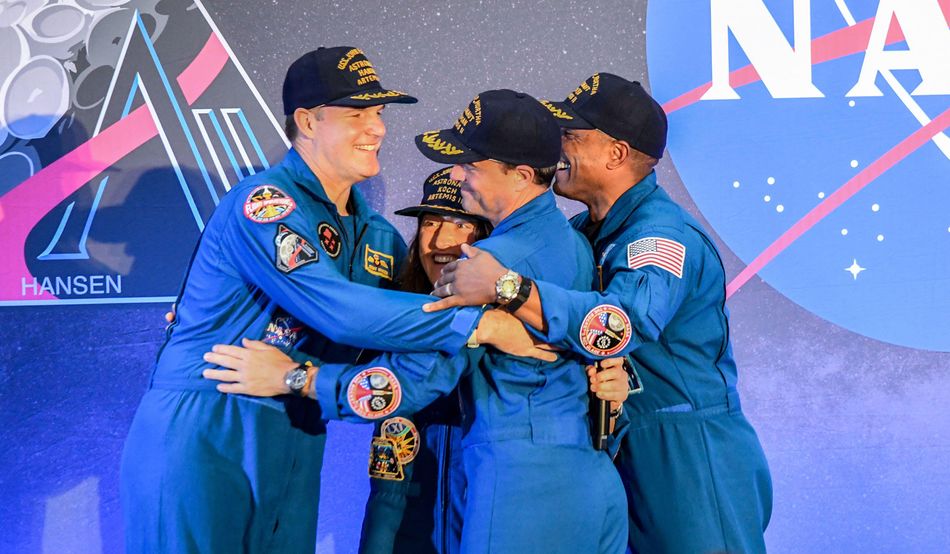
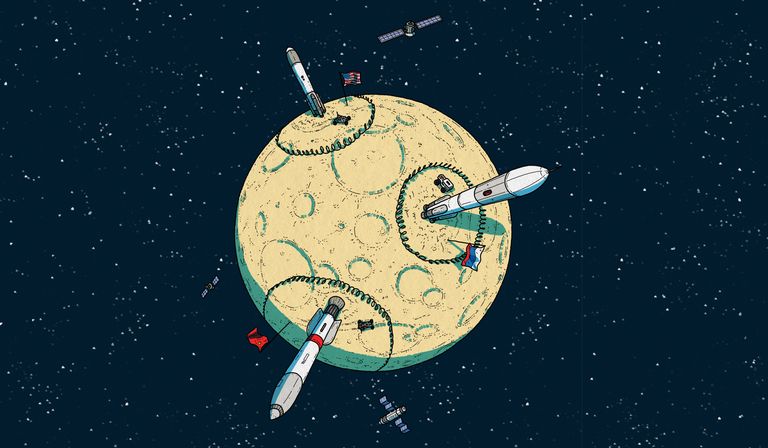
It was only in 1969, with the moon landing, that the US recovered its sense of space superiority. Today, in the afterglow of the Artemis II mission, a new space race is underway, this time to establish the first permanent base on the moon and secure key resources. This is a contest over who sets the rules and reaps the benefit of space missions. It is also about power—and the belief that dominance in space is the key to power on Earth. But this power game is no longer only between Russia and the US: China is now America’s main rival in the stratosphere.
China was relatively late to the space game, launching its first satellite in 1970. For 20 days, Dong Fang Hong 1 (The East is Red 1) circled Earth blasting a recording of China’s hymn to Mao Zedong back to listeners at home.
Since those modest beginnings, China has become one of the world’s most active space nations. It is now one of the most prolific launchers of satellites, with four national spaceports (Jiuquan, Taiyuan, Xichang, Wenchang). It has its own satellite fleet for communications, navigation, remote sensing and scientific research, and since 2022 has operated its own modular space station. The first Chinese astronaut went into space in 2003, China reached Mars in 2021 and in 2024 achieved the first-ever machine landing on the far side of the moon—the destination of Artemis II in April this year. China plans a crewed moon landing in 2030 and a permanent lunar research base, the latter with Russia.
China portrays its space programme as a peaceful scientific exercise conducted for the benefit of all mankind and in accordance with the 1967 UN Outer Space Treaty, the foundational agreement governing space exploration and exploitation. The treaty bans weapons of mass destruction in space, limits the use of celestial bodies to peaceful purposes, and mandates that outer space be freely explored for the benefit of all. It also prevents countries from claiming sovereignty over outer space or celestial bodies, and holds nations liable for damage caused by their space objects. As of October 2025, 118 countries, including all major spacefaring nations, are party to the treaty. The UN’s Committee on the Peaceful Uses of Outer Space (Copuos), established in 1959, now has 104 member countries and meets annually.
Pressing challenges, such as congestion in low Earth orbit, are set to become rapidly worse
But parallel to these efforts, the intensifying geopolitical tensions between the US and China are locking the two into a high-stakes competition. This rivalry threatens a world that is increasingly dependent on space for navigation, communications and other essential services on Earth. Pressing challenges, such as congestion in low Earth orbit, are set to become rapidly worse as this competition intensifies and as space services are integrated into battlefield operations—while rules for managing crisis are failing to keep up with the risks.
China had an early lesson in the limits of cooperation and its own vulnerability to US pressure. In February 1978, the US air force launched the world’s first experimental GPS satellite. Within five years, more than a dozen satellites were providing accurate navigation and weather data to the US military. In 1983, Ronald Reagan, president at the time, opened the service up, free of charge, for civil aviation and shipping. The trigger was a catastrophic incident involving a Korean Air Lines flight out of New York that September. After accidentally straying into Soviet airspace due to a navigation error, it was wrongly identified as a spy plane and shot down by the USSR, killing 269 people on board.
As China discovered a decade later, access to GPS could also be used as an instrument of coercion. In 1993, a Chinese tanker bound for Iran, the Yinhe, suddenly found itself unable to navigate while at sea. The ship had been under close and conspicuous surveillance by the US navy when US intelligence suspected that some of the 782 containers on board were carrying chemicals for nerve gas. When the Yinhe refused a request to return to its home port, the US disabled its GPS and stranded the ship on the high seas for more than three weeks. When China finally agreed to an international inspection, no such chemicals were found.
Among the lessons the Chinese authorities drew from the Yinhe incident was that, as long as the US dominated GPS, it could—and would—use its monopoly to enforce its will on others.
This was the stimulus China needed to develop its own BeiDou satellites, a rival to GPS, and now one of the world’s four major systems along with those of the US, the Russian Federation and the European Union. Collectively they make up the Global Navigation Satellite Systems (GNSS). All four providers continue to offer free use of their systems, operating to jointly developed International Civil Aviation Organization standards. Today, GPS applications are employed by billions of people every day. Consider how often you check the weather on your phone, or use a maps app to work out the best route to travel. The GNSS has been a successful example of shared regulation in space. As geopolitical tensions grow, however, that cooperation is beginning to fray.
Both GNSS and GPS are vital to aviation, but the industry now reports an explosion of interference in satellite signals through jamming and spoofing (the blocking of signals and transmission of false signals, respectively). These techniques are widely used on the battlefield to defend against drones and GPS-guided munitions, but their strong false signals are also picked up by aircraft navigation systems, causing confusion and leading commercial flights off course. Spoofing black spots have emerged near conflict zones including Ukraine, where Russian interference is widely reported, and the border between India and Pakistan.
Another area of intense activity is the Baltic Sea where, between August 2023 and April 2024, approximately 46,000 incidents of GPS interference were reported, most of them linked to suspected Russian jamming. In January last year, a Ryanair plane about to land at Vilnius airport was diverted to Warsaw because of GPS interference. Russia denied responsibility.
In 2024, the Royal Institute of Navigation reported that as many as 1,500 flights a day were suffering from spoofing. Between mid-July and mid-August 2024 alone, a total of 41,000 flights were reportedly affected. Pilots are trained to navigate without GPS, but spoofing can disrupt other airplane systems and generate false messages about, for example, the height of the plane. The use of GPS is now so widespread, and the technology so widely available, that governments are concerned that systematic jamming could also disrupt financial, electricity and communications systems.
Many miles above the Earth, meanwhile, a different but equally dangerous game of threat and counterthreat is played out in satellite manoeuvres, as space powers try to track and assess rival technologies. According to the US Defense Intelligence Agency (DIA), Chinese and Russian space surveillance networks can search for, track and characterise satellites in all Earth orbits. This poses a threat to space-based services used for military, commercial and civil purposes; the latter includes space exploration and scientific research, and bodies such as Nasa and the UK Space Agency.
There have also been frequent reports of suspicious activity which suggest countries are making progress in developing offensive weapons. The US, Russia, China, France and India have all developed space-based weapons with the potential to attack targets on Earth or missiles orbiting space systems. India, Russia and China have all tested an anti-satellite weapon by destroying one of their own satellites—China in 2007 and Russia most recently in November 2021, a test that created 1,500 pieces of dangerous trackable debris in low Earth orbit. Investment by several states in offensive counterspace capabilities could threaten the use of space by the UK and its allies. It also raises the risk of conflict spilling out beyond our planet.
In a report made public in 2022, the DIA claimed that China and Russia were developing military capabilities for space conflict, ranging from new generations of ground-based anti-satellite missiles to laser weapons that can hide missile deployments by blinding satellite sensors.
Russia is also believed to be developing a new satellite designed to carry a nuclear weapon, and Moscow has said that what it calls “quasi-civilian” commercial satellites used for military purposes “may become” a legitimate target. Last year, Russia told international regulators that it considered European satellites supporting Ukraine’s military to be such targets. China has launched satellite inspection and repair systems that could also function as weapons.
The US looks at China’s growing capabilities and sees a threat; China thinks the same of the US
In 2015, China created a defence space force as part of the Chinese military’s Strategic Support Force, which also incorporates cyber and electronic warfare. Today, according to US assessments, China’s counterspace capabilities include ground-based laser weapons capable of disrupting, degrading or damaging satellite sensors, and its military exercises regularly incorporate jamming space-based communications, radars and navigation systems.
But just as the US looks at China’s growing capabilities and sees a threat, China thinks the same of the US. Chinese security analysts are particularly alarmed by developments in low Earth orbit, a domain that has been transformed by Elon Musk’s Starlink. Musk announced his proposal for a space-based internet service in January 2015. The initial plan was for 4,000 satellites and, in May 2019, the first 60 Starlink satellites were successfully launched. Just six months later, the European Space Agency announced it had been obliged to direct its own Aeolus satellite to undertake evasive manoeuvres to avoid collision with Starlink.
Since then, Musk’s ambitions have grown. The US Federal Communications Commission has granted his company SpaceX permission to fly 12,000 Starlink satellites, and the company has filed for permission from the International Telecommunication Union for up to 30,000 more. Starlink satellites are already the main source of collision risk in low Earth orbit, according to Hugh Lewis, a leading space debris expert. There are concerns, too, that such large numbers of satellites burning up at the end of their life could alter the chemistry of the upper layers of the atmosphere, with unforeseen consequences for life on Earth.
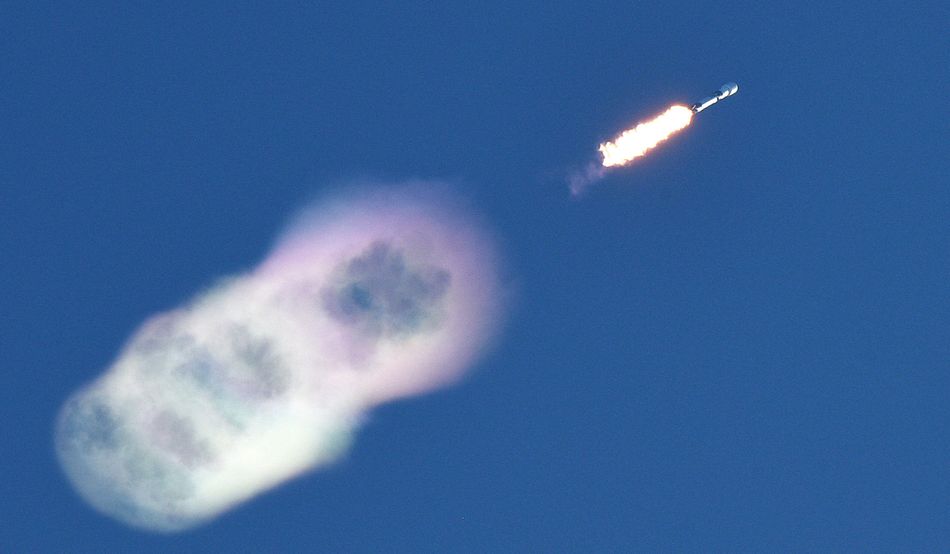
All these problems are only likely to get much worse. Deeply suspicious of Starlink, China plans to launch its own massive satellite networks, which will significantly worsen congestion: an initial 13,000 satellites are planned in its Guowang constellation and thousands more in others.
The explosion in the numbers of satellites has heightened the nightmarish scenario of a Kessler event, named after Donald Kessler, a Nasa scientist who in 1978 advanced the possibility of a chain reaction in space. The Kessler Syndrome predicts that the density of objects sharing low Earth orbit could become so high that one collision could trigger a runaway cascade of further collisions. Fragments as tiny as paint chips or bolts become lethal threats when travelling at 30,000 miles an hour. One collision could create thousands of new bits of space junk, which might in turn cause more collisions, rendering low Earth orbit unusable.
The war in Ukraine brought space firmly into day-to-day warfare
There are believed to be more than 36,500 pieces of debris larger than 10cm and millions of smaller ones already in orbit. Operators are obliged to continually monitor and manoeuvre satellites to avoid collisions. Several space nations are working on the challenge of junk removal and the responsible disposal of dead satellites, but a rapid expansion of mega clusters would overwhelm those efforts.
The Kessler Syndrome illustrates why shooting down a rival’s satellite is the space equivalent of the nuclear doctrine of mutually assured destruction. But Beijing nevertheless regards Starlink’s satellites as a US military asset—a conviction strongly reinforced by the war in Ukraine, where space has played a central role.
Just hours before Russian tanks crossed the Ukrainian border on 24th February 2022, tens of thousands of satellite modems across Ukraine and central Europe were knocked offline. The cyberattack, attributed to Russian state-sponsored hackers, targeted a commercial satellite network in order to disable Ukraine’s military communications. Disrupting internet services across Europe was collateral damage.
Two days later, Ukraine’s vice prime minister and minister of digital transformation Mykhailo Fedorov posted to Elon Musk on X, asking him to send Starlink terminals to Ukraine. They arrived quickly, and over the next three years 50,000 Starlink terminals helped to connect Ukraine’s battlefield and to provide uninterrupted communications for its army. StarShield, the military version, was publicly launched in December 2022.
The war in Ukraine brought space firmly into day-to-day warfare. It also confirmed Chinese convictions that Starlink is a military threat.
In a paper published in 2024, researchers from the Chinese National University of Defence Technology argue that the war in Ukraine made Starlink a real-world combat application. It had enabled Ukrainian forces besieged at Azovstal to communicate, fed targeting data to artillery units and provided Nato with the precise location of the Russian cruiser Moskva, allowing Ukrainian units to strike.
Of equal concern, the researchers say, is that Starlink could enable continuous tracking of Russia and China’s mobile nuclear missile launchers, a key element in the nuclear strategy of both countries. China must respond, they argue, both by reinforcing its own defences and building deterrence, as well as working to frame space law in such a way as to convert the UN’s voluntary Guidelines for Long-Term Sustainability of Outer Space Activities from soft law to binding hard law. That would require disclosure of military intelligence functions on satellite networks such as Starlink’s and the registration of small low-orbit spacecraft.
Humans are taking Earth’s most deep-rooted problems into a domain that lacks regulation
In Washington, a series of reports point to China’s acquisition of offensive capabilities. The DIA insists that China and Russia are both developing military capabilities for space conflict, from lasers to new generations of ground-based anti-satellite missiles. The US Space Force’s proposed response includes plans for 30,000 satellites, building an “internet in space” and moving to “a mature warfighting approach centered on campaigning, maneuver, and reconstitution that preserves strategic advantage without driving unnecessary escalation.”
The Artemis II mission, with its high-quality video streaming and astonishing images of our blue planet, recaptured the promise, excitement and romance of space for millions. But the reality is that, as mankind expands into space, humans are taking Earth’s most deep-rooted problems into a domain that lacks regulation and in which the will to cooperate is fragile.
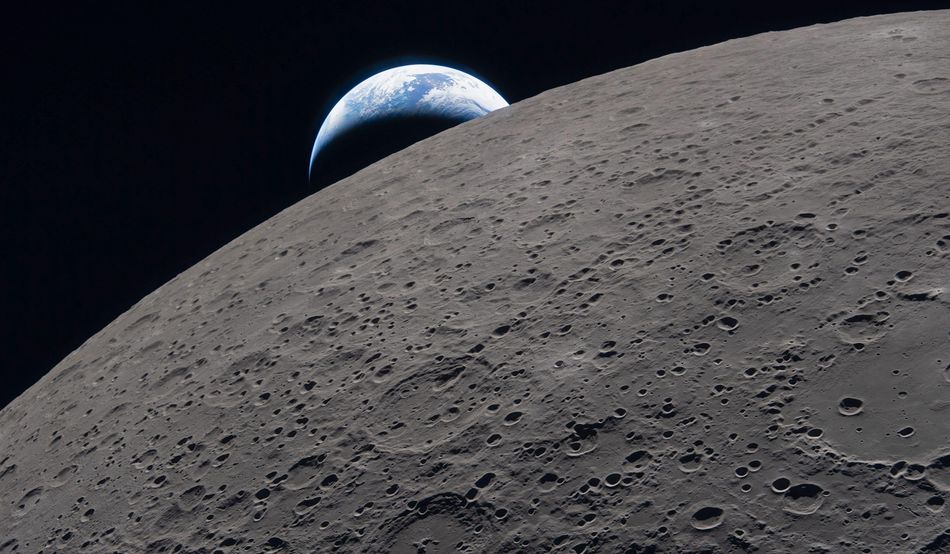
The Artemis accords themselves are a case study in rivalry. Initially launched in 2017 by the US as a series of bilateral agreements and now signed by more than 60 countries, they affirm the principles of cooperation and peaceful use of space, but they do so outside the channels of UN space law, including Copuos. The accords are not binding instruments of international law, but they are seen by Russia and China as a US attempt to establish influence over subsequent frameworks of governance for resource extraction and human settlements on the moon. Russia and China have refused to sign, and are instead leading a rival coalition, the International Lunar Research Station.
In April 2024, the Security Council failed to adopt its first-ever resolution on outer space, which aimed to limit the risk of an arms race. Had it been adopted, it would have affirmed the obligation to fully comply with the Outer Space Treaty, not to place nuclear weapons or any other kinds of weapons of mass destruction in Earth orbit or install such weapons on celestial bodies “or station such weapons in outer space in any other manner”.
The resolution failed because of objections from Russia and China. Despite the heartwarming messages from the crew of Artemis II, the arms race in space continues.