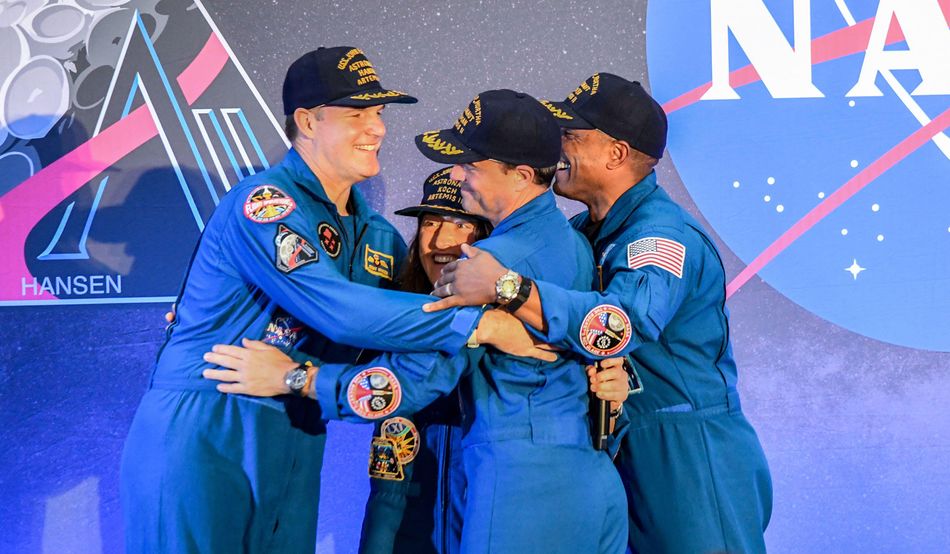
Three days after the president of the United States threatened, via social media, the destruction of an entire civilisation, Artemis II splashed down in the Pacific Ocean, its crew having travelled farther from Earth than any humans before them. It is hard to hold these two images in the mind at once. An American spacecraft returning from the limits of human reach, and the supposed leader of the free world threatening genocide as though it were just another move on the board.
It is tempting to treat this as a simple contrast: the nobility of science set against the moral depravity of our politics. But the dissonance is more complex. It points to an instability in how we, collectively, remain answerable to reality itself.
Consider what made Artemis possible. Not individual brilliance alone, and certainly not force of will, but the opposite: submission—to evidence, to constraint, to processes that no single individual or group controls. This is a vast, distributed effort in which people across institutions and nations subject their judgements to shared standards —deferring, revising, correcting. They accept limits in order, eventually, to transcend them—together.
This is what the public use of reason looks like at scale. It is not a private achievement. It is a shared, fragile accomplishment. Sending astronauts to the moon is one of its glories. So is the eradication of disease.
Now consider how political decisions are being made by the Trump administration, especially in its war on Iran. “Policies” are announced and withdrawn. Goals shift without explanation. Claims contradict one another without consequence. Evidence is invoked when useful and ignored when not. In the same week, Donald Trump described Iran as both “completely defeated” and an imminent threat requiring further escalation.
This is not simply bad reasoning or a failure of temperament. It is a reversion to a pre-modern form of rule where power flows from the will of the sovereign rather than from publicly accountable procedures. For state power to operate in these personalist terms, it must be freed from the demands of evidence, from institutional constraint, from the slow friction of deliberation. It must, in effect, be unbound from reason itself.
And so, the administration has worked to dismantle those constraints that bind judgement to evidence, intention to outcome and thought to action. Expertise is sidelined or purged; decisions are taken without stable processes of consultation; the machinery of government is bent to the impulses of a single will.
Little wonder, then, that an administration that glories in US spaceflight has also aggressively undermined the conditions that make it possible. Federal science budgets have been slashed and whole research areas—climate science included—sidelined. Thousands of scientists have left public service.
This is no accident. Modern science is one of the clearest institutional expressions of the authority of reason in public life. It demands that claims about the world must answer to reasons that others can assess, challenge and share. It does this at scale, distributing authority across methods, communities and evidence, making reality the final arbiter.
Authoritarian politics has often had an ambivalent relationship with science: 20th-century regimes often sought to harness or bend it toward state power. Trumpism turns away from that model altogether. Scientific prowess is less a national strength to be exploited and more a rival model of power to be defeated.
During the president’s call to the Artemis crew, the astronauts spoke in the language of disciplined collaboration, while Trump drifted into anecdotes about sports and personal friendships, repeatedly invoking his supposed role in saving Nasa. What the crew had accomplished became a story of individual prowess and patronage. “America First”, even in orbit—less a national ideal than an extension of the great ruler himself.
The irony is neat. The most stratospheric of human achievements is styled as the expression of one man’s unconstrained will. But we reach the moon not by escaping constraint but by submitting to it—by studying it, modelling it, and working within it together.
The problems we face—environmental collapse, nuclear proliferation—require the cooperation and humility that large-scale science exemplifies. The ethos of “America First,” by contrast, is structurally incapable of responding to these problems, because it prefers the fantasy of wilful control to the discipline of learning about and adapting to how things actually are.
Artemis is a story of human progress. But it is also a warning. Its achievement depends on a fragile settlement: that power answers to the world as it is, not as one man would have it be. That settlement can be undone.
The question is not whether we can still admire science when it produces spectacular results. It is whether we defend the collective practices and institutions that make reason, not will, sovereign in our common life.