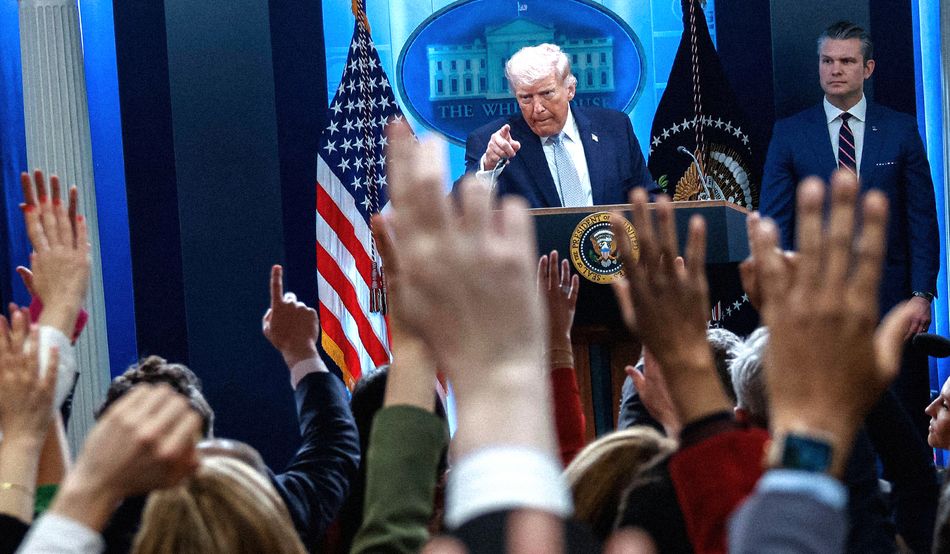
“A whole civilization will die tonight, never to be brought back again.” This is what President Trump told the world would happen, if he did not get his way on something.
Even among the many extreme and unpleasant statements published by the United States president, this stands out. It was a threat of genocide, by the means of either conventional or even nuclear weapons.
For the leader of the world’s greatest military power to threaten such a thing should have consequences. His cabinet and Congress could promptly work together to remove him from office under the 25th amendment. Further or alternatively, Trump could be impeached and convicted and ejected from office.
But, of course, none of these things happened, or will happen. The political system of the United States is in paralysis. There are individual opposition politicians urging his removal by one way or another, but the system itself is not functioning.
Many of those with the actual power to remove him—or even curb him—seem hypnotised. Others are waiting this out, hoping that the mid-term elections in November will mean the problem will somehow go away.
What is not being done is any recourse to the one document that provides for situations where a president needs prompt removal from office: the constitution of the United States. The checks and balances are already there, ready to be used. But they are ignored, as if these provisions did not exist. The United States may as well not have a written constitution.
For what is now happening is not because of any inherent strength of the presidency in the United States political system. It is happening because the legislative and judicial branches are letting it happen. The constitutional tools are there to fix this, but those who can use these tools are refusing to use them.
And the international legal order offers no constraint. Although it is important in principle to recognise that what Trump is threatening is in breach of international laws, nobody expects these laws to make any practical difference. There will be no sanctions on Trump or the United States for the threat to destroy an entire civilisation. Many world leaders also are just waiting for the problem to somehow go away.
So we have a situation where perhaps the most serious threat imaginable is made and there is nothing which will be done or can be done. One can legitimately ask what the purpose is of either constitutional law or international law if not to deal with situations like this. Law is intended to deal with big things as well as little things.
Perhaps this, the gravest of threats, will be forgotten about in the next news cycle. Perhaps it will be dismissed as mere rhetoric, used to either mask a climbdown or to force some resolution. Perhaps many will find a way not to think about it at all.
But war crimes and crimes against humanity matter, and the concerns they raise should linger. In Australia and the United Kingdom, for example, sterling work is being done to force accountability in respect of alleged war crimes by special forces in Afghanistan, even though the incidents in question happened more than a decade ago. War crimes should never just be shrugged off.
And perhaps this threat by Trump to commit genocide will not be shrugged off. Even if he faces no immediate consequences under either domestic or international legal orders, that post should also linger. It is a test of whether we take war crimes and crimes against humanity seriously.
For civilisations can die in different ways. They can be destroyed from the outside, but they can also implode from within when civility is lost. And when that civility is lost, that too sometimes is never to be brought back.