For much of modern British constitutional history, we formally pretended that the office of prime minister did not exist. In practice, the office is usually dated back to the 1720s and the ascendancy of Sir Robert Walpole, though some make claims for earlier figures.
But according to the statute book, the first mention of prime minister was in 1917. There are people alive today older than the legal existence of the office. Its existence in other formal ways is hardly more ancient: it was Benjamin Disraeli who caused a stir in 1878 when expressly describing himself as prime minister when signing the treaty of Berlin.
The pretence was that a prime minister was simply that: the first among equals. The thing was the prime-minister-and-cabinet, within a broader framework of the crown-in-parliament. As the great Victorian journalist and constitutional observer Walter Bagehot stated, “the real power is not in the Sovereign, it is in the Prime Minister and in the Cabinet—that is, in the hands of a committee appointed by Parliament, and of the chairman of that committee”.
General elections came and went, and parliaments came and went. Once the franchise was extended it became exceptionally rare for the cabinet to change hands between the parties outright in the middle of a parliamentary term. Almost invariably the party returned with a majority at one general election would still be in sole power at the next election, when they might then lose power.
From time to time a party could lose overall control or enter into a coalition of some kind, but straight switches of party control were for general elections, and not for anything in between. And this suited the constitutional theory that prime ministers hardly existed or mattered.
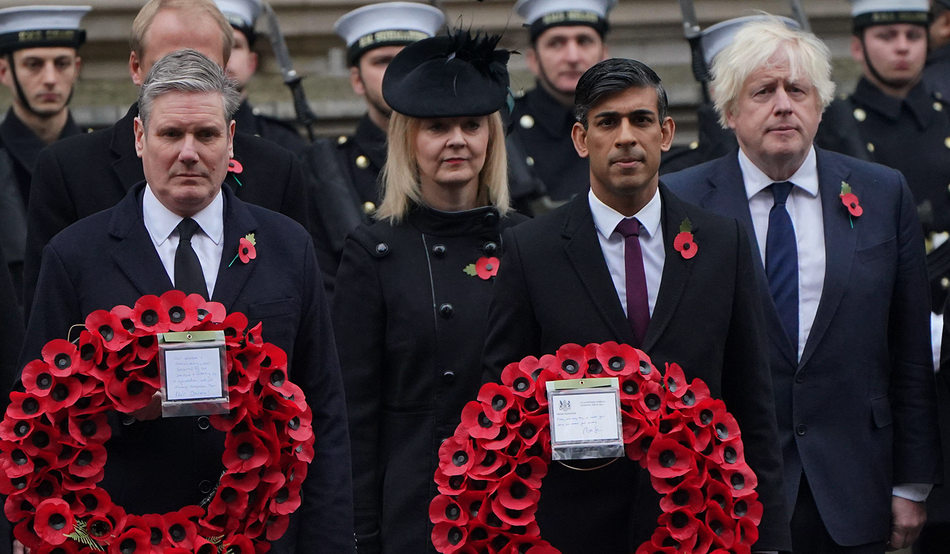
What can change between general elections, and frequently does, is the occupant of the office of prime minister. Since 1974, for example, every prime minister has either taken office or left office between general elections—and recently there have been three cases of the prime minister both entering and leaving office between elections: Theresa May, Boris Johnson and Liz Truss. The perhaps classic notion of a prime minister both coming to and losing power with a general election has not happened since the days of Edward Heath (1970-74) and Harold Wilson (1964-70).
Again, this suits the constitutional theory that prime ministers hardly exist or matter. The current chair of the cabinet is incidental, according to this constitutional fiction, for it is the cabinet (and thereby the government as a whole) that has to have the confidence of the House of Commons.
And so looking through the lens of old constitutional theory, the last ten years or so have been eventful but not unusual: coalition government ended in 2015, replaced by one-party government from 2015 to 2024 (though with no overall control from 2017-19), and then replaced by another one-party government from 2024. There were even sizeable majorities for the winning parties in 2015, 2019 and 2024. Nothing exceptional here, it would seem, nothing unusual.
The reality of the last ten years or so is, of course, very different. Looking at what has happened from the perspective of the office of prime minister, we have had constant drama and recurring mayhem.
Prime ministers were ejected from office between elections in 2016, 2019, and 2022 (twice). It looks as if it is going to happen again with the current occupant, Keir Starmer. The three examples in the last 50 years of prime ministers both gaining and losing office between general elections all happened from 2016 to 2022, with three premiers in succession.
Compare and contrast this churn (if not turmoil) with the lengthy terms of recent prime ministers Margaret Thatcher (11 years) and Tony Blair (ten years). We have had as many prime ministers (six) in the last ten years, with David Cameron holding office at the start of 2016, as in the 40 years from James Callaghan taking office in 1976.
All this points to the resilience of the parliamentary system rather than to any presidential approach in British politics. Prime ministers with presidential ambitions tend to lose office fairly quickly. The body politic regurgitated and spat out Johnson and Truss in a way unthinkable to, say, the United States system of government.
Why is this? How do we have an office of such practical political importance which is also so unstable that its holders often cannot keep it for very long? Surely, one would think, the occupant of the office would have at their ready disposal the means of ensuring their survival, if not longevity, in office?
The answers to these questions lie in the gap between constitutional theory and political reality. The estimable Stephen Bush at the Financial Times has recently written about the “Starmer-shaped hole where a prime minister should be”. Bush is absolutely spot-on.
But there is also a prime minister-shaped hole in our constitutional arrangements. The office has little direct or formal power: almost all the powers of legal consequence are those of the Crown being exercised on the Crown’s behalf.
Downing Street has very little control over Whitehall over than by patronage and exerting pressure. The Olly Robbins and Peter Mandelson affair indicates the emphasis on informal channels. Unless prime ministers have commanding charisma or ministers with shared ideological convictions, or both, they will keep stepping into holes, each one shaped just for them.
From the viewpoint of old constitutional theory, nothing untoward is happening. The Labour party elected to power in 2024 will still be in power at the next general election, just as the Conservative party continuously was in power (albeit sometimes in coalition or without overall control) from 2010 to 2024. This is the superficial impress of continuity and stability in our constitutional arrangements.
But the political reality of prime ministers coming and going at speed is unlikely to change soon. The political and cultural forces partly unleashed by Brexit, combined with an over-centralised UK news media, mean the days of ten- or 11-year premierships seem unlikely to return soon. The decline of political parties themselves as means of organisation and mobilisation in an age of social media also pushes matters into our ongoing frenzy.
We used to pretend the office of prime minister neither existed nor mattered, and eventually the office got formal recognition. But if we are to take the office seriously, then its occupant needs structural power rather than just personal presence and well-placed allies. For until we take the office seriously, the turnover is likely to continue. It is a position which in its current configuration requires almost superhuman abilities, and this is hardly an age of political superheroes.