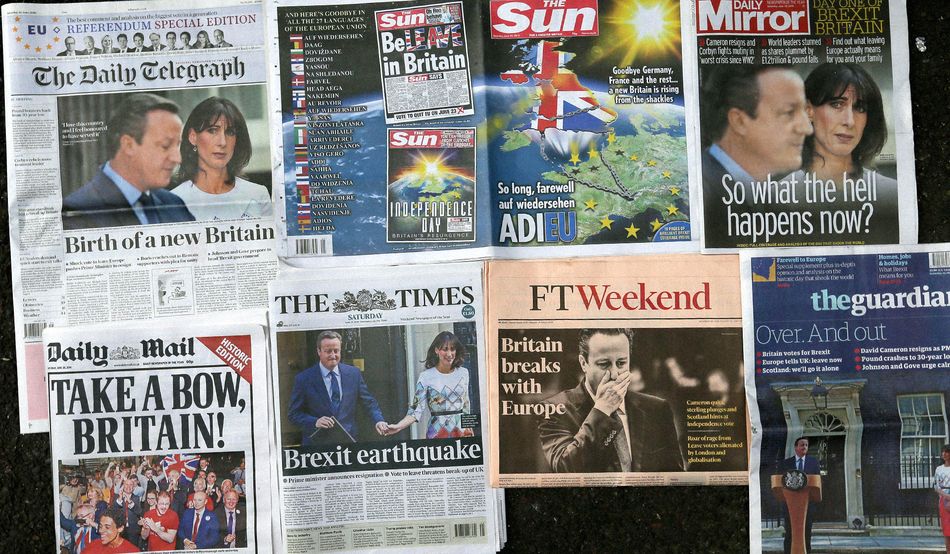
Rarely has a decade’s celebration been so muted. On 23rd June 2026 we mark 10 years since that most epochal moment in recent British political history: the electorate’s decision to leave the European Union. The proponents of Brexit predicted only bright things for the UK: it would become a liberated country, at peace with itself, booming economically as it struck out on its own. Oh well.
To be fair, some of the predictions from Brexit’s opponents—economic collapse, a full-blown third world war—are yet to come.
What I don’t think many of us expected, though, is for Brexit to remain the great unmentionable. That it would be treated much like an unfortunate holiday dalliance or ill-timed joke at a wedding, something to be hidden away lest it cause renewed embarrassment.
The press has been feigning increasingly shocked reactions to speaking this unspeakable. Most recently, the Makerfield byelection, to be held just a few days before Brexit’s grand if strangely unadvertised 10th anniversary, has recently had its own moment of “don’t mention the referendum”.
The race, which was ostensibly about whether Andy Burnham will eventually replace Keir Starmer as prime minister, has also developed an entertaining subplot around Brexit, with the topic inadvertently appearing and then being urgently hidden from view, like a half-clothed lover in a well-paced farce.
Brexit’s first undesired appearance came in Wes Streeting’s speech after he resigned as health secretary, where he noted that leaving the EU was an issue where Labour had suffered from “overcautiousness”, even though it was one of the “big issues that define our age”, and that it had made the UK “less wealthy” so we might consider “one day” being back in the Union.
Many people reading this, including some of those who voted Leave, might shrug at Streeting’s fairly milquetoast views. Not the Labour party though. There was an immediate flurry of excitement as people wondered if Streeting criticising Brexit was a devious way of undermining Burnham’s byelection campaign.
A few days later, and from the other side of the political spectrum, came an even more bizarre attempt to ward off the vengeful spirits of Brexit. It emerged that Reform UK’s Makerfield candidate, Robert Kenyon, had once remarked on social media that he had not voted for Brexit. This most egregious claim led to a panicked retort from Reform that he had actually voted for Brexit, as if the angry Brexit gods needed to be immediately appeased. At the time, no such counterclaim came regarding Kenyon’s many sexist and homophobic posts, which were apparently mere “locker-room banter” (the party also argued that they pre-dated his entry into politics), though he has since told the BBC he made “crass” comments online.
Burnham has added to the drama himself. Quite recently he talked about hoping the UK would be back in the EU in his lifetime. Now he has recommitted to Starmer’s infamous red lines about keeping out of the customs union and single market, let alone actually rejoining. Lord make me a Rejoiner, but not just yet.
Even that once great Europhile Tony Blair couldn’t quite bring himself to recommend rejoining the EU in his recent lengthy intervention into Labour party politics. Blair reiterated that he felt Brexit had been a mistake, but said that rejoining was pointless until the UK could negotiate from a position of strength. Given the economic costs of doing so, this did seem like a roundabout way of saying that it won’t happen.
In other words, don’t mention the Brexit, or if you must, then insist it’s a done deal, or if you absolutely have to acknowledge that rejoining is theoretically possible, suggest it be done perhaps around the time that Elon Musk has colonised Mars.
In the meantime, the public seems rather more open to the idea that a proposal it marginally voted for might have not turned out as hoped. This is not an unusual thing for electorates to realise. For example, it is how the electorate feels about the current government and indeed the previous one. We have elections to correct for mistakes made in previous elections. Such is the wonder of democracy.
Oh, except in one case. There is a paradox in how the press interprets polls in the UK. While Reform polling at just under 30 per cent means that we must all apparently prepare ourselves for Prime Minister Nigel Farage, support for rejoining the EU being at over 50 per cent must be ignored, gainsaid or qualified. And politicians trying to put themselves on the side of this new majority are just “on manoeuvres” in factional party disputes, rather than following the (cough) will of the people.
In fact the polling group More in Common found that, based on voter intention, every major party (except Reform) comprises more Remainers than Leavers. In this world, one of Farage’s many rivals might discover at some point that saying the word “Rejoin” three times in a row will not in fact summon the angry Brexit bogeyman.
Eventually, politicians will learn that the public now dislikes Brexit more or less as much as they dislike every other political outcome of the last 10 years. It’s been that kind of decade. But while Theresa May, Boris Johnson, Liz Truss, Jeremy Corbyn and Keir Starmer are all the butt of venomous jokes, the British political establishment seems less willing to acknowledge the failings of a policy, not politician, that won an election.
Perhaps this is because we only have ourselves to blame. Still, let’s play to national stereotypes and accentuate the positive. After all, a decade on, what could be more British than our absolute refusal to face the embarrassing consequences of the Brexit vote?