England expects. Again. Or should that be “still”. Thirty years ago, England’s underperformance at major men’s international football tournaments turned David Baddiel and Frank Skinner into troubadours of both misery and desperate-sounding optimism with their chart-topping single “Three Lions”. But it turns out that “30 years of hurt” was, at best, only half-time. Neither the World Cup nor the other big prize the team competes for—the Euros—has “come home”. (The latter never once having been “home” in the first place.) The lyrics of “Three Lions” have since been sensibly shorn of any temporal precision and, as another tournament begins, Baddiel, Skinner and the Lightning Seeds can look forward to another surge in their royalties.
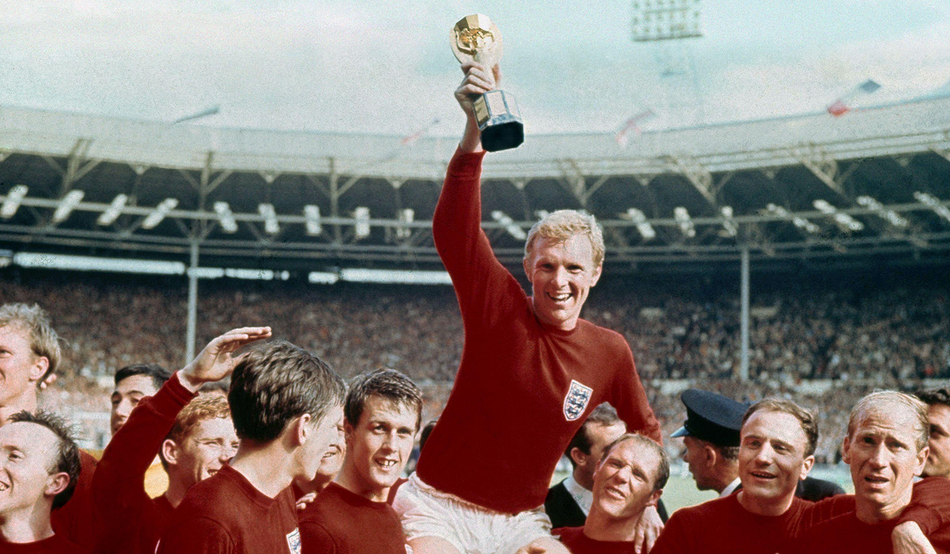
The truth will out. When it comes to winning, England is the runt of the major footballing nations. Ever since Bobby Moore held the tiddly Jules Rimet trophy aloft at Wembley on 30th July 1966, nix. (Moore famously wiped his hands before receiving the trophy to ensure the Queen would not dirty hers.) A couple of World Cup semi-finals (1990 and 2018) and recently a couple of Euros finals (2021 and 2024). But no baubles. England are getting better, but we were not robbed in any of these near-miss moments—no matter that we lost a couple of them only after penalty shootout calamities.
Meanwhile—and take a breath here—the French, Spanish, Italians, Germans, Portuguese, Dutch, Danes, Czechs, Brazilians, Argentinians and even the Greeks have had their parades and extra national holidays. In many cases, several times over. Not once in the entire 60 years of drought, with the debatable exception of the last Euros, have England been thought of by anyone other than the English themselves as the best team going into a tournament.
You may say this is miserabilism of the worst kind, but the facts are non-negotiable. There is a silver lining. England have become very good at qualifying for these jamborees—despatching minnows such as Andorra and middle footballing powers like Serbia with commendable efficiency, if not much swagger. The Italians, who are as football-obsessed as us, have somehow contrived not to get to the final stages of the World Cup three times in a row—and it’s mildly surprising that Giorgia Meloni has survived the shock.
And yet, in today’s game failing to qualify is no mean achievement for a serious footballing nation. Fifa’s greed has led to a sprawling World Cup of 48 teams shuttling around the United States, Mexico and Canada. This means almost twice as many matches than in Qatar in 2022, and more than three times the number played in England in 1966. We will enjoy, or endure, 104 matches over more than five weeks—in 1966, we made do with 32.
For the first fortnight or so, a lot of them will be tedious; sub-Premier League standard, and by a long way. Thereafter we can expect thrills, spills and increasing histrionics, while in England’s case we will likely witness, for the umpteenth time, a rising tide of football’s most toxic ingredient: hope.
The team is not bad at all; you see, I am already, dangerously, slipping into upbeat mode. Things have improved in the 20 years since the horribly overhyped era of David Beckham and his teammates: a “golden generation” who did not much like each other and crumbled when things got serious. After this came a less glamorous form of mediocrity, reaching its nadir at Euro 2016 with a memorable second-round exit to Iceland, until the arrival of Gareth Southgate later that year. He was a calm hero to some, including me, but Mogadon man to England fans with a sense of entitlement. Southgate extracted the venom from the enterprise, finding a vocabulary and tone that was civil, almost grave, while managing to convey a sense that there were other things going on in the world that might be even more serious than football.
Not once have England been thought of by anyone other than the English themselves as the best team going
Southgate had some players of genuine standing—above all, his sober spiritual doppelgänger and captain Harry Kane—and England mostly moved beyond their customary quarter-final exits. But fans’ pulses never raced at the style of football under Southgate and they don’t now. Kane will be the team’s spearhead this summer—and I am a seriously devoted fan—but he is not an out-and-out genius like Diego Maradona or Lionel Messi: outlandish talents who propelled Argentina to World Cup victories 36 years apart.
Kane is surrounded by decent players and England now has its third overseas manager in the shape of Thomas Tuchel, the German who has survived nationalist brickbats for saying he would not sing “God Save the King”. He is forthright and entertaining (Southgate was not) and has won big prizes at club level. But his selections suggest he has inherited the deeply embedded suspicion of maverick talent that has characterised most England managers.
The fabulously creative defender Trent Alexander-Arnold (ex-Liverpool and now at Real Madrid) will spend summer on the beach, while lesser mortals strut their plodding wares in the cause of minimising error. It will not end in glory. Although let’s open our hearts to optimism and cliché: it’s a funny old game and you can’t be certain. I should be thrilled to be proved wrong.