In spring 1953, Britain was looking forward. After the trauma of the war and its aftermath, people were no longer focused simply on surviving. Thanks in part to the postwar settlement and welfare state introduced by Clement Attlee’s Labour government, which had nonetheless then lost the 1951 general election, many had time and money to enjoy themselves. Rationing had long since eased, with bread, clothes, petrol and confectionery freely available. Television was an increasingly popular diversion, and a perfect occasion for the new mass medium was imminent: the crowning of a youthful new monarch, marking the start of a new age.
The coronation of Elizabeth II was scheduled for live broadcast on 2nd June 1953, following the death of George VI in February the previous year. In the 12 months from March 1952, the number of licence payers increased from 1,457,000 to 2,142,452.
And in England, especially, there was something else too. The nation was charmed by its queen, but its footballing royalty was similarly adored. Just a few weeks before Elizabeth was to be crowned at Westminster Abbey, Stanley Matthews would play in the FA Cup final at Wembley. Disputes between the Football Association (FA) and the BBC meant that only the second half of the 1951 final had been screened, followed by a total televisual blackout for the 1952 final. This time though, public interest was too great to resist. The BBC paid £1,000 for the rights to screen the match between Bolton Wanderers and Matthews’ Blackpool, with many bringing forward their planned purchase of a television set in order to enjoy the occasion.
Matthews, the Stoke-born son of a boxer, was a brilliant and mesmeric footballer who embodied personal qualities believed by many Britons to represent both the national character and their own best selves: dedication, humility and rectitude. But in his two previous finals, playing for Blackpool in 1948 and 1951, his team had lost.
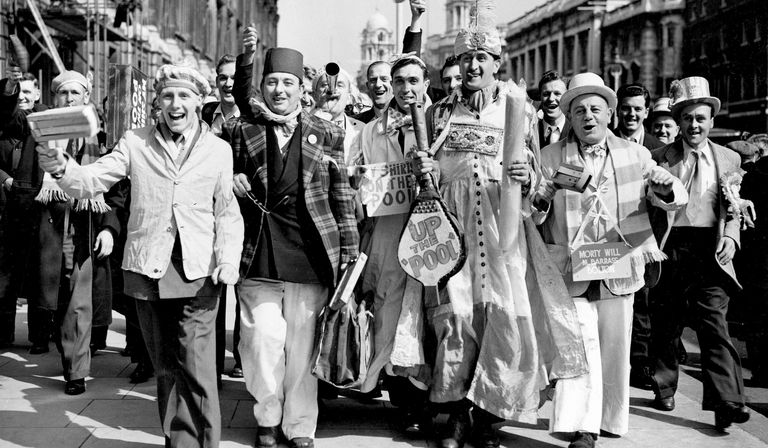
The Atomic Boys, one of football’s first supporter groups, were inspired by Blackpool’s variety acts, with stilt-walkers, clowns and a two-man pantomime bull among the weekend barmies
The 1953 final was seen as the 38-year-old’s last chance of redemption. On 2nd May, an audience estimated at 10m would gather around rented and newly bought television sets across the country hoping to see the climax of his career, when he would finally win the major trophy he deserved.
A right-winger, Matthews was famed for his lateral movement and ability to inject pace from a standing start. His signature move involved bringing the ball inside with the right instep of his boot, before ducking back outside while the defender was still off-balance.
The principal beneficiary of this brilliance was Stan Mortensen, Blackpool’s centre-forward. The pair hit it off while playing exhibition games for the RAF and for Blackpool during the war, consummating their friendship in the usual way: by being arrested for selling black market goods while touring Belgium in 1945. But this was not made public until decades later; at the time, they were just Stan and Stan, complementary talents and personalities. Where Matthews was quiet and modest, Mortensen’s infectious zest and levity embodied another archetype of British masculinity, while on the pitch Mortensen compensated for a lack of physicality with his bravery and conviction.
With its pleasure beach, tower and the anarchic fun of its variety performances, Blackpool was well established as England’s entertainment capital: Frank Sinatra would perform at its Opera House that July. But this scene had had little to do with football until, in 1946, a Blackpool fan named Syd Bevers left an FA Cup replay at Leeds United’s Elland Road perturbed. “There was something missing,” he said, “in an England that was recovering from the Second World War and needed something to brighten up spirits generally. And that was colour.”
So he founded the Atomic Boys, one of football’s first supporter groups. Inspired by Blackpool’s variety acts, they integrated stilt-walkers, clowns, and a two-man pantomime bull that charged at a matador among the weekend barmies. Other get-up was borrowed from Louis Tussaud’s Waxworks in town, while Bevers became known for wearing odd shoes and Arabian robes, coloured tangerine like the team’s shorts. “These boys were good, colourful characters,” he said. “Some of them were blessed, gifted with fun.”
The most famous member of the collective was Donald, Bevers’ pet duck and Blackpool’s mascot, who was usually placed on the centre-spot prior to kick-off. After an untimely demise he was replaced by Douglas—a gift from the actor Douglas Fairbanks Jr, whom the group had watched perform in his new film Mr Drake’s Duck. Douglas the duck travelled to the 1953 final along with 20,000 or so Blackpoolers, a significant percentage of the town’s population of around 147,500. They would be part of a Wembley crowd of 100,000.
Before the match, the Atomic Boys visited Downing Street—“as gay as a pack of clowns in a harlequinade”, according to one newspaper report—then Bevers, dressed in tangerine cloak and silver headdress, knocked on the door of Number 10. To everyone’s shock he was admitted, presenting the prime minister’s secretary with a seven-pound stick of rock stamped “Sir Winston” all the way through. From there, the Atomic Boys went to Wembley, Douglas hidden inside a carpetbag as they queued to get in, his every quack covered by a prompt cough from one of their number. Once inside, Douglas and Bevers briefly paraded around the stadium’s cinder track before kick-off.
The Atomic Boys created a vehicle for unruly expression that was frowned upon in normal life. Their blend of family, friends, colour and fun crystallised football as a party and a fantasy that was separate to, but symbiotic with, events on the pitch, an experience as much about the people as the sport. Naturally, the Atomic Boys were never more exercised than during the 1953 Cup run, but for most of the country the story was of one man’s quest for glory: Matthews deserved to win the FA Cup and the FA Cup deserved to be won by Matthews. With the Queen in the royal box, the afternoon represented a vision of hope—the country united in celebrating itself.
Central to the atmosphere was half an hour of community singing, finishing 10 minutes before kick-off and featuring the Coldstream Guards. Songsheets, sponsored by the Daily Express, were supplied to fans, with the running order including: “God Save the Queen”, “Pack Up Your Troubles in Your Old Kit Bag”, “She’ll Be Comin’ Round the Mountain”, “I Do Like to Be Beside the Seaside”, “Land of Hope and Glory”, “Little Brown Jug”, “My Bonnie”, “I’ve Got a Lovely Bunch of Coconuts”, “Heart of Oak”, “Abide With Me”, and “If You Were the Only Girl (In the World)”. All this fed into what seemed a benign nationalism, an example of what the sociologist Emile Durkheim called “collective effervescence”, the imagined community of the nation-state made to feel real.
Up in the stands, Matthews’ mother-in-law was given brandy after passing out when, with a minute to go, Blackpool won a free-kick
For the television audience, commentary came from Kenneth Wolstenholme. A pedagogical, paternal narrator, he assured viewers they were participating in the most important event on Earth at that time, while delivering regular updates on “the great maestro Matthews himself”. The maestro’s mission became significantly harder within two minutes of kick-off when the Blackpool goalie shovelled in a speculative shot, making Bolton’s Nat Lofthouse one of very few men to have scored in every round of the Cup over one season. Though Mortensen equalised in the 35th minute, Bolton soon scored again to lead 2-1 at half-time.
Ten minutes into the second half, Blackpool fell further behind. History was against them: no team had ever lost a cup final after scoring three and no team had ever retrieved a two-goal deficit to win. But gradually, Matthews’ influence on the game increased. “He stood there, toes turned inwards, looking like a little old man—until he moved,” said Lofthouse. Sure enough, on 68 minutes he set up Mortensen, who collided with man and post in the process of scoring. “If he’s scored, he doesn’t care if he’s dying!” advised Wolstenholme, before adding “there’s Matthews, number 7.”
Up in the stands, Matthews’ mother-in-law was given brandy after passing out when, with a minute to go, Blackpool won a free-kick just outside the Bolton box. “I’m gonna have a crack at goal,” said Mortensen. A devastating shot completed his hat-trick, and Matthews’s mother-in-law duly fainted a second time.
“Some people might say that this hasn’t been the greatest final,” Wolstenholme declared. “But there can’t have been a more exciting one.” An enthralled audience, inexperienced in both the game and medium, was now certain it was witnessing, and was a part of, greatness.
Blackpool pushed for the winner. Deep into the second minute of injury time, Matthews attacked his opposing full-back once more, beating him on the outside and pulling the ball back across goal for Bill Perry to score the winner. “Just look at the people!” cried Wolstenholme, with most of the crowd cavorting as one, as seduced by football’s incomparable drama, suspense and passion as the viewers at home. “In the last 15 minutes,” said the FA secretary, Stanley Rous, “Matthews had the Wembley crowd for the very first time standing on the seats, on the frontiers of hysteria.”
Never had such immersive theatre and unexpected rapture been shared by so many people; never had they experienced such a thrill of release in witnessing the feats of another; Matthews felt wholly known. In that moment, England’s reserve was shed.
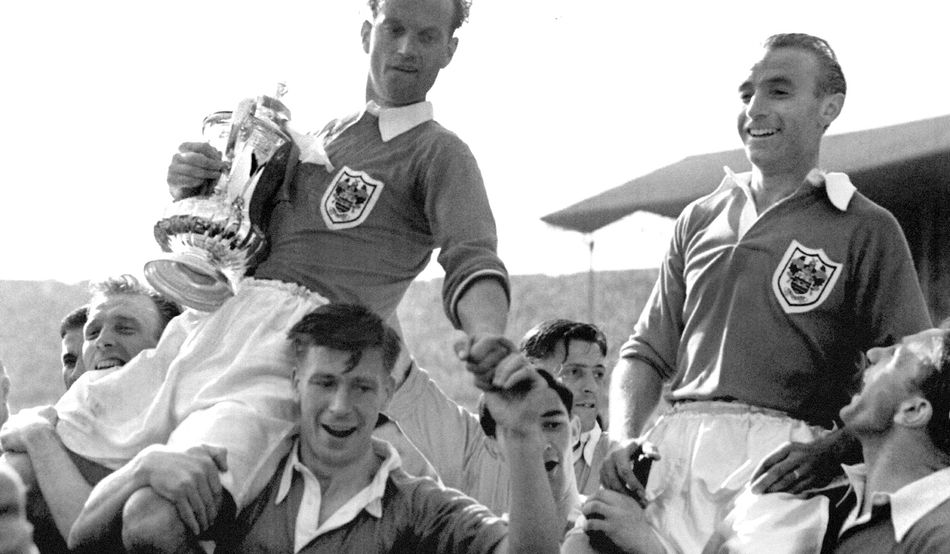
Immediately after the winning goal, Mortensen leant towards Perry, then went to find Matthews, the rest of the team doing the same, then again at full-time. “There it is!” exclaimed Wolstenholme. “And where’s Stanley Matthews… there’s Stanley, at long last he’s done it… and everybody cheering him!”
The Blackpool team ascended Wembley’s 39 steps to the royal box to receive “the most coveted football trophy of them all”, according to Wolstenholme. The slow slog through a league season watched by few, erased in the intensity of one day. The triumph of spectacle over substance made perfect sense in a country obsessed with royalty and pageantry.
The FA Cup was already a storied, famous competition. But now its assimilation into the national routine and collective consciousness was complete. It was both a major sporting event and a cultural concept, a reference point and a ritual. Watching the final would become a rite of passage, with its own language, vernacular, heritage and folklore that would inspire fiction, comic books, and the backyard games and dreams of millions.
That evening, players of both sides visited London’s Café Royal before, on the Monday, Blackpool returned home to be welcomed by locals and tourists, football fans and casual observers. First to arrive in the town square, at 11 in the morning, were half a dozen women who perched on the barricades—“and we’re not moving for anyone,” they informed the West Lancashire Evening Gazette.
Matthews, on the other hand, remained disquietingly equanimous about winning the trophy: it was not until 1987, when pressed by Barry Davies, that he showed any emotion. “It was something,” he said, a tear or two falling.
His placidity was no affectation. Even in his younger days, Matthews saved his strength for when he needed it, a footballer in the purest sense who nurtured the relationship between foot and ball. Growing up, he would practise with an inflated pig’s bladder when he had nothing else, staying out late alone to improve his accuracy by booting whatever sphere he had at a lamppost, just as Donald Bradman honed his skills as a batsman by hitting a golf ball with a stump.
Behind this discipline—and daintiness—was Matthews’s father Jack, a featherweight boxer and hairdresser known as “the Fighting Barber of Hanley”. He presided over a household light on effusion: no one ever told Matthews that he’d played well, and there was no talk of football in the home. “I got the impression that my father never went to the game,” Matthews said, “but I heard later that he sneaked away from his shop.”
Once he was on the books of his hometown club, Matthews improved his fitness by walking two miles to training, walking home for lunch, walking back for the afternoon session, and then walking home once more—unless it was snowing, the only circumstance in which he was given the bus fare. “I enjoyed it,” he said simply, and his brother Ron confirmed that there was no coercion. “Some people seem to think [Jack] must have been a typically strict Edwardian father, but he was nothing like that at all. If you didn’t want to run he wouldn’t bother you, he just had someone who really wanted to learn in Stan.”
This predilection made it easy for Matthews to adopt the lifestyle that sustained his career for so long. “His main thing was fresh air, breathing, running,” said the entertainer Charlie Chester, also a family friend, while former teammate Jimmy Armfield described him as “probably the most dedicated footballer of all time”. “He took the game into the modern era,” he said. “He was into training, diet, physical fitness… a phenomenon.”
Specifically, he ate lots of salad and fruit, and on Mondays nothing at all, honing his stamina and agility once at Blackpool by running on the sand and also on the crowded promenade, swerving around those in his way. But Matthews was creative, too. He would walk to the ground with lead in his shoes so that when he put on his custom-made boots, his feet would seem lighter—in much the same way that Cristiano Ronaldo, perhaps the most zealous professional of the modern era, wears his boots a size too small to get a closer, more natural feel of the ball, and practises with weights strapped to his ankles. That, though, is where the similarity ends, for Matthews had none of Ronaldo’s egotism. On the pitch, his role was as a provider and, even in the final that now bears his name, he supplied the moment of glory for someone else.
“I was cruel on the field. I wanted to beat my opponent. I wanted to destroy his confidence”
Matthews was an everyman, representing either what people thought they were or thought they should be; they deferred to his reputational perfection just as they did to the Queen’s. The ideal hero for a country that had endured hundreds of thousands of deaths and seen millions willingly risk their lives to benefit the collective, he didn’t really drink nor—to the best of anyone’s knowledge—did he swear or philander. If he was running on the beach and kids invited him to join their kickaround, he kicked around; when England were eliminated from the 1950 World Cup, he stayed on to watch the remaining teams; during retirement, he coached whoever wanted to learn, most famously an all-black team in Soweto known as Stan’s Men.
In the end, of course, this image turned out to not quite be true. Matthews was the everyman who left his first wife, the daughter of the trainer at Stoke, for someone who had worked as a communist spy for Czechoslovakia. While playing for England in Berlin in 1938, he performed the Nazi salute along with the rest of his teammates. And where some saw reserve, others saw aloofness. “I was cruel on the field,” he said. “I wanted to beat my opponent. If I did that, I wanted to destroy his confidence because, when a player has no confidence on the field, then you’ve every chance you can do what you want with him.”
The same day that Matthews won his medal, Roger Bannister smashed the British mile record, his time of 4:03.6 making the four-minute mile seem possible; a few weeks later, Edmund Hillary conquered Everest; days after that came the coronation. The following month, the American golfer Ben Hogan was victorious at Carnoustie in the only Open Championship in which he ever competed, while his compatriot Little Mo Connolly won her second Wimbledon, part of the first calendar-year Grand Slam in women’s tennis. And at the end of the summer, England regained the Ashes from Australia for the first time in 20 years.
All this helped create a unique moment of excitement and hope, football no longer simply football but a cultural phenomenon for an influential country in a globalising world. Its socialising web of language, expression, experience and money could no longer be denied. This was a reality not lost on Winston Churchill and Field Marshall Lord Montgomery who, as Freemen of Blackpool, were both quick to contact the town hall to offer congratulations.
Three years earlier, England had lost to the United States at the 1950 World Cup—at the time, the biggest shock in the history of the game. And yet the newspapers the morning after were dominated by defeat in a different sport to a different strain of chippy colonial: the West Indies had won their first Test at Lord’s. Shortly after the Matthews final, the great cricket writer and critic Neville Cardus used the letters pages of the Times to wonder whether its “drama and heroism” meant football would now usurp cricket as the “game of the people”. This was a prophetic thought, but formed from a flawed premise: it was only now, with an audience of millions, that such a thing truly existed.