Everything about England’s performance against Algeria was terrible. There was nothing to redeem it except for the fact that no goals were conceded and that David James looked competent.
The defence is a disaster waiting to happen. Admittedly, they have only conceded one goal in two games and that was a freak. But against a top attack, Glen Johnson will be taken apart, and any of the centrebacks who have played so far will be cruelly exposed.
The midfield is a disaster that has already happened. The wingers can’t run at anyone or cross the ball. Barry is clearly not yet match fit, though he intervened effectively as a third centreback. Lampard and Gerrard were completely ineffective, unable to service the strikers or control the midfield. Gerrard’s refusal to play where he was put left huge gaps, which Algeria exploited.
The strikers can’t score. They can’t even create chances. Rooney and Heskey increasingly went deeper and deeper to get the ball. It was a worrying reminder that apart from Crouch, none of the England strikers have scored in eight matches.
Worse than any of these individual components, disastrous as they are, is that England are having some kind of collective breakdown. Morale has clearly collapsed. The team played with no passion or spirit, and they all looked miserable. During qualification, they scored 34 goals in 10 games, including nine against their main rivals, Croatia. Now they look as if they could never score again.
So how could a team that was playing pretty well—at times very well—fall apart?
Some good players are missing: Ferdinand at centreback, Hargreaves in the middle, Beckham on the wing, Owen up front. But it’s not as if England has been hit by a series of devastating injuries to irreplaceable players.
Could they be worn out? Players like Lampard, Ashley Cole, Terry, Rooney and Gerrard all had gruelling seasons, and Rooney does not look as if he has recovered from a serious ankle injury. England tend to play better in the early Autumn when players are still fresh and seem to struggle in the spring when they are tired.
Either of these may be a partial explanation for the lack of energy, but it cannot be the whole story. When England cannot even pass the ball with the minimum of accuracy, this suggests a bigger problem than tactics. It suggests total demoralization. There are now only two options: modest change or revolution.
Capello can try to make wholesale changes to the team. This is what Domenech did with France in the World Cup qualifying campaign in 2006, when he brought Makélélé, Thuram, and Zidane out of international retirement to help the national team qualify. It is possible that a bit of tinkering will see England through. They may even squeak through into the quarter finals, where they will surely be put out of their misery.
If it doesn’t, there is another emergency option: replace Capello. For Lampard, Gerrard, Terry, David James, Carragher and Heskey, this is their last World Cup. Perhaps for others too. As with France, there is clearly a complete breakdown of trust between the coach and the team with only one game to go. It would be unprecedented but not altogether surprising if there was a coup, with Stuart Pearce or even Beckham brought in to rebuild morale with only one game to go.
But these are short-term options. What is needed is long-term thinking. If Capello is responsible for the decline in morale, then he needs to be replaced after the World Cup, preferably either by an English manager (Hodgson and Redknapp are the only two candidates) or by a European manager with experience of working with English players (Hiddink is the outstanding candidate).
If England players are so worn down by a long season, the structure of the English season must change. There are other worrying signs that footballers are not coping with the stresses and strains of competitive football at such a level. There has never been such a list of big-name injuries, chronic and acute. The game has sped up and we must start to ask whether bodies can take playing so many games at such a pace.
The size of the premiership could be cut to 18 clubs, reducing the number of games by four. Drop the Carling Cup or just leave it for clubs from the smaller divisions who need the money. It’s an irrelevance. In the two seasons when there’s a major summer competition, the premiership season should be brought forward by four weeks to rest England players before the tournament. Cutting the size of the premiership will make this easier anyway.
This may sound extreme, but it isn’t. After all, the current arrangement is just a transition before a proper European super-league, which is inevitable. That’s where the big money and the real TV rights are. That is what is driving football now—not traditional loyalties.
Guest post: England v Algeria—what went wrong?
June 21, 2010
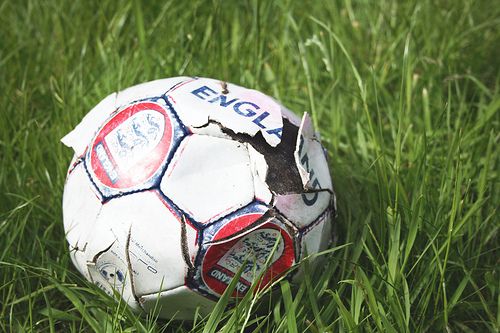
Morale has collapsed across the whole team