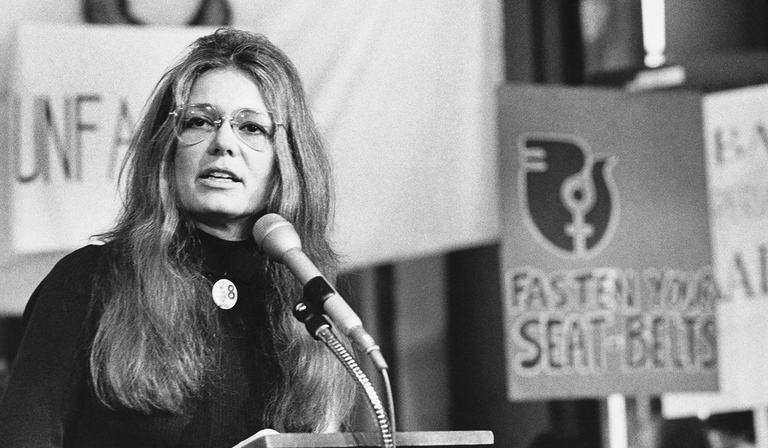
In 1998, for the 30th anniversary issue of New York magazine, Gloria Steinem, the trailblazing second-wave feminist (and one of the magazine’s co-founders) imagined her twilight years: “In my old age – really old age, since I’m going to live past 100, I hope – I would love to have a diner.”
It would be a roadside establishment with “blue gingham curtains”, and she would open it because “diners are the most democratic places. Everyone goes – truck drivers go, people from the neighborhood, people in their tuxes after parties go… And in the back room, we could have a little revolutionary meeting from time to time.”
Steinem, who died on Wednesday 2nd September aged 92, didn’t open a diner, but she never did give up her role as revolutionary convener. The New York brownstone apartment where she had lived since 1968 was a place for “hundreds of guests” to take part in “talking circles”. These, she told the New York Times last year, “have always been — since people gathered around a campfire — a crucial life-giving community.” (Steinem dedicated her home in perpetuity as a centre for social justice movements.)
For once, the word “iconic” is not misplaced. With her long, straight hair and ever-present big sunglasses, the image of Steinem was almost as important as her life of activism, writing, politics and travel. She defied contemporary expectations of women. As a leader of the second wave—the period of the women’s movement from the early 1960s to the 1980s, which focused on legal, social and economic rights—she fought for equality, revolutionising American journalism in the process.
Born in Toledo, Ohio, in 1934, Steinem spent her first decade of life moving around. Living in a caravan, she and her parents—mother Presbyterian, father Jewish—and her elder sister travelled while her father sold antiques. Life was so itinerant that Steinem only attended school regularly from around the age of 10, after her parents divorced in 1944. “My father was a gregarious, overweight man who always had a dream, though it never quite worked out,” she wrote in her memoir, An Unexpected Life, out later this month. “My mother used to explain this phenomenon by telling me that each child was like the seed of a flower, and no one knew what it would become until it bloomed.”
With her father gone, and her sister, who was nine years older, moving out, Steinem cared for her mentally ill mother from a young age, until attending university in Massachusetts. “I became her caretaker,” she recalled in the book. “In those years, I would stay home from school to help her if her hands were too shaky due to her addiction to a tranquilizer called sodium pentothal.”
After her studies she then spent two years in India. “I saw up close what massive poverty looked like,” she wrote in the new book. “I also witnessed what a national movement, started by women and taken up by Gandhi, was doing to release people from the bonds of caste, sex, and economic and colonial dependency as well as British rule.”
A big break came in 1963, with a piece of undercover reporting: posing as a Playboy Bunny
Returning to America, Steinem was a journalist for major magazines, covering the nascent women’s movement from the early 1960s, despite the mainstream media's lack of interest in women. A big break came in 1963, with a piece of undercover reporting for Show magazine: posing as a Playboy Bunny. But she reflected later that her true feminist awakening came in 1969, when she went to report on an “abortion speak-out” in a church basement in New York, where women had gathered to share their stories.
This particular assignment was transformative: “There was something about seeing women tell the truth about their lives in public, and seeing women take seriously something that only happens to women. In my experience, things were only taken seriously if they also happened to men.”
Three years later, in 1972, Steinem would launch Ms., a magazine run by and for women that was nothing short of radical. First produced as an insert in New York in 1971, it was sold on newsstands the following year. Ms. was not about looking pretty or keeping house, as women’s magazines were at the time (and arguably still are, for the most part). Nor was it filled with adverts for the latest gadgets for the housewife with means. The bright red cover featured a blue-skinned, multi-handed figure of a woman reminiscent of a Hindu goddess. She had objects of women’s oppression—a frying pan, a duster, a clock—in her eight hands, a baby in her belly and tears rolling down her cheeks. “The Housewife’s Moment of Truth” was the cover line.
“There was no national voice for those of us who had the radical idea that women are people,” she would later recall. “Though that first issue was released in January 1972 and dated ‘spring 1972’ so it could stay on the newsstand for months, it sold out in eight days.”
A year before Roe v Wade legalised abortion across America, the first issue of Ms. contained an open letter from 53 women calling for legalisation. “I have had an abortion,” the women declared. “I publicly join millions of other American women in demanding a repeal of all laws that restrict our reproductive freedom.”
Alongside the likes of Susan Sontag and Nora Ephron, Steinem was one of the signatories. Indeed, she dedicated her 2015 memoir, My Life on the Road, to a “Dr John Sharpe of London, who in 1957, a decade before physicians in England could legally perform an abortion for any reason other than the health of the woman, took the considerable risk of referring for an abortion a twenty-two-year-old American on her way to India. Knowing only that she had broken an engagement at home to seek an unknown fate, he said, ‘You must promise me two things. First, you will not tell anyone my name. Second, you will do what you want to do with your life.’”
Steinem edited Ms. for the next 15 years, and became a leader of the women’s movement, combining her journalism with activism and the difficult business of Washington politics. In 1971, she co-founded the National Women’s Political Caucus, saying in a speech that women needed “revolution”: “Sex and race because they are easy and visible differences have been the primary ways of organizing human beings into superior and inferior groups and into the cheap labor on which this system still depends. We are talking about a society in which there will be no roles other than those chosen or those earned.”
While no one truly doubted Steinem’s commitment to women, some accused her of overlooking intersecting discriminations
The word “race” might stand out from that passage to her critics—of which there were many. While no one truly doubted Steinem’s commitment to women, some accused her of overlooking intersecting discriminations. For them, she was the face of a brand of liberal feminism that privileged white, good-looking women above all, and which had plenty of blind spots.
Steinem would continue to organise throughout her life—whether campaigning for the Equal Rights Amendment (ERA) to guarantee equal rights for Americans, regardless of sex (the ERA had first been introduced to Congress in 1923), or helping initiate Take Our Daughters to Work Day in the 1990s. And she continued to write, publishing 10 books, including a biography of Marilyn Monroe, the quintessential symbol of the paradoxes, cruelties and impossibilities of womanhood before the second wave.
In the America where Steinem grew up, the vast majority of women didn’t get to choose much about their lives, and in her own life she embodied the power of choosing for oneself. Having decided not to have a baby at the age of 22, she had various partners, but would only marry much later, aged 66, in 2000, to David Bale, an entrepreneur and animal rights activist (and father of the actor Christian Bale). He died of cancer in 2003.
For a woman like me, born after the second wave, the world Steinem helped forge was one of unimaginable freedoms compared to the one she came into. Still, towards the end of her life, she was witness to the vandalism of what she and her compatriots had worked for. Roe v Wade was overturned in 2022. Donald Trump’s two election victories were a reflection of the continued and deep resistance to freedom and equality for women. “I never expected Trump,” she told the NYT last year. “And that we still haven’t had a female president — I would not have expected that.”
In 2021, Ms. magazine reimagined its launch cover for the Covid era. The blue-skinned, multi-limbed woman from 1972 was now holding a baby and facemask, while also working on a laptop, cleaning the house, and supervising a child during their online schooling. “Do We Care?” began the cover line—since the care burden on women was so much greater than that on men. “The Nation’s Moment of Truth,” it added. So much has changed since Steinem sat in that church basement—and yet, here we are, still facing many of the same battles.
Steinem died only weeks before the release of her new memoir, her 10th book. Despite the savagery of the current backlash against feminism, her joy and optimism are evident from the very first page. “I’m both older than I ever imagined I would become,” she wrote, “and happier than I ever imagined I could be. I’ve been rewarded with friends who are my chosen family. I have trusted friends in other countries, and we strive to be safe and free.”