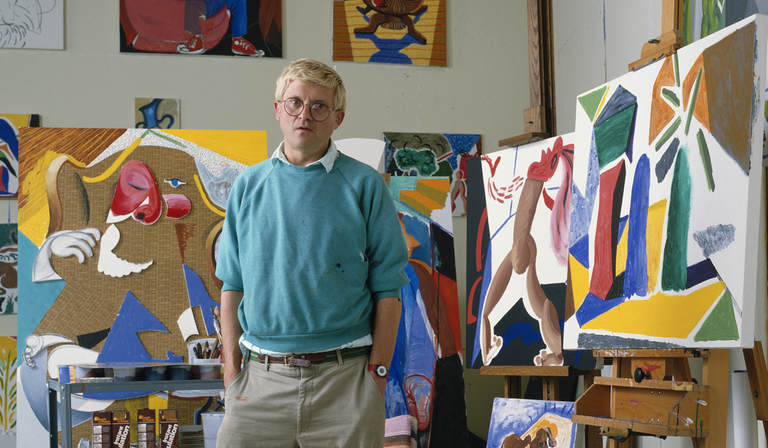
David Hockney liked to make things bigger. Starting with A Bigger Splash (1967)—a painting that secured his fame before the age of 30—came an increasing recurrence of the word in the decades to follow: in works like A Bigger Grand Canyon (1998), Bigger Trees Near Warter (2007) and A Bigger Green Valley (2008); and in his 2012 and 2023 exhibitions A Bigger Picture and Bigger and Closer. There’s an obvious question raised by the comparative form—bigger than what?—but the fact Hockney preferred to leave this unanswered was entirely in keeping with his practice more generally. The role of art is essentially an expansive one: its pleasure comes from knowing there is always more to learn and discover.
You could also use bigger to describe the culmination of Hockney’s own life and career. At the time of his death at the age of 88 on 11th June, his worldwide popularity had never been greater. Just last year, the Fondation Louis Vuitton in Paris staged the most substantial ever show of his work, amassing close to a million visitors and double the attendance of his previous major retrospective at Tate Britain in 2017. (A show that was itself the most visited in the gallery’s history.) Behind this success was more than just giving the people what they wanted—though by Hockney’s estimation this was probably not a bad thing, either—but a serious intellectual commitment to painting, and painting figuratively. “Every generation looks differently,” he said in one of his many conversations with the art critic Martin Gayford. Throughout his life, he made it his responsibility as an artist to show us just how differently we might look.
Hockney’s reputation was of a painter concerned with the pleasure of looking. But really his preoccupation with looking was more fundamental
Born in Bradford in 1937, Hockney was the fourth of five children. Historically, his family on both sides were agricultural labourers who lived close to the edges of poverty. His father, a lay Methodist preacher and clerk for a drysalter company at the time of Hockney’s birth, was by all accounts an unabashed dandy. A budding photographer never seen out of his three-piece Sunday best, he would buy paper collars from Woolworths and paint them in colourful patterns. It was perhaps from observing his father that Hockney first developed his own creative itch, at which he scratched incessantly from an early age. As a child, he drew on any scraps he could get his hands on: around the margins of the daily newspaper, in the flyleaves of hymn books during church services, with chalk on the linoleum floor of the kitchen; only a stern word stopped him from drawing on the wallpaper. On discovering that art classes were largely reserved for the less academically gifted at Bradford Grammar School, he deliberately flunked his exams; in a class of 30, his grades put him 30th. “He should realise that ability in and enthusiasm for art alone is not enough to make a career for him,” wrote his form mistress.
Rather than seeing any of this as a problem, Hockney’s parents were encouraging. In 1953 he enrolled at Bradford School of Art and then—after two years as a hospital orderly, national service for the conscientious objector—the Royal College of Art in London, where he mingled with other future luminaries such as RB Kitaj, Frank Bowling and Peter Blake. Pop Art was at this point approaching its zenith, its influence on the young Hockney unavoidable if inchoate in practice. Many of his postgraduate works, such as We Two Boys Together Clinging (1961) and Tea Painting in an Illusionistic Style (1961), exhibit an uneasy hash between a muddy kind of abstraction and ho-hum pop culture references. What with his chief accents invariably being grey, black or burnt umber, Hockney’s most glaring omission at this time was the one thing now practically synonymous with his name: colour. Like Van Gogh, he needed to go abroad in search of this necessary ingredient, finding it not in the south of France but Los Angeles. Not long after he moved to California in 1964, where he would spend most of the next four decades, his work was permanently transformed. Gone were the hunched and pallid figures, in their place glittering swimming pools, baby blue skies, yawning green palms and pink, young, usually half-naked men.
It was this period that sealed Hockney’s reputation as a painter of pleasure—“If you’ve been to England, you know what a lovely blue, hedonistic pool means,” he told Rolling Stone in 1990—downstream of which came the idea that all his work, regardless of subject, was concerned with the pleasure of looking. But really Hockney’s preoccupation with looking was more fundamental than this, particularly when it came to the monopolistic ascendency of photography in the latter half of the 20th century. “Most people feel that the world looks like a photograph,” he once told Gayford. “I’ve always assumed that the photograph is nearly right, but that little bit by which it misses makes it miss by a mile.” The problem with the photograph, he argued, was that it could only capture one moment in time, when in fact how we perceive the real world with our eyes is through a series of continuous moments. Photography is static and, thus, dishonest, even alienating; it may appear as life, but it does not truly reflect our experience of it. And this is where painting, as the process of picture-making through time, comes into its own. “The hand moving through time reflects the eye moving through time,” as Hockney said in a lecture he delivered at the V&A in 1983. “The evidence of the hand is our time.”
It was to break this stasis that Hockney made his own ventures in photography throughout the 1980s, though admittedly these often just proved his original thesis: even in noted works, such as Pearblossom Hwy., 11-18th April 1986, #2, stasis has only been replaced by a less certain rigidness. At this point, it might tempt some incorrigible pleasure-seekers to say that Hockney’s lifelong dabbling with other mediums of expression was a distraction from the real work of making beautiful pictures in paint. But it was only through this dabbling that he discovered how to make the centuries-old tradition of painting—and the painterly way of looking—relevant in a resolutely multimedia age, which we should laud as his most remarkable, and hopefully most enduring, achievement.
Hockney’s oeuvre provides many examples of this achievement in action, but for simplicity’s sake, let’s pick one: Bigger Trees Near Warter. Sometimes called the world’s largest landscape painting done entirely outdoors, it is made up of 50 individual canvasses that altogether measure 4.6m high by 12.2m long. Because Hockney was painting en plein air in sections over six weeks and could hang only six canvases in his studio at a time, his assistant (and latterly partner) Jean-Pierre Gonçalves de Lima would photograph each one and gradually stitch them into a digital mosaic to help keep track of overall progress, adjusting things as they went. “The computer is a very good tool,” Hockney would recount, “but it needs imagination to use it well.”
The final picture is something that perfectly matches the totemic, monumental feeling that we might experience on stumbling across this copse of trees in real life. It is so large and overwhelming you can never truly see it all at once, no matter how far back you stand, because to look at it is a constant negotiation between catching the details and making sense of the whole; you are engulfed by the infinity of nature. Like all of Hockney’s work, it is an entirely new experience of looking at the world through paint—and, yes, from start to finish, it is nothing but a pleasure.