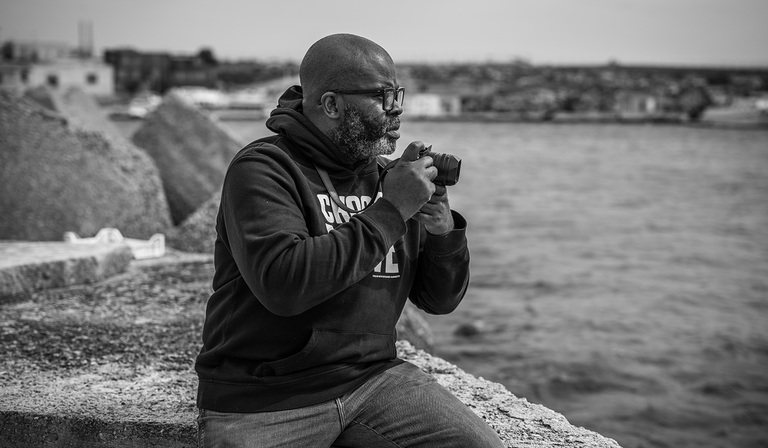
The day after the ninth anniversary of the Grenfell fire, photographer Misan Harriman seems tired. He has spent the weekend with survivors and bereaved family members, people he has photographed for nearly a decade.
“If you hold a camera and a microphone and you go into marginalised communities, you have to earn their trust,” he says. “You can’t fake it, you can’t charm them.” Harriman, 48, may not have the power to launch government inquiries, he says, but his job, as he sees it, is to archive their loss—“to help them know that they haven’t been forgotten”.
A self-taught photographer, Harriman first became recognised for his striking black and white portraits taken at protests in the wake of the killing of George Floyd. Later that year, Harriman became the first black photographer to shoot the cover of British Vogue.
Now a new film, Shoot the People, follows him documenting protest movements across the world. In the film Harriman, who is on the autism spectrum, admits he has “to work hard just to be normal, to fit in”. His photography journey has been unconventional, too, only starting at the age of 40 after being gifted a camera by his wife, whom he first met at a wedding (the “old-school” way).
Though much of his work involves shooting celebrities—he took the photograph announcing the Duke and Duchess of Sussex’s second pregnancy—Harriman follows a tradition of photographers, from Cecil Beaton to Gordon Parks, whose portfolios combined celebrity portraiture with reportage-style works.
In one scene, shot in 2024 when Harriman’s directorial debut The After was nominated for an Academy Award, he is shown in a green velvet jacket on his way to the Oscars ceremony. As the limousine passes a crowd of anti-war protesters, we see Harriman seriously consider joining them.
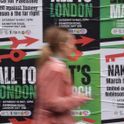
Harriman has been vocal about his opposition to Israel’s war in Gaza. “If our leaders aren’t doing anything, the people will hold them to account on the streets,” he tells me. These protests have sometimes been framed by the press as “hate marches”. But the images captured by Harriman’s camera tell a different story; he describes seeing “grandmothers from Grimsby with Zimmer frames that can barely stand up straight”; Irish men and women, Muslims, and a large Jewish bloc: “For me they represent what Judaism is; its central pillar is altruism.”
Born into a prominent family in Nigeria and sent to boarding school in England, Harriman believes that his privileges have come with responsibilities. His activism on social media has sometimes riled those on the right: Harriman became the centre of a controversy this May, when a decontextualised clip of his comments on the rise of Reform UK circulated online, in which he quoted Susan Sontag’s post-Holocaust reflections. Additionally, the Telegraph accused him of sharing a conspiracy theory in a post following the Golders Green attack in April, in which two Jewish men were stabbed, when he asked why there had been limited coverage of a third victim, Ishmail Hussein.
Over one three-week period, the Telegraph and the Times alone published 14 pieces against Harriman, and some MPs called for him to be sacked as chair of the Southbank Centre. More than 250 cultural figures signed a letter in his support. He will step down as chair at the end of his current term in the autumn.
Over the years, Harriman has witnessed every kind of protest, from pro-Israel events to marches by the far right, as well as climate change deniers and flat Earthers. “Most people are not evil and wicked. They can be confused and scared, but if they spend time with someone that has a different experience to them, it can really help… I know some former literal Nazi white supremacists that are now on marches for Gaza, for climate action, for women’s rights.” He only recently stopped going to far-right marches due to concerns for his own safety.
He is concerned about the erosion of protest rights in the UK. Rather than revoke the sweeping anti-protest laws introduced by the previous Conservative government, this Labour administration has attempted to expand them with the Crime and Policing Bill 2025, which grants the police more powers to regulate and restrict acts of protest.
But, for Harriman, it’s the simple moments of human connection that make documenting a protest worthwhile—watching mothers and children, and the mixing of different communities. “I’ve seen Holocaust survivors dancing with Nakba survivors—old men in the twilight years of their lives,” he says, “and if that’s not hope, I don’t know what is. It’s certainly not hate.”
Shoot the People is in cinemas from 10th July